Ravanda Castle — known in the historical sources as Râvendân, or as Ravendel in Crusader documents — is a medieval fortress rising on a rocky hill that commands the valley of the Afrin River, in the historic Ayıntap–Kilis region south of Gaziantep. Because its position controlled the road between Antioch and Edessa (Urfa), it served as a strategic frontier castle that changed hands repeatedly, above all during the Crusades. Largely ruined today, the castle preserves — in its walls, towers and cisterns — the surviving traces of the region's medieval defensive architecture.
Ravanda is counted among the castles of Gaziantep as part of the fortified structures around the city; and for those wishing to follow the age it belongs to within a broader frame, the History of Gaziantep page is a complementary stop. As it is a sparsely documented site, this page rests only on facts that can be reliably sourced.
Location and Name
Administratively, Ravanda Castle lies today within the bounds of the Polateli district of Kilis province, near the village of Belenözü; it is part of the historic Ayıntap region south of central Gaziantep. The castle was built on a rocky, conical hill that commands the valley of the Afrin River. This high and steep position gave the castle both a natural defensive advantage and the ability to keep watch over the surrounding roads.
The castle's name appears in the sources in different forms: as Râvendân (Ravendan) in Turkish and Arabic sources, and as Ravendel in the Western sources of the Crusader period; today it is known locally as Ravanda Castle. All of these names point to the same fortified hill.
Location: near the village of Belenözü, Polateli district, Kilis province (historic Ayıntap region) · Geography: a rocky, conical hill commanding the Afrin River valley · Historical names: Râvendân / Ravendel · Period: medieval; first concrete record during the First Crusade (1097) · Condition today: largely ruined; remains of walls, towers, cisterns and a courtyard.
The Crusader Era: The County of Edessa and the Islamic Frontier
The earliest concrete historical information about Ravanda Castle goes back to the year 1097, the period when the First Crusade passed through the region. At that time the castle was under the control of a local Seljuk (Turkish) garrison and kept watch over the Antioch–Edessa (Urfa) road. In 1097–1098 it was captured by Baudouin de Boulogne (Baldwin of Boulogne) — who would later become Count of Edessa and ultimately King of Jerusalem — with the support of the local Armenian population of the area.
After its capture, the castle was attached to the Crusader County of Edessa, the first Crusader state in Upper Mesopotamia. Within this county, which consisted mostly of castles and fortified strongpoints, Râvendân was regarded as one of the important links in the frontier defence. Among the scholarly studies devoted to the castle, the article titled "Râvendân, One of the Castles of the Crusades Period," published in the Turkish Historical Society's journal Belleten, stands out.
Strategic Role: Guardian of the Antioch–Edessa Road
The importance of Ravanda Castle stemmed largely from its position: the castle rose at a point that controlled the road between Antioch and Edessa (Urfa). This route formed a vital line that linked the capitals of the Crusader states to one another and at the same time passed through the frontier zone between the Muslim principalities and the Crusader territories. The castle therefore held value both as an outpost overseeing communications and as a strategic position for control of the region.
A Frontier Castle That Changed Hands (12th–13th Centuries)
Throughout the Middle Ages, Ravanda changed hands many times in step with the shifting balance of power in the region. In the 12th century, the castle was among those in the area that passed into Islamic control during the rise of Imad ad-Din Zengi, atabeg of Mosul, and his pressure on the County of Edessa. It is recorded that the castle was then brought back under Seljuk/Islamic control once more during the period of Nur ad-Din Mahmud (Nûreddin Mahmud), the emir of Aleppo.
The most concrete record concerning the castle's fortification belongs to the era of Saladin (the Ayyubid sultan). According to the sources, Saladin repaired and strengthened Ravanda Castle roughly between 1176 and 1181; during this time an inscription bearing his name — "al-Malik al-Nasir Yusuf ibn Ayyub" — was placed over the castle's gateway. This inscription is reported not to have survived and to be lost. After this period, the castle remained in the hands of the Ayyubids.
In the second half of the 13th century, control of the region shifted again: the area first came under Mongol influence (the sources place this change around 1261), and shortly afterwards passed into Mamluk control (around 1268). Because these late dates can vary slightly between sources, the exact years should be treated with caution.
Its Condition Today: Ruined Remains
Ravanda Castle stands today largely in ruins. Among the principal elements visible on the site are walls running east to west, angular and round towers, an inner-castle courtyard, the remains of a palace and the large cisterns built to meet the water needs of the period. These features show that the castle was not merely a watchpoint but a fortified settlement in which life went on.
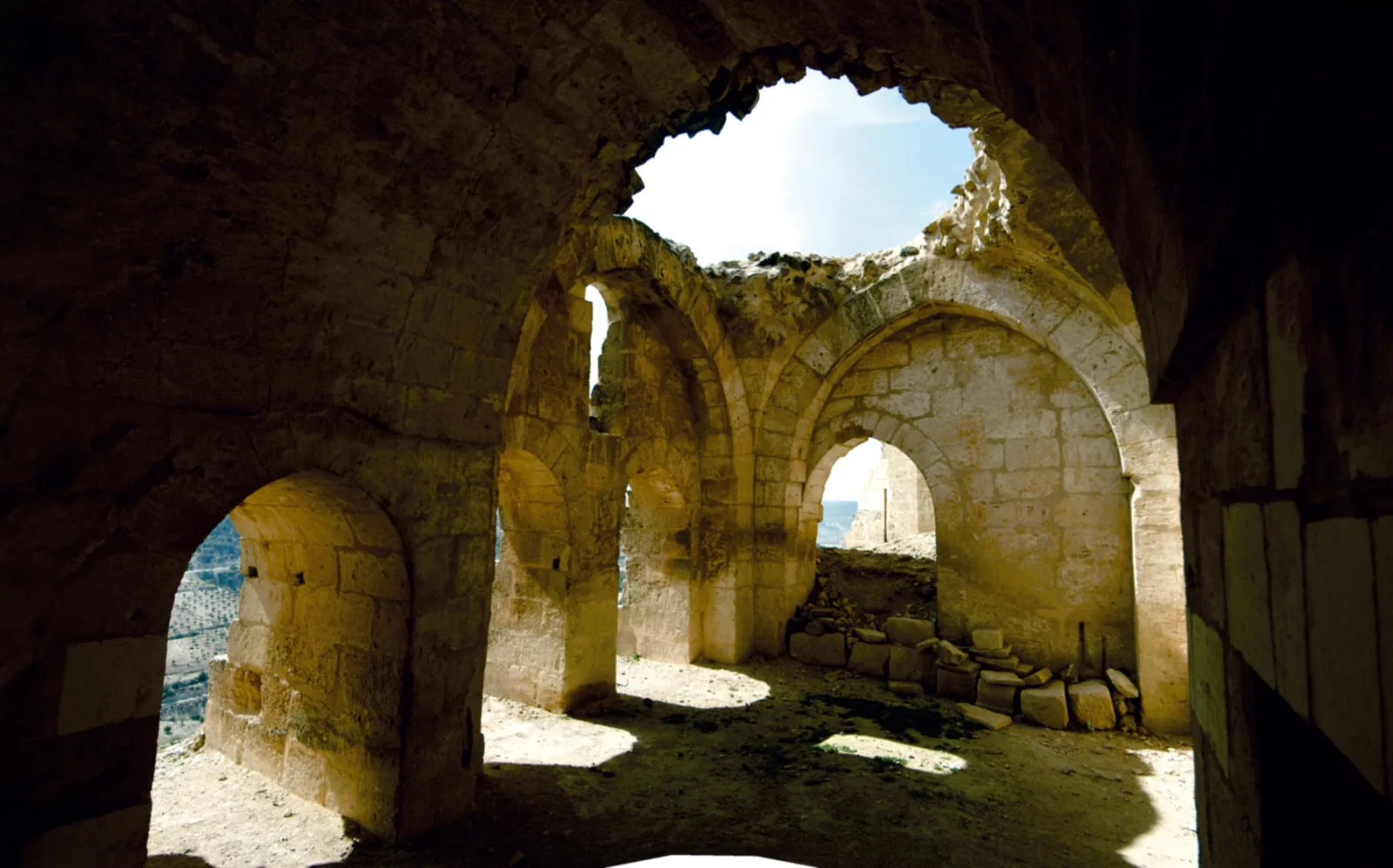
Its position on a rocky hill and the repairs it underwent in different periods have given the architectural fabric of the castle a layered character. That said, Ravanda is a relatively sparsely documented site on which only a limited number of scholarly studies exist; for this reason, certain details of the castle have still not been clarified with certainty.
For those who wish to see the region's other fortified structures and the castle's medieval context as a whole, the Castles category and the History of Gaziantep pages are complementary resources to consult.
Frequently Asked Questions
Where is Ravanda Castle located?
Ravanda Castle lies, administratively, in the Polateli district of present-day Kilis province, near the village of Belenözü, and is part of the historic Ayıntap region south of Gaziantep. The castle was built on a rocky, conical hill that commands the valley of the Afrin River.
What is the historical name of Ravanda Castle?
The castle appears as Râvendân (Ravendan) in Turkish and Arabic sources, and as Ravendel in the Western sources of the Crusader period. Today it is known locally as Ravanda Castle; all of these names point to the same fortified hill.
Who took the castle during the Crusader era?
The earliest concrete records of the castle go back to the year 1097, the period of the First Crusade. At that time the castle was under the control of a local Seljuk (Turkish) garrison and kept watch over the Antioch–Edessa road; in 1097–1098 it was captured by Baudouin de Boulogne with the support of the local Armenian population, and attached to the Crusader County of Edessa.
Why was Ravanda Castle strategically important?
The castle rose at a point that controlled the road between Antioch and Edessa (Urfa). This route both linked the centres of the Crusader states to one another and passed through the frontier zone between the Muslim principalities and the Crusader territories; for this reason the castle was valuable for surveillance and control.
What is Saladin's connection to the castle?
According to the sources, Saladin repaired and strengthened the castle roughly between 1176 and 1181 and placed an inscription bearing his name ("al-Malik al-Nasir Yusuf ibn Ayyub") over the gateway. This inscription is reported not to have survived and to be lost.
What remains of the castle today?
The castle is today largely in ruins. On the site one can see walls running east to west, angular and round towers, an inner-castle courtyard, the remains of a palace and large cisterns.