In the Nizip district of Gaziantep, a quiet craft has unfolded for centuries around the cauldrons set up after the olive harvest. Nizip Soap is an age-old olive-oil soap in which the oil pressed from the region's abundant groves, along with the pomace left from that pressing, is patiently worked by hand into golden-amber bars. Gentle in lather and mild in scent, this soap is free of harsh chemical additives and has found its place both on bathroom shelves in local homes and in the markets of distant countries. Officially bound to the soil of Nizip through its geographical indication, the product is a reminder that Gaziantep is a land of mastery not only in its kitchens but also in its crafts.
Nizip Soap takes its name from Nizip, the olive country of Gaziantep, and is a traditional soap made primarily from olive oil and from the pomace (prina) oil left over once the olives have been pressed. The craft grew up entwined with the district's olive culture: after the olives are pressed and their oil extracted, the residue is not wasted but carried to the cauldrons of the soap workshops, where it gains new value. In this way Nizip becomes the name of an integrated production culture that draws both the oil of the table and the soap of the bath from the same tree.
Carried on today in numerous workshops across the district, this production still happens largely by hand and over time, in defiance of the speed of industrial soap. A single bar takes months to travel from raw material to shelf, because what defines the character of Nizip Soap is not haste but patience.
What Is Nizip Soap?
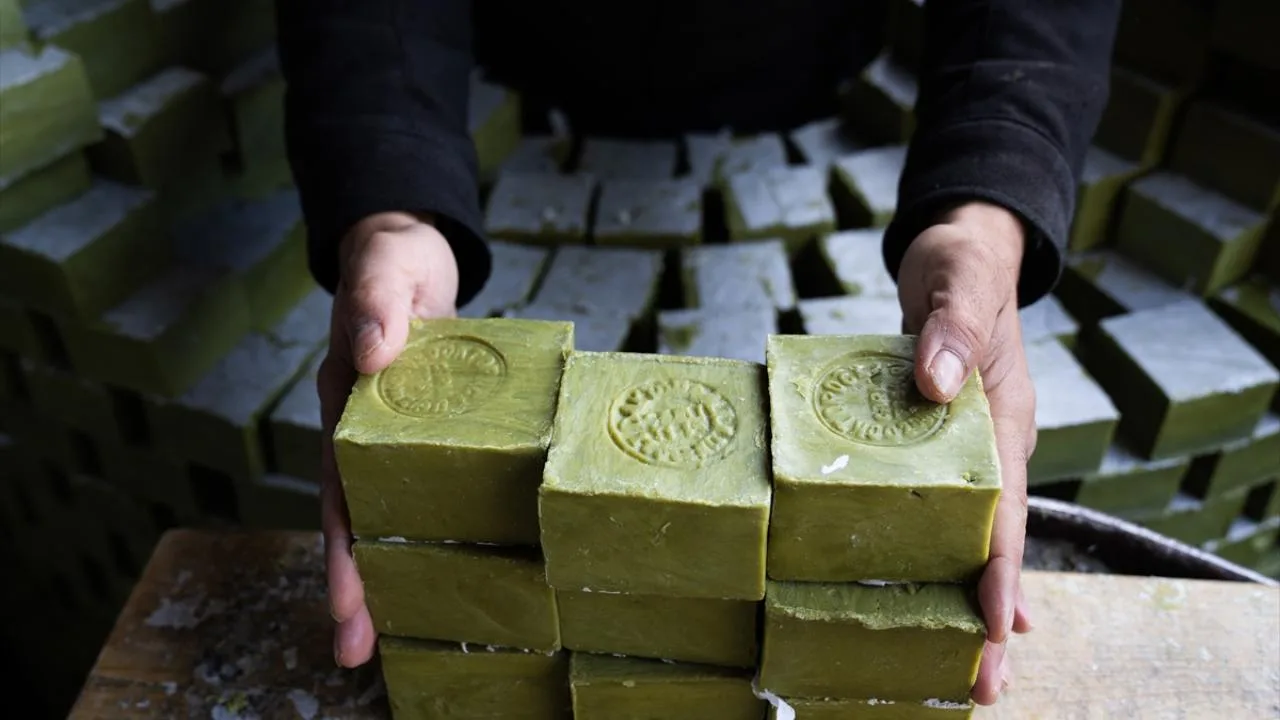
Nizip Soap is a hard (bar) type olive soap. Its main components are the pomace (prina) oil extracted from the residue of pressing Nizip olives and Nizip olive oil; the registered recipe also includes a portion of palm stearin. For this oil to become soap, it must be combined with caustic soda (sodium hydroxide) and undergo the chemical reaction known as saponification. The result is a plain soap that carries the natural moisturizing qualities of olive oil and is free of perfumes and synthetic lather boosters.
Under the geographical-indication recipe the soap is based mainly on pomace (prina) oil and Nizip olive oil, together with a portion of palm stearin; what defines its character is the high proportion of locally sourced olive and pomace oil, which shapes both the soap's color and its softness against the skin. The color usually ranges from pale yellow to off-white, while the scent is the natural, light aroma of olive oil itself.
From Olive to Soap: The Traditional Production Method
Making Nizip Soap is a craft that demands time from start to finish: it begins with a cauldron process lasting several days and is completed by a curing period that runs for months. The process broadly consists of the following stages:
Cooking
The soap-grade oil and caustic soda are boiled in large cauldrons at high heat, stirred for hours. At this stage the oil reacts with the caustic and saponification begins. The cauldron is brought to the desired consistency over several days, boiled again with brine where needed.
Spreading and Cutting
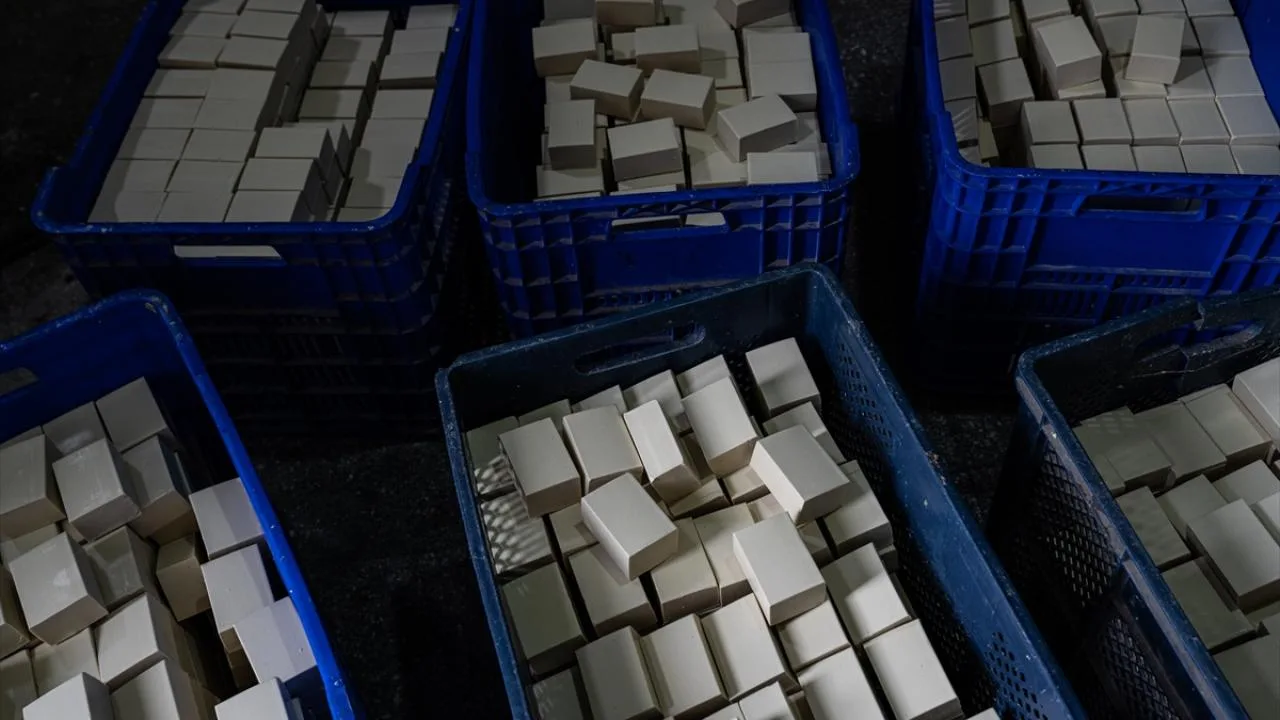
The soap paste, once it reaches the right consistency, is spread onto a flat, sheltered surface and left to rest for a while. After this initial set, the sheet is cut into evenly sized bars by hand. Cutting is a skill done more by hand and eye than by machine, and it takes experience.
Curing
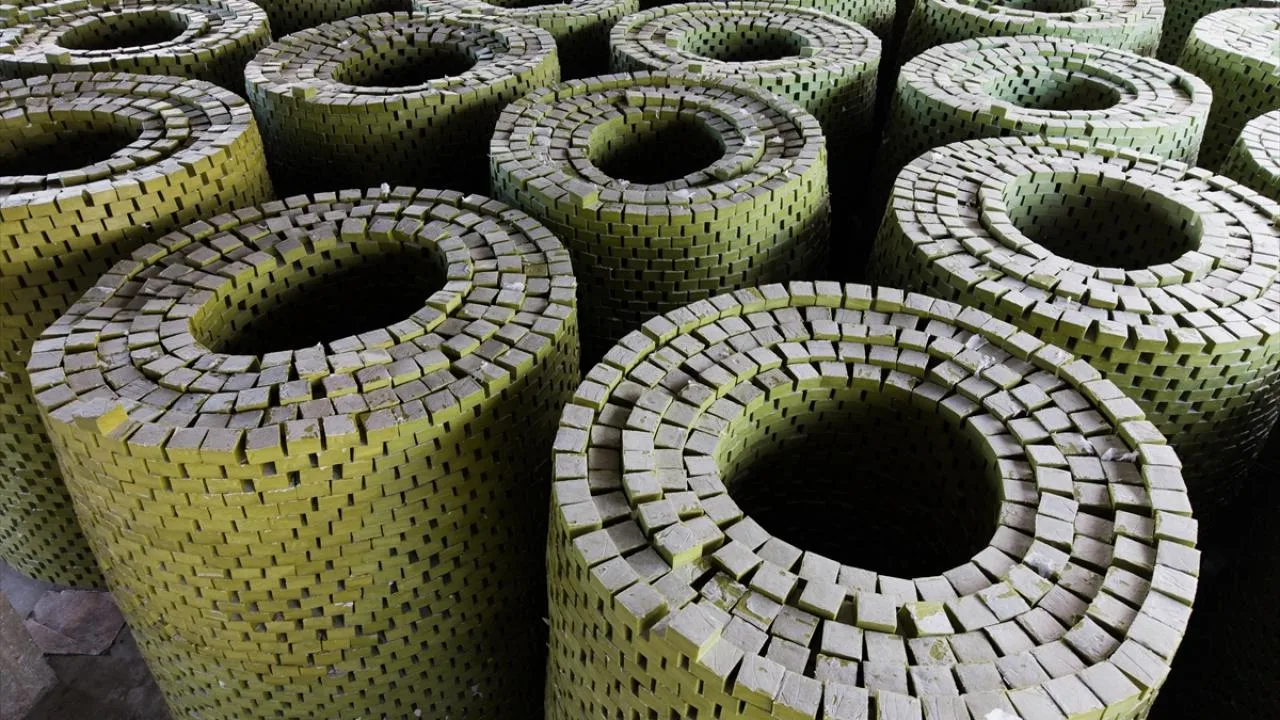
The cut soaps are stacked on top of one another in dome or cage formations so that air can circulate, then left to cure for months in a cool place out of direct sunlight. Nizip's dry climate provides a natural advantage at this stage. The curing period lasts at least several months and can run considerably longer depending on weather conditions. Only once the soap has hardened and matured fully is it packaged.
Nizip Soap is registered as a mark of source under registration number 335 within the scope of Industrial Property Law No. 6769; the application was filed in 2012 and the registration was completed on 20 March 2018. The registering body is the Nizip Chamber of Commerce, and the geographical boundary is defined as the Nizip district of Gaziantep province.
The Geographical Indication and the Bond with the Olive
The protection of Nizip Soap as a geographical indication registers not just a name but a method of production and a geography. A mark of source officially recognizes that the product owes its particular qualities to the Nizip region and that its production must take place within these boundaries. The quality of the soap depends directly on the quality of the Nizip olive: the high oil ratio and fleshy structure of the olives grown here make both the oil and the soap made from it distinctive.
This bond runs both ways. Nizip olive oil itself is also a separately protected geographical indication; the soap, as the final link in this value chain, represents a circular production culture in which no part of the olive is wasted. The very existence of the soap shows that the depth of Gaziantep's crafts is not limited to weaving looms and copper hammers but reaches all the way to olive cauldrons.
Deep Roots in Regional Trade
Olive oil and soap have held an important place in the commercial life of this geography for centuries. In the first half of the eighteenth century, the merchants of Ayntab marketed their goods across a wide network; soap derived from olives was among these commodities and was traded along routes reaching centers such as Aleppo, Damascus, Hama, Homs and the Hijaz. This is a picture not of today's Nizip Soap brand specifically, but of the region's deep-rooted economic tradition based on olive and soap production.
This historical background helps explain why soap-making in Nizip is so established and continuous. The olive, as a resource nourishing both the cuisine and the craft of the region, has been passed down from generation to generation, and the tradition of the soap workshop has risen upon this accumulated knowledge.
Mastery, Transmission and the Present Day
The production of Nizip Soap is largely a body of knowledge kept alive within families and through the master-apprentice relationship. Decisions such as when to boil the cauldron, when the paste has reached the right consistency, how to cut, and how long to cure the soap are learned through experience rather than from books. In this sense the soap workshops are the district's living schools of craft.
Today Nizip Soap is in demand both at home and abroad as a product distinguished by its natural, additive-free structure, and it is exported to many countries. The growing interest in natural soaps has brought this age-old craft back into focus, while the geographical indication has laid the groundwork for protecting the product from imitation and for the correct use of its name. For visitors to Gaziantep, Nizip Soap stands out as a souvenir that fits easily into a bag, belongs to the locality and carries a story.
Sources
- T.C. Türk Patent ve Marka Kurumu (TÜRKPATENT), Coğrafi İşaretler Veritabanı – Nizip Sabunu, Mahreç İşareti, Tescil No: 335 (Tescil tarihi: 20.03.2018).
- Gaziantep Büyükşehir Belediyesi, Coğrafi İşaretli Ürünler – Nizip Sabunu.
- Kars, R. (2018). XVIII. Yüzyılın İlk Yarısında Ayntablı Tüccarların Faaliyetleri Kapsamında İç Ticarete Konu Olan Emtia. Gaziantep Üniversitesi Ayıntâb Araştırmaları Dergisi, 1(1), 36-48.
Frequently Asked Questions
What is Nizip Soap made from?
It is made mainly from pomace (prina) oil extracted from pressed Nizip olives and from Nizip olive oil; the registered recipe also includes a portion of palm stearin, and the mixture is saponified with caustic soda (sodium hydroxide).
Does Nizip Soap have a geographical indication?
Yes. It is registered as a mark of source under registration number 335, completed on 20 March 2018 in the name of the Nizip Chamber of Commerce.
How long does it take to make Nizip Soap?
The cauldron and cutting work take several days, while curing lasts at least several months; depending on weather, the whole process can run much longer.
What sets Nizip Soap apart from other soaps?
It is set apart by its raw material being based entirely on the Nizip olive and by being made with the traditional cauldron method, without perfumes or synthetic additives.
Where is Nizip Soap produced?
It is produced in the Nizip district of Gaziantep; the geographical indication also limits the production area to this district.
Is Nizip Soap sold outside Gaziantep?
Yes. Besides being in demand domestically for its natural character, it is exported to many countries.