Gaziantep Castle and Defence Museum rises on a mound that commands the city centre and stands as the most powerful symbol of the city. Built on a settlement hill whose foundations reach back to the Chalcolithic age, the castle took shape as a watchtower in the Roman period and gained its present monumental appearance under the Byzantine emperor Justinian I, in the 6th century CE. Within this roughly two-thousand-year-old stone structure stands a Heroism Panorama Museum that stages the Defence of Antep; thus a single hill carries, at one and the same time, both an ancient work of defensive architecture and the memory of a resistance fought a century ago.
This article covers the castle's overlapping historical layers, the physical logic of its stone body, the Gaziantep Defence and Heroism Panorama Museum inside it, the restoration carried out after the 2023 earthquakes, and a visitor's discovery guide.
Architecture and Historical Layers
The mound on which the castle rises is a settlement hill that reaches back some six thousand years, to the Chalcolithic period; beneath today's stone walls, in other words, lies a far older town built up layer upon layer. The castle first took shape as a watchtower in the Roman period, in the 2nd–4th centuries CE, and was expanded over time. The structure gained its present monumental form under the Byzantine emperor Justinian I (527–565 CE); during the reign of Justinian — remembered as the "emperor of fortresses" for the many walls rebuilt in his time — scattered defensive elements were drawn together into a unified castle ringed entirely with towers.
In the centuries that followed, the castle was repaired again and again according to the needs of the states that ruled the region. Under the Mamluks and the Ottomans the walls and towers were renewed; towers were added to either side of the entrance bridge, and structures such as a cistern, a small mosque and a bathhouse — the means of sustaining daily life — were built within the castle. The castle is therefore not the work of a single age but the joint creation of overlapping civilisations; a careful eye can still tell apart the stonework and repair traces of different periods in the walls.
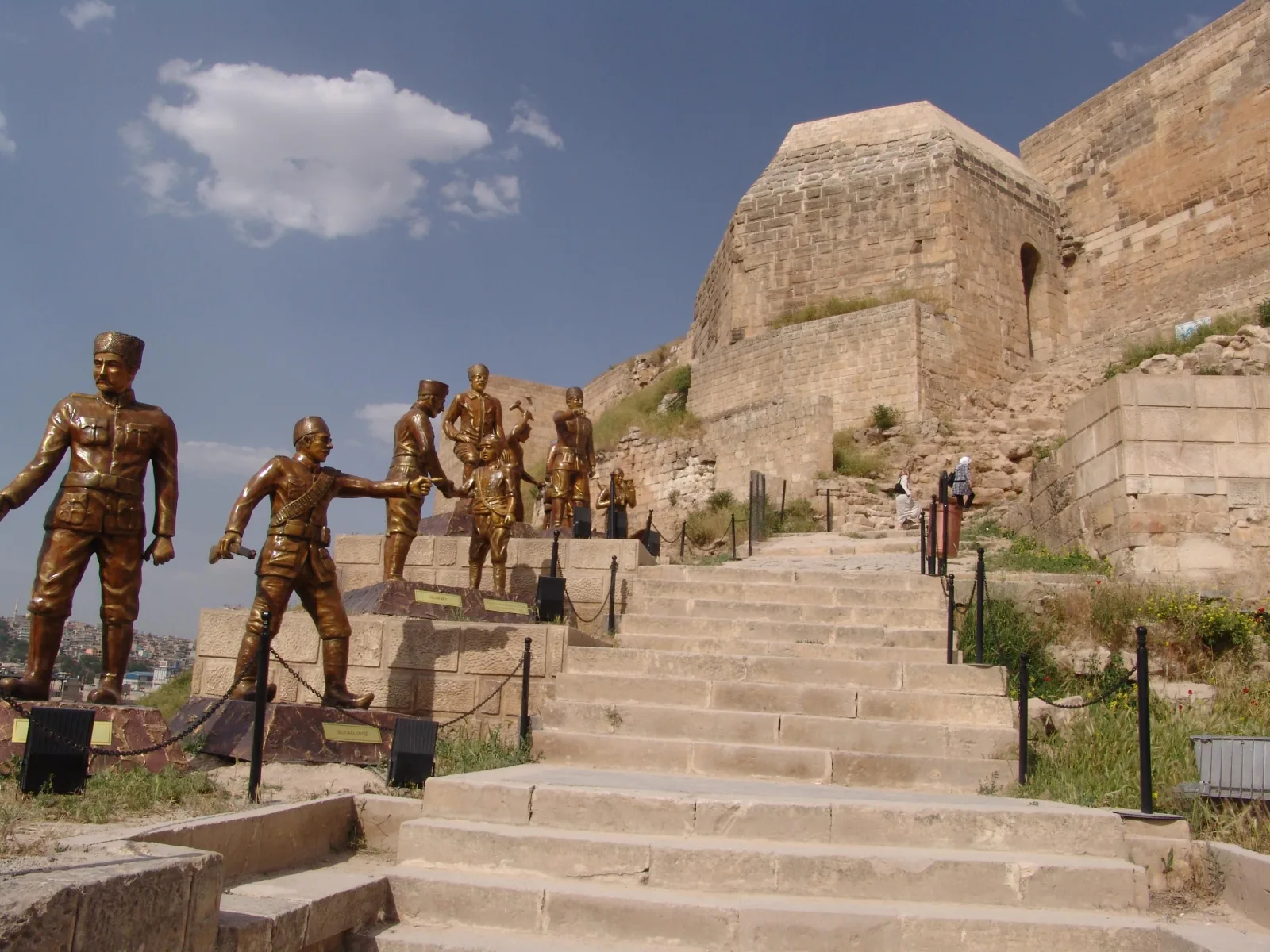
The Main Structures to See
The Curtain Wall, Towers and Moat
In plan the castle has a near-circular shape and is encircled by a stone curtain wall roughly 1,200 metres long. Historical sources state that the castle had 36 towers; in his Seyahatname (Book of Travels), Evliya Çelebi too speaks of the castle's thirty-six towers. Today twelve of these towers still stand; the rest are thought to have stood on outer walls that later vanished entirely. Set atop the mound of about 25 metres in height, the castle was once protected by a deep, wide moat that surrounded it, entered by a movable bridge that crossed it.
The Entrance Bridge and In-Castle Buildings
The castle is reached by a system of ramp and bridge climbing from the foot of the mound; the towers added to either side of the entrance form the last line of defence guarding the gate. Within the walls lie the remains of the cistern, small mosque and bathhouse that met the daily needs of the garrison that sheltered here for centuries. These structures show that the castle was not merely a military stronghold but a small town lived in behind its walls.
The Heroism Panorama Galleries
The castle's true "museum" layer is the Gaziantep Defence and Heroism Panorama Museum that runs along its restored galleries. Opened to visitors in 2009, this gallery recounts the 1920–1921 Defence of Antep chronologically along a route that begins at the castle entrance and runs for roughly 200 metres. The resistance is staged through numerous panels, reliefs, sculptures, busts, portrait reliefs and models. The leading figures of the struggle, its fronts and its organisation come alive in sequence as the visitor passes through the gallery. We treat this gallery in a section of its own below.
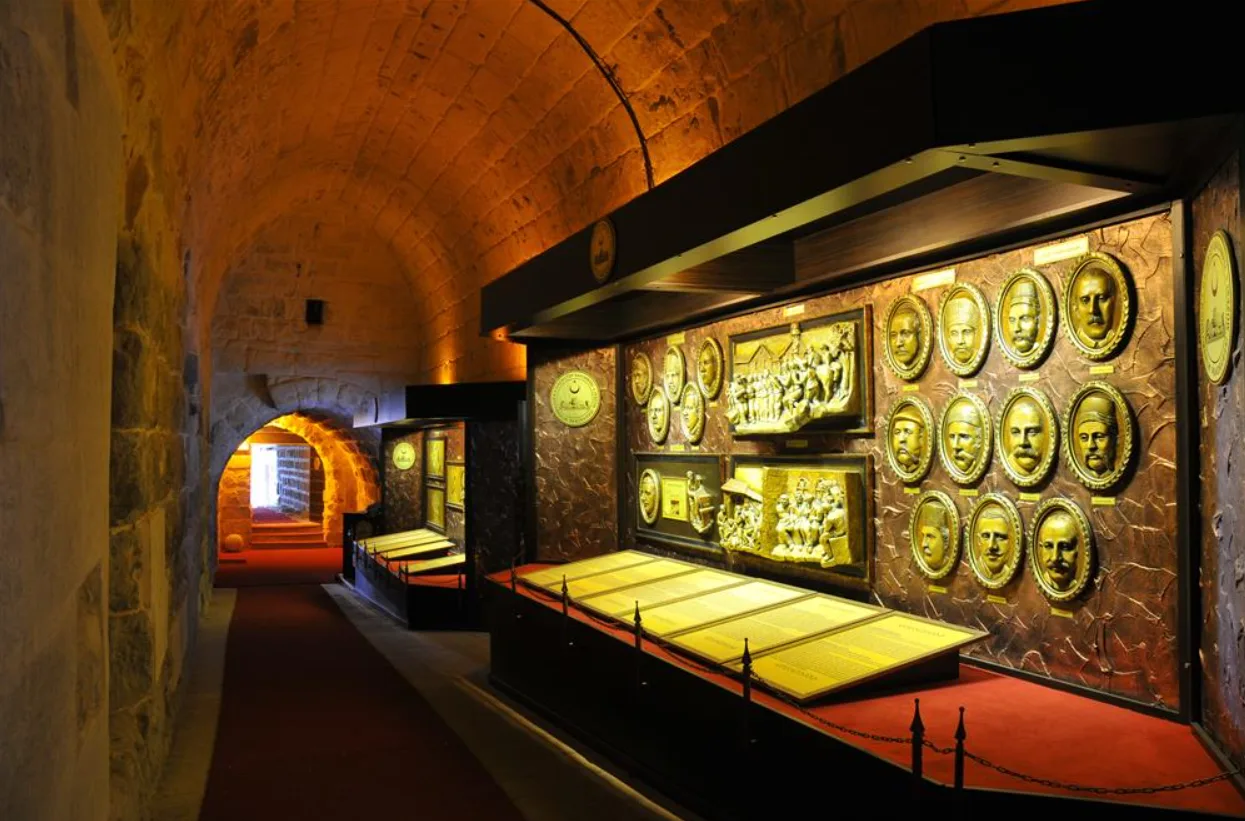
The Defence and Heroism Panorama Museum Inside the Castle
The gallery museum inside the castle adds a modern layer of memory to the stone structure's military past. The resistance the people of Antep mounted against occupying forces in 1920–1921 has here been turned into a narrative that can be followed from beginning to end. The panels along the gallery relate the events in order; the sculptures, busts and portrait reliefs make visible the figures who took part in the resistance, while the models bring to life the neighbourhoods and positions where the fighting took place.
This arrangement lifts the castle beyond being a mere stone structure: in a single place the visitor tours both a two-thousand-year-old work of defensive architecture and the memory of the national struggle that won the city its "Gazi" (veteran) title. The full story of this resistance staged at the castle is told in detail on the War of Independence and the Defence of Antep page.
The Defence of Antep is recounted at more than one venue in Gaziantep. The subject of this page is the 2009 Gaziantep Defence and Heroism Panorama Museum located inside the castle. The Panorama 25 December Museum, housed in a separate building near the castle, is a larger, distinct museum that opened in 2020.
Earthquake and Restoration
The earthquakes that struck the region on 6 February 2023 also damaged the castle. In the tremors, some of the bastions on the eastern, southern and south-eastern sides, together with part of the retaining wall surrounding it, collapsed, and some interior sections of the two-thousand-year-old structure were harmed. After the damage, a comprehensive restoration was launched by the Ministry of Culture and Tourism.
During the restoration not only were the collapsed bastions and walls rebuilt; the structure was also made more resilient to future tremors through techniques such as detecting ground fractures with georadar surveys and strengthening the wall foundations with ground injection. This work is a reminder that the castle is not merely a monument but a living heritage that demands constant care and protection.
A Visitor's Discovery Guide
- Read the layers: repairs from different periods in the walls (Byzantine, Mamluk, Ottoman) and the sections renewed after the earthquake can be told apart when you look at the castle carefully; each layer represents a distinct age.
- Tour the in-castle gallery: running from the entrance along the gallery, the Heroism Panorama lifts the castle beyond being a mere stone structure and places it at the heart of the memory of the national struggle.
- Make time for the view: the commanding position of the mound turns the castle into a natural vantage point for looking out over the city; from here the fabric of the historic centre can be seen as a whole.
The castle gains meaning when toured together with the city's other walled structures and museums. To get to know the structure on this same mound more closely as a work of defensive architecture, see the Gaziantep Castle page; for the region's other castles and walled settlements, the Castles section; and to see all of the city's museums together, the Museums page. You can follow the city's complete historical chronology on the History of Gaziantep page.
Summary and Cultural Value
Gaziantep Castle and Defence Museum is a single structure on which an unbroken history has piled up, layer upon layer — from a Chalcolithic mound to a Roman watchtower, from Byzantine walls to Mamluk and Ottoman repairs, and finally to the memory of the national struggle. Together with the Heroism Panorama Museum inside it, the castle carries both the city's oldest and its most recent past at one and the same time; its careful restoration after the earthquake shows that this heritage is still being kept alive today. For everyone who visits the city, the castle is the most direct way to read Gaziantep's two-thousand-year defensive identity on a single hill.
Frequently Asked Questions
When was Gaziantep Castle built?
The castle is built on a mound that reaches back to the Chalcolithic age. It was first built as a watchtower in the Roman period (2nd–4th centuries CE), and took its present form under the Byzantine emperor Justinian I, in the 6th century CE.
How many towers does the castle have?
According to historical sources, the castle had 36 towers; Evliya Çelebi records this too. Today twelve of these towers still stand. The circumference of the curtain wall is roughly 1,200 metres.
Is there a museum inside the castle?
Yes. The Gaziantep Defence and Heroism Panorama Museum, opened in 2009, occupies the gallery sections inside the castle; the Defence of Antep is brought to life through panels, sculptures, reliefs, busts and models.
Was Gaziantep Castle damaged in the 2023 earthquakes?
Yes. In the earthquakes of 6 February 2023, some of the bastions on the eastern, southern and south-eastern sides and part of the retaining wall collapsed. A comprehensive restoration was then carried out by the Ministry of Culture and Tourism.
Is Gaziantep Castle on the UNESCO World Heritage List?
No. Gaziantep Castle is not on the UNESCO World Heritage List or its Tentative List. The heritage from Gaziantep on the UNESCO Tentative List consists of the city's underground water structures (livas and kasteller, the historic water galleries and reservoirs) and sites such as Yesemek; the castle is not among them.