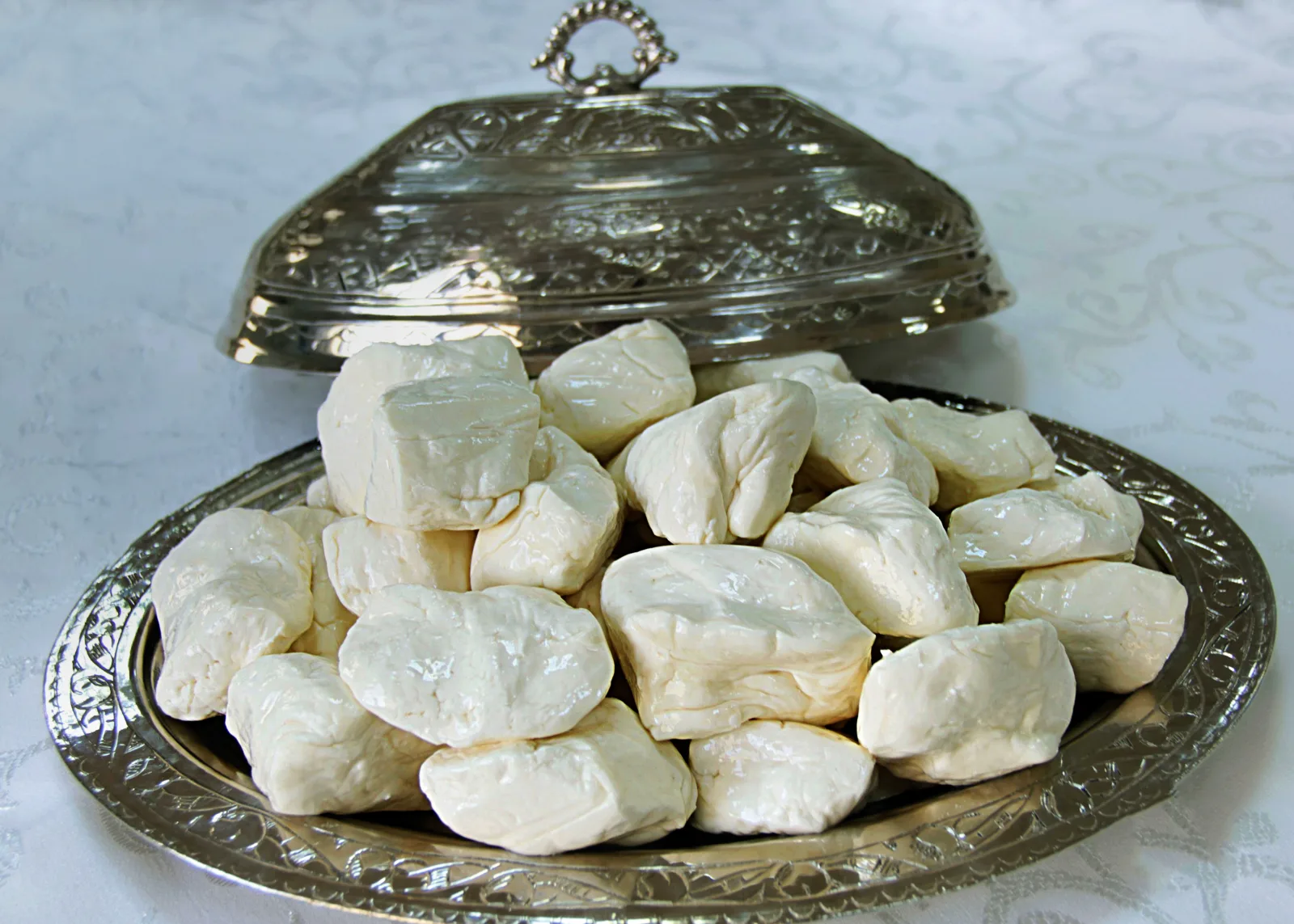
Antep Cheese (in Turkish "Antep Peyniri") is a semi-hard pressed (sıkma) cheese made from sheep and/or goat milk, whose curd is scalded in hot whey and then shaped by hand-pressing between the palms. It is eaten fresh or matured in a heavily salted brine; with its grey-white color, elastic texture and distinctive salty flavor, it is one of the cornerstones of the Gaziantep table. Holding pride of place in the famous Antep breakfast, this cheese is registered with TÜRKPATENT under the name "Antep Peyniri."
The identity of Antep cheese lies in the production method that sets it apart from ordinary white cheeses: the curd is scalded in hot water, so the cheese takes on an elastic, semi-hard structure that holds together and has a satisfying bite. Found in the region both fresh and matured in brine, this cheese appears in many corners of Gaziantep cuisine — from the breakfast spread to the pastry tray and even cheese-based desserts. It is one of the most deeply rooted expressions of the city's milk and cheesemaking tradition.
What Is Antep Cheese?
Antep cheese is a pressed (sıkma) cheese: sheep or goat milk (or a mixture of the two) is curdled, and the resulting curd is briefly scalded in hot whey and then shaped by hand-pressing between the palms. These scalding and pressing steps give the cheese its defining elastic, semi-hard and resilient texture. The cheese can be eaten fresh straight away; but the form matured in a heavily salted brine for keeping is especially widespread in the region. In Antep, this cheese is the main ingredient of both the everyday breakfast and many pastries and desserts.
Defining Characteristics
- Its Milk (Sheep and/or Goat): Antep cheese can be made from sheep milk alone, goat milk alone, or a mixture of the two. The character of the milk forms the foundation of the cheese's salty, full flavor.
- Scalded Curd: This is the step that sets it apart from ordinary white cheese: the cut curd is briefly scalded in hot whey. This gives the cheese an elastic, cohesive structure.
- The Pressing (Sıkma) Method: The scalded curd is shaped while still warm by pressing it between the palms. This is where the name "pressed cheese" (sıkma) comes from; irregular, oval pieces formed by hand are the cheese's typical look.
- Semi-hard, Elastic Texture: Its appearance is homogeneous, pore-free and smooth; it has a semi-hard, elastic texture that does not crumble too much when cut and dissolves easily in the mouth.
- Fresh or Brined: The cheese is eaten both fresh and matured in a heavily salted brine so it withstands Gaziantep's hot climate. The brine gives the cheese a pronounced salty character.
The Cheese of the Antep Table
In Gaziantep cuisine, cheese is not only a flavor that accompanies breakfast; it is also an ingredient at the heart of pastry- and dessert-making. Thanks to the elastic, durable structure it gains from scalding and pressing, Antep cheese is suited both to being sliced and brought to the table and to being worked into dough and desserts. This versatility lifts the cheese out of being an ordinary breakfast item and turns it into a deep-rooted raw material that appears across many branches of the city's kitchen.
History and Geographic Origins
Antep cheese is a product of the deep-rooted milk and cheesemaking tradition of Gaziantep and its region. Animal husbandry based on raising sheep and goats made the preservation of milk by turning it into cheese a natural part of daily life for centuries. Scalding the curd in hot water, pressing it, and keeping it in a heavily salted brine is a practical, region-specific way of storing cheese for a long time in a hot climate. It would not be right to claim a specific date or a "first made in such-and-such year" here; what is known is that this cheese has a long-established, deeply rooted tradition of production and consumption in the Gaziantep region.
The Registration of Antep Cheese
The cheese's bond with the region is also officially recognized through the geographical indication the product holds under its own name. Because it is closely tied to a particular geography and production tradition, this cheese is registered as a Designation of Origin (Menşe Adı) — the category given to products named after their place of origin. The registration protects the cheese's name and places it among Gaziantep's geographically indicated products. The registered product is recorded under the names "Antep Peyniri," "Gaziantep Peyniri" and "Antep Sıkma Peyniri."
Antep cheese is registered with TÜRKPATENT under the names "Antep Peyniri / Gaziantep Peyniri / Antep Sıkma Peyniri" as a Designation of Origin (Menşe Adı) — Registration No 356, 2018. The registering body is the Gaziantep Chamber of Commerce (Gaziantep Ticaret Borsası). This record places Antep cheese among Gaziantep's geographically indicated products.
Antep Cheese in Gaziantep Cuisine
Antep cheese holds a broad place at the Gaziantep table, from the first meal of the day to plates of treats. The place where we see it at its most splendid is, without doubt, the Antep breakfast: alongside olives, honey, clotted cream, jam and warm bread, sliced Antep cheese is the indispensable flavor at the center of the spread. Yet the cheese's talents are not limited to breakfast; the durable structure it gains from being scalded and pressed also makes it a favored ingredient in pastries and desserts.
Which Dishes Use It?
The best-known use of Antep cheese is the breakfast table; but it also takes a leading role in the region's pastry and dessert culture. On the savory side, the cheese is placed between layers of dough and baked to form the heart of filling pastries such as Vegetable Cheese Pastry. One of the finest examples of how Gaziantep cuisine balances salty and sweet is Sweet Cheese Pastry, where the cheese meets a syrup-soaked dough. That same salty-sweet harmony shows itself again in Cheese Semolina Halva, served warm and given a distinctive texture by the cheese's elasticity. These examples reveal that Antep cheese is not merely a breakfast item but a fundamental raw material that nourishes many branches of the kitchen.
Why It Matters
Antep cheese is one of the most everyday and at the same time most characteristic ingredients of Gaziantep cuisine. On one hand, as the constant of the breakfast spread each morning, it carries the city's daily rhythm of flavor; on the other, through its versatility in pastries and desserts, it feeds the region's distinctive palate built on a balance of salty and sweet. Made by scalding and pressing, this cheese sums up Gaziantep's milk and cheesemaking tradition in a single slice; through its registered identity, it is preserved as a deep-rooted part of the city's gastronomic heritage.
Frequently Asked Questions
What is Antep cheese and what kind of cheese is it?
Antep cheese is a semi-hard pressed (sıkma) cheese made from sheep and/or goat milk, whose curd is scalded in hot whey and then shaped by hand-pressing between the palms.
What milk is Antep cheese made from?
It can be made from sheep milk alone, goat milk alone, or a mixture of sheep and goat milk. The character of the milk forms the foundation of the cheese's salty, full flavor.
Is Antep cheese registered?
Yes. It is registered with TÜRKPATENT under the names "Antep Peyniri / Gaziantep Peyniri / Antep Sıkma Peyniri" as a Designation of Origin (Menşe Adı), Registration No 356, 2018.
Where is Antep cheese used in Gaziantep cuisine?
Above all it is the indispensable part of the famous Antep breakfast; it is also the main ingredient of pastries and desserts such as Vegetable Cheese Pastry, Sweet Cheese Pastry and Cheese Semolina Halva.