 Vegetarian
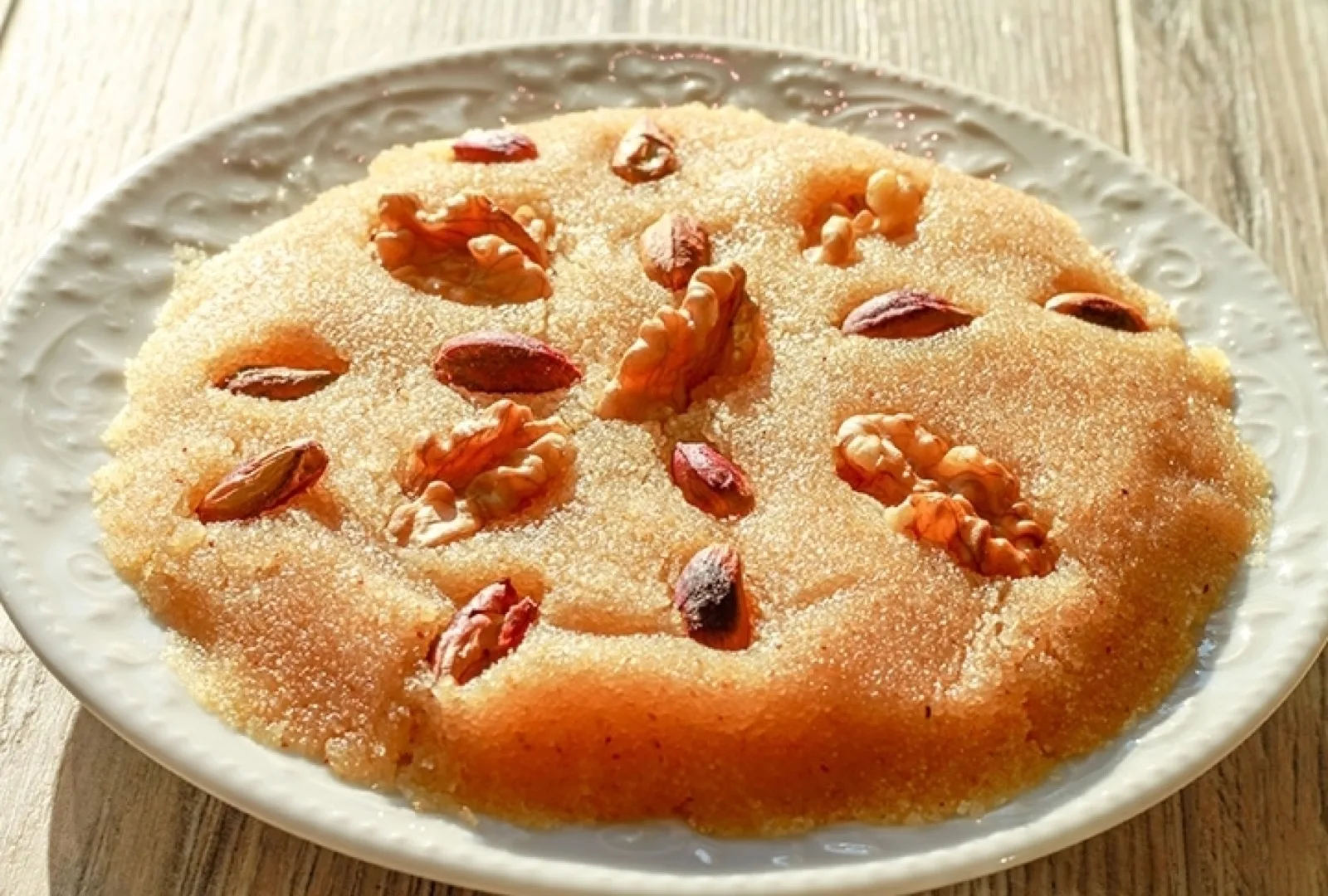
Cheese semolina halva (peynirli irmik helvası) is a Gaziantep dessert in which semolina is roasted in clarified butter, cooked with sugar and water, then stirred together with fresh unsalted cheese until the cheese melts and turns stringy, and served hot at once. The signature of the dessert is the way the cheese stretches in fine strands when lifted with a spoon while still hot: the grainy texture of the roasted semolina, the measured sweetness of the sugar and the faintly salty softness of the melting cheese all meet in a single bite. Filed on 20 July 2020 through an application by the Gaziantep Metropolitan Municipality, cheese semolina halva was registered as a geographical indication by TÜRKPATENT on 10 February 2022 (Geographical Indication / Mahreç İşareti, Reg. No: 1029).
The identity of the dessert springs from the harmony of a few essentials: semolina roasted in clarified butter until pinkish, white sugar, water, and a fresh unsalted cheese that is full-bodied yet stretches when it melts. Behind these lies not a process spread over days but a fast cycle that demands timing — roasting the semolina, letting it drink up its sweetened liquid, and adding the cheese at the last moment, stirring on the heat until it turns stringy.
This article explores the world of ingredients that shapes cheese semolina halva, its roasting and cheese-adding technique, its origins in Gaziantep cuisine, its geographical indication protection, and its place as a hot offering at the city's table.
What Is Cheese Semolina Halva and What Is in It?
Cheese semolina halva is a halva made by roasting semolina in clarified butter and cooking it with sugar and water to form a semolina-halva base, then stirring fresh unsalted cheese into this hot base and turning it until the cheese melts and stretches. What sets it apart from a plain semolina halva is the cheese worked into it: fresh cheese that meets the heat melts and lends the halva both a flowing, stringy texture and a sweet-and-salty balance. The sweetness of the dessert comes from the sugared water that the semolina absorbs while cooking; it is not soaked in a heavy syrup. Cheese semolina halva is spooned into a bowl while the cheese is still hot and at its stretching point, and served hot, often finished with a scattering of crushed Antep pistachio on top.
Core Components
- Semolina: The backbone of the dessert is semolina roasted in clarified butter. In the geographical indication recipe, around 150-160 grams of semolina are used for one dish; the semolina is roasted over low heat, stirred constantly, until it turns pinkish and releases its aroma. This roasting keeps the grains firm and distinct rather than mushy, giving the halva an aromatic, lightly toasted base.
- Fresh Unsalted Cheese: The soul of the dessert is fresh, unsalted cheese that melts and stretches when it meets the heat. The registered recipe specifies around 150-250 grams of fresh cheese; if the cheese is too salty it is first sliced and soaked in water to draw out the salt, then squeezed dry and added to the halva. Stretching into fine strands as it melts, this cheese gives the halva both its signature texture and its sweet-and-salty character.
- Clarified Butter (Sade Yağ): The fat in which the semolina is roasted is traditionally clarified butter (sade yağ); the recipe specifies around 30-60 grams for one dish. The clarified butter gives the semolina its roasted aroma and the halva a rich mouthfeel, and it helps the grains cook separately without clumping together.
- White Sugar: The halva's sweetness comes not from syrup but from white sugar added to the cooking water; the recipe uses around 240-300 grams of sugar for one dish. The sugar dissolves in the water and is absorbed by the semolina; this is why cheese semolina halva is a dessert of measured sweetness, moist in texture and balanced.
- Water: The liquid that lets the semolina swell and cook is water; according to the recipe, around 400-420 grams of water, together with the sugar, are added over the roasted semolina for one dish. The water and sugar are cooked over low heat until fully absorbed by the semolina; only then is the cheese added.
The Geography of Its Service
By the nature of its preparation, cheese semolina halva is eaten fresh and hot; because the cheese loses its signature texture once it cools and hardens, the halva is usually prepared the moment it is to be eaten, just before it reaches the table. Serving it hot lets the cheese stretch on the spoon and keeps the halva soft. In Gaziantep, this halva is most often served as a dessert after a meal or as a hot offering presented to a guest; it may be finished with crushed Antep pistachio or cinnamon. Because it depends on being served hot, cheese semolina halva — unlike gift sweets such as baklava or pistachio paste — has largely remained a flavour prepared and eaten on the spot at Gaziantep's own tables.
The History and Cultural Origins of Cheese Semolina Halva
The origins of cheese semolina halva rest both on Anatolia's deep-rooted tradition of halva and on the relationship Gaziantep builds between semolina desserts and fresh cheese. Although semolina halva is very common in Turkish cuisine, the dessert today associated with Gaziantep gained its distinctive identity when fresh cheese was worked into the halva.
A Deep-Rooted Halva Tradition
Making halva — roasting semolina in fat and cooking it with sweetened water or milk — is part of the centuries-old accumulation of Turkish cuisine. Local accounts and artisan memory position cheese semolina halva as one of Gaziantep's deep-rooted desserts; the idea of adding cheese to halva appears to have grown from semolina halva and fresh cheese sitting side by side at the city's table. While these accounts show the dessert's deep cultural place, a precise starting date is not documented; for this reason cheese semolina halva is best regarded, historically, as part of the region's deep-rooted heritage of halva-making.
How It Became a Signature Dessert of Gaziantep
What identifies cheese semolina halva with Gaziantep is the ingredients in the city's hands and its master-apprentice tradition. When the region's fresh, stretching cheese, its clarified butter and the roasting-and-stirring technique handed down through generations come together, a plain semolina halva becomes a dessert that bears the city's name and stretches with cheese. Adding the cheese at exactly the right point — neither before it can melt nor so late that it hardens — and stirring it in is a skill that demands timing and a practised hand.
Geographical Indication Registration
Cheese semolina halva went through an official registration process to protect its region-specific ingredients and method of production. The process, begun through an application by the Gaziantep Metropolitan Municipality, was filed on 20 July 2020 and concluded with a geographical indication registration by TÜRKPATENT on 10 February 2022 (Geographical Indication / Mahreç İşareti, Reg. No: 1029). The registration guarantees that the name "Antep Peynirli İrmik Helvası / Gaziantep Peynirli İrmik Helvası" may be used only for a product tied to the region and made with the defined ingredients and method.
Cheese semolina halva was entered into the TÜRKPATENT geographical indications register as a Geographical Indication (Mahreç İşareti, Reg. No: 1029) on 10 February 2022; the application was made on 20 July 2020 by the Gaziantep Metropolitan Municipality. The registration document defines the method of production, from roasting the semolina in clarified butter, to the proportions of sugar and water, to adding the fresh unsalted cheese at the last moment and stirring until it melts, and serving it hot.
The Cheese Semolina Halva Tradition and Ritual in Gaziantep
In Gaziantep, cheese semolina halva is not merely a dessert; it is part of sharing, of the hot offering and of the tradition that closes a meal. It holds a place of its own in the city's culinary fabric as one of the rare flavours that bring dessert and cheese together on a single plate.
The Dessert of the Hot Offering
Cheese semolina halva's place in Gaziantep culture is tied to the tradition of the hot offering. The dessert is a freshly made treat served hot to a guest who comes to the home or at the end of a meal; the stretching of the cheese on the spoon requires it to arrive at the table with the freshness of the moment it was cooked. Thus the halva finds its place within the city's table customs as a flavour that does not tolerate waiting and is shared at once.
The Craft of Roasting and Adding the Cheese
Cheese semolina halva is defined as much by its technique as by the plainness of its ingredients. The semolina is roasted in clarified butter over low heat, stirred constantly, until it turns pinkish; then sugar and water are added and it is cooked until the semolina absorbs the liquid. The heart of the dessert lies in the final stage: fresh unsalted cheese, drained and squeezed, is stirred into the hot halva and turned until it begins to melt and stretch into fine strands. Adding the cheese at the right moment and not overcooking it into hardness calls for striking a balance — a body that does not fall apart, with cheese that stretches inside. The handing down through generations of techniques such as roasting the semolina and turning the halva with cheese is also part of the diversity of crafts that was one reason for Gaziantep's admission to the UNESCO Creative Cities Network in the field of gastronomy in 2015.
Its Place at the Table
In Gaziantep, cheese semolina halva is often a way to complete a meal; in place of a heavy baklava, it closes the table as a hot, balanced dessert. Those curious about the relationship Gaziantep cuisine builds with fresh cheese and with the pistachio can follow these ingredients on their journey from dessert to kebab in signature dishes such as pistachio kebab and Gaziantep baklava.
Why You Should Try It
A single spoonful of hot cheese semolina halva carries to the palate Gaziantep's tradition of bringing dessert and cheese together on one plate: the aromatic, grainy texture of the roasted semolina, the measured sweetness of the sugar and the faintly salty, stringy softness of the melting cheese all arrive at once. Sweetened only by the sugar the semolina absorbs rather than drenched in syrup, the halva is a balanced dessert rather than a heavy one. And because the cheese loses its stretch once it cools, the truest way to taste it is to eat it freshly made and hot.
Frequently Asked Questions
What is cheese semolina halva and where is it from?
It is a halva particular to Gaziantep: semolina roasted in clarified butter, cooked with sugar and water, then stirred with fresh unsalted cheese until it stretches, and served hot.
What is in cheese semolina halva?
It uses semolina, fresh unsalted cheese, clarified butter, white sugar and water. There is no heavy syrup; its sweetness comes from the sugared water the semolina absorbs while cooking.
Does cheese semolina halva have a geographical indication?
Yes. Cheese semolina halva was registered as a geographical indication by TÜRKPATENT on 10 February 2022 (Mahreç İşareti, Reg. No: 1029).
How and when is cheese semolina halva eaten?
It is eaten fresh and hot, served while the cheese stretches on the spoon. It is mostly a hot offering presented after a meal or to a guest.
Why does the cheese stretch inside the halva?
The fresh unsalted cheese stirred into the halva melts when it meets the hot semolina and stretches into fine strands on the spoon. This stretch is the dessert's signature texture, which is why it is eaten hot.