 Vegetarian
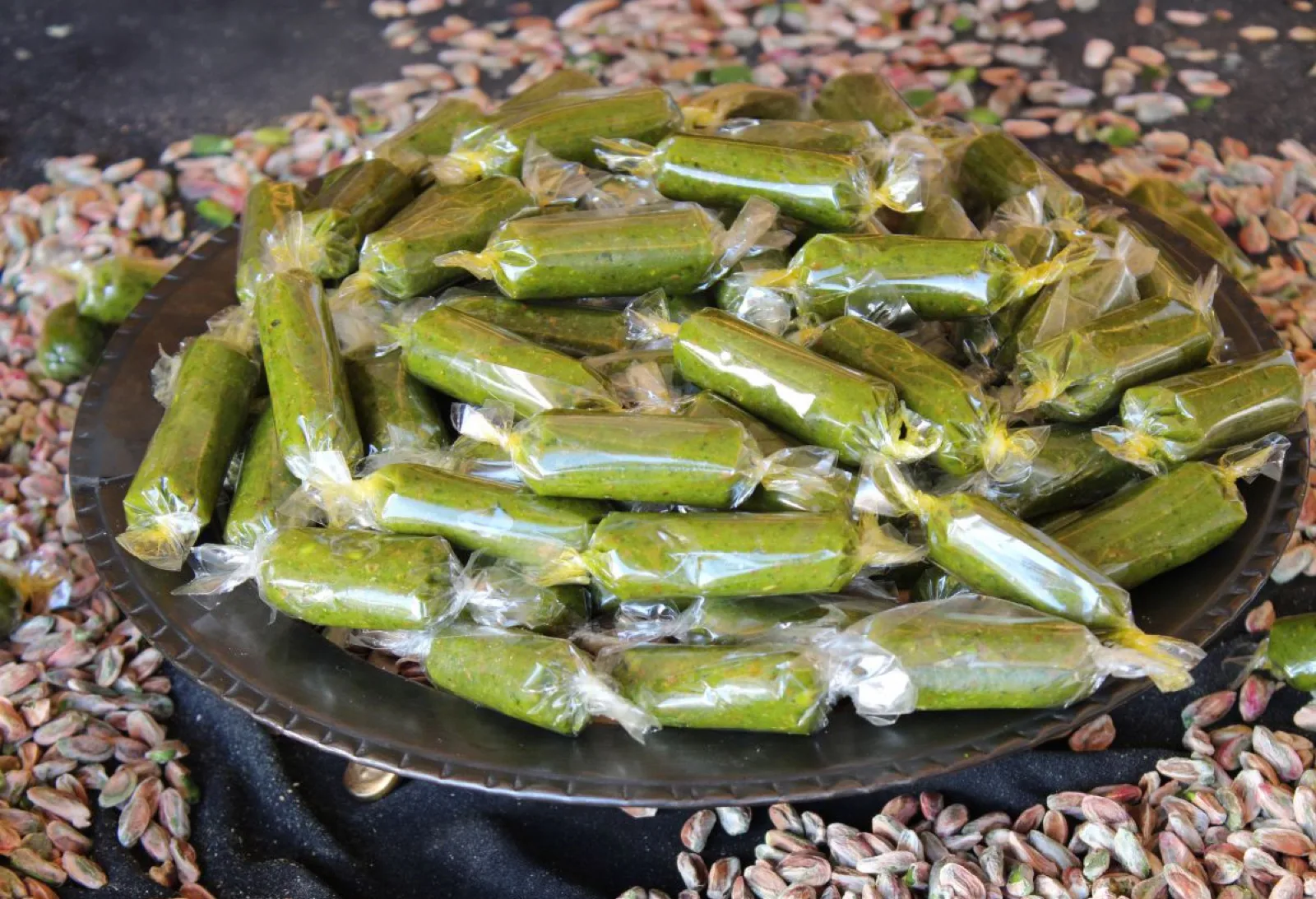
Antep pistachio paste — known locally as fıstık ezmesi — is a deeply rooted, traditional Turkish confectionery art unique to Gaziantep, made by grinding raw Antep pistachios and blending them with thick sugar syrup into a smooth, golden-green sweet. Granted geographical indication protection by TÜRKPATENT in 2017 (Registration No. 237), it was registered as a geographical indication by the European Union in June 2025, becoming the 36th Turkish product to receive EU protection. A single bite of pistachio paste carries Gaziantep's climate, its soil, and centuries of master-apprentice tradition into a single moment on the palate.
The character of pistachio paste lies in three essentials: the choice of high-quality "boz iç" Antep pistachios, using them raw and in the correct ratio, and balancing them with measured sweetness. Unlike almost every modern confection technique, traditional Antep pistachio paste contains no additives; its aroma comes directly from the pistachio's own oil.
This article explores the ingredients that define pistachio paste, the story of its protected registration, its historical roots in Gaziantep, and its ritual place in the city's social life.
What Is Pistachio Paste and What Is in It?
Antep pistachio paste is a dense, intensely flavoured confection made by grinding entirely raw Antep pistachios to a flour-fine texture and binding them with separately boiled, thick sugar syrup. Traditionally it is formed into a roll and cut into bite-sized slices, or shaped in regionally patterned moulds; when sliced, it reveals a smooth, velvety and homogeneous emerald-green cross-section.
Core Ingredients
The traditional Antep pistachio paste is built on just two essentials:
- Antep Pistachio (Boz İç): The secret of the registration is the pistachio itself. Producers use the high-oil, deep green-and-purple-shelled Antep pistachio, grown in Gaziantep and its surrounding districts. This special pistachio is protected by TÜRKPATENT as a Designation of Origin in Türkiye, and its EU registration process is being carefully pursued — making it one of the most geographically distinctive agricultural products in the world.
- Sugar: The traditional and registered recipe uses only white sugar (sucrose) and water. Under the rules of the geographical indication, the use of glucose syrup, corn syrup or any preservative additive in genuine Antep pistachio paste is strictly prohibited.
While some variations include cocoa, chocolate coating, hazelnut, or grape molasses, the TÜRKPATENT registration is based on the simple, pistachio-and-sugar version.
The Soul of Production: Grinding and Syrup
Two critical stages define the character of pistachio paste. The first is grinding the pistachios entirely raw (unroasted) to a flour-fine texture in precise machines that do not release the oil — preserving the emerald-green colour and the milky scent; even the slightest roasting would yellow that famous green. The second is bringing the ground raw pistachio together, while still hot, with thick sugar syrup boiled to exactly the right density in copper cauldrons. The master's skill enters here: the syrup-and-pistachio mixture is passed through special rollers until it becomes a smooth, firm and homogeneous block of dough. Pressed into moulds, this dense paste hardens as it cools and reaches a sliceable consistency; traditional pistachio paste is never flowing.
The word fıstık has a deep history, reaching from the Old Persian root pista to the Ancient Greek form pistákion, and from there to the Arabic fustuq; Turkish, in turn, inherited this rich heritage and adapted it to its own phonetics. Ezme is the Turkish noun form of the verb ezmek, "to crush" or "to grind." The compound name is simple — "crushed pistachio" — but no name describes the product more accurately.
The History and Cultural Origins of Pistachio Paste
While pistachio paste is not as ancient as the pistachio itself, its roots lie at the intersection of Gaziantep's pistachio cultivation and its confectionery traditions. In local oral culture, the practice of combining pistachios with sugar is described as a way of preserving abundant harvests — a means of carrying summer's pistachio bounty through the winter.
The Ancient Past of Antep Pistachio in the Region
The Antep pistachio (Pistacia vera) has been cultivated for thousands of years across the geography between Southeastern Anatolia and Central Asia. Since antiquity, the pistachio has been eaten not only as a nut but also combined with honey and sugar to make long-keeping confections. The Antep pistachio was registered as a Designation of Origin by TÜRKPATENT in 2000 — legally affirming that the genuine product comes only from specific districts of Gaziantep province.
The Maturing of Antep's Confectionery Tradition
The form of pistachio paste we know today is said to have emerged in 19th-century Gaziantep as a joint product of the city's flourishing baklava and confectionery crafts. By that century, the production of Antep baklava, halva and pistachio sweets like muska had become a significant branch of the city's economy. Pistachio paste spread through this network as part of the confectionery culture, mostly as a stand-alone confection sold by the slice.
The Official Registration Story
To protect the product's distinctive regional quality and traditional method, Pistachio Paste was granted TÜRKPATENT Geographical Indication status in 2017. The registration number is 237, and the applicant was the Gaziantep Chamber of Commerce. The full official name is:
"Antep Fıstık Ezmesi (Antepfıstığı Ezmesi / Gaziantep Fıstık Ezmesi)"
Furthermore, on 25 June 2025, the product was registered as a geographical indication by the European Union. This marks the 36th Turkish product to enter EU geographical indication protection. Thanks to the EU registration, the name "Pistachio Paste" can only be used for products made in Gaziantep that meet the official registration requirements.
The Tradition and Ritual of Pistachio Paste in Gaziantep
In Gaziantep, pistachio paste is neither merely a dessert nor only a gift confection. It is a quiet but indispensable part of the city's hospitality rituals.
An Essential of the Guest Table
When a guest arrives in an Antep home, the offering tray almost always carries a few slices of pistachio paste. Served as part of the local coffee culture — alongside mırra (bitter coffee) or unsweetened Turkish coffee, or simply a glass of cold water to balance its intense sweetness — these small green slices embody an Antep refinement: "tasting the sweet of the house from the hand of the host." Sending the departing guest off with a small package is a centuries-old farewell ritual still observed today.
Holiday and Wedding Tables
During Ramadan and Kurban holidays, pistachio paste sits on the festive tray alongside Antep baklava, şöbiyet, bülbül yuvası and Antep cookie. At weddings, engagement parties, and henna nights, it is one of the leading "pistachio sweets" offered to guests.
A Culture of Gift and Connection Between Cities
For anyone leaving Gaziantep, pistachio paste is an easily carried, long-lasting gift from the city. The luggage of an Antep native travelling to Istanbul, Ankara, or abroad almost always contains a box of pistachio paste. In this sense, the product is not just food; it is the city's way of reminding itself to another geography.
Pistachio paste is used directly as a filling in traditional pestil (fruit-leather) sweets such as muska. By contrast, in syrup-soaked pastries like baklava, katmer and şöbiyet, it is not the paste form but pure ground Antep pistachio — free of sugar — that is used; adding the sugar-bound paste to a syruped pastry would oversweeten the dessert. In this sense, pistachio paste is mostly eaten on its own — one of those rare Turkish sweets whose entire flavour world is complete on the palate even when eaten alone.
Why You Should Try It
A single bite of Antep pistachio paste joins the milky, raw aroma of the pistachio, the dense richness of its natural oil, and the measured sweetness of sugar all at once on the palate. It is far more intense, far more vegetal and far more natural than the hazelnut creams more familiar to most palates. Tasted with a cup of bitter coffee, in the afternoon hour when sunlight falls across the stone houses of the historic Bey Quarter, you understand at the first bite why Europe added this small green slice to its registered-products list as Türkiye's 36th. For anyone seeking to know Gaziantep, pistachio paste is more than a dessert — it is how the city offers itself to its visitor.
Frequently Asked Questions
What is pistachio paste and what is in it?
It is a traditional golden-green confection made by grinding raw Antep pistachios to a flour-fine texture and blending them with thick sugar syrup. The traditional recipe contains only pistachio and sugar.
Does pistachio paste have a geographical indication and EU registration?
Yes. It received TÜRKPATENT geographical indication status in 2017 (No. 237) and was registered by the European Union in June 2025, becoming the 36th Turkish product to gain EU protection.
How is pistachio paste made and eaten?
Raw pistachios are ground without releasing their oil, bound with boiled thick syrup and passed through rollers into a smooth block. It is usually eaten on its own, sliced, with coffee or a glass of cold water.
How can you tell genuine Antep pistachio paste?
It is known by the homogeneous emerald-green cross-section from raw grinding, its smooth velvety texture and its plain, additive-free taste; it contains no glucose or corn syrup and is never flowing.
Why is pistachio paste so prized?
Its value rests on the high-oil "boz iç" Antep pistachio and the additive-free traditional recipe; its aroma comes directly from the pistachio's own oil, and it is protected by both TÜRKPATENT and the EU.