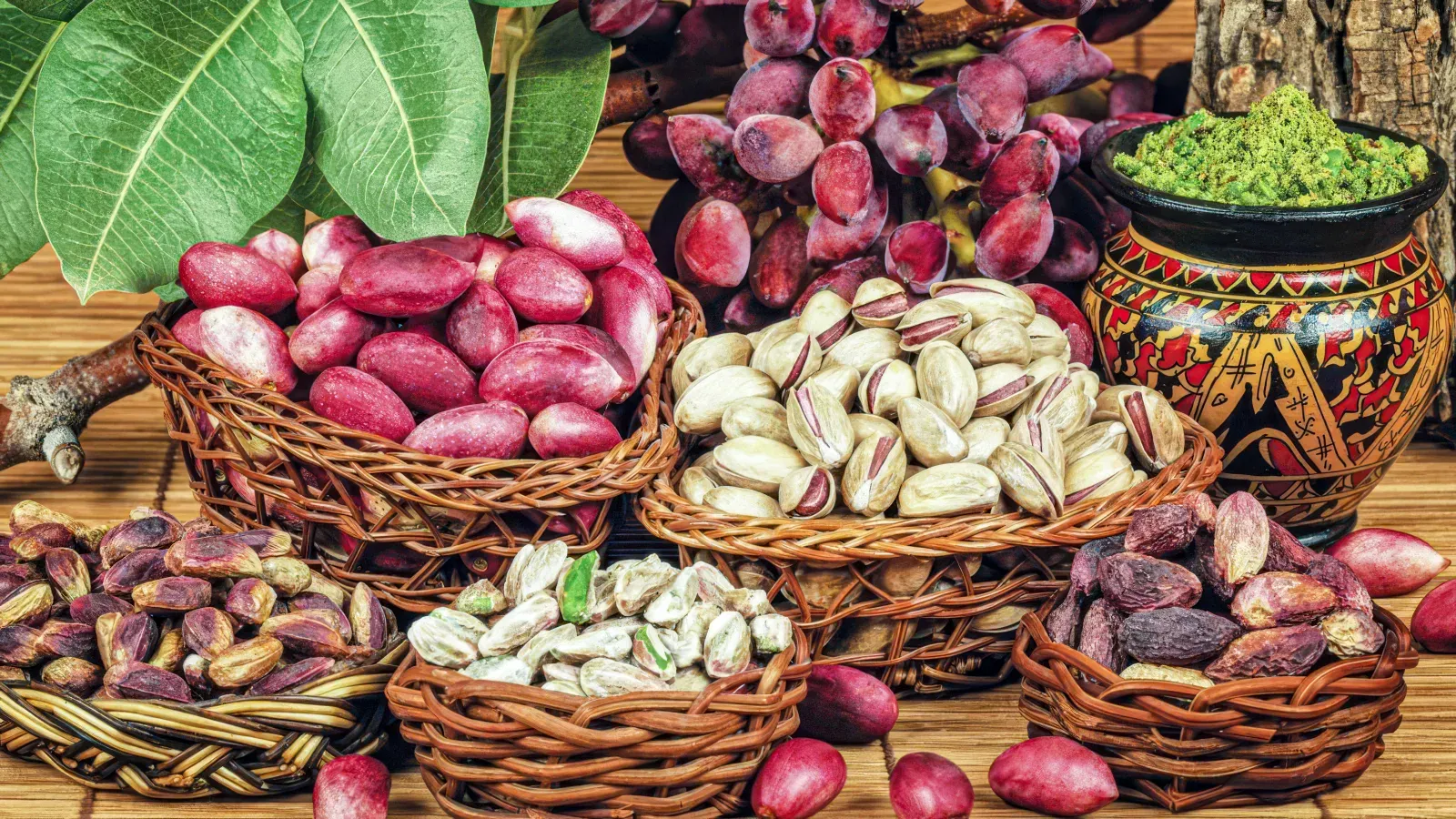
The Antep Pistachio (in Turkish, Antep Fıstığı; botanically Pistacia vera) is Gaziantep's signature product and the heart of the city's gastronomic identity. Grown on the region's arid hills, often grafted onto wild terebinth (menengiç) rootstock, it is a small, intensely green, aromatic pistachio — the indispensable element of Antep desserts. Registered by Türkiye's TÜRKPATENT as a Designation of Origin (No 27, 2000), the Antep pistachio carries one of the country's earliest geographical indications, securing the name for products genuinely of the region.
The Antep pistachio stands at the foundation of the flavours that make Gaziantep what it is. The green abundance between the layers of baklava, the chopped kernels folded into the buttered dough of katmer, the pure essence of pistachio paste — all rest on this small, dark-green kernel. The city's title of UNESCO City of Gastronomy (2015) owes much to the culture of using this single raw material, matured over centuries. The Antep pistachio is not merely a nut; it is a carrier of culture that brings a region's climate, soil and labour straight to the palate.
What Is Antep Pistachio?
The Antep pistachio is the edible seed (kernel) of a tree belonging to the species Pistacia vera. A member of the cashew family (Anacardiaceae), this species favours a hot, dry climate; long, hot summers and low humidity deepen the kernel's aroma and oil content. The stony, calcareous soils and continental climate of Gaziantep and its surroundings offer an exceptionally suitable setting for the tree. As the fruit ripens, its hard outer shell splits to reveal the green-and-purple-toned kernel within, wrapped in a thin skin. This kernel is the part prized in the kitchen.
Defining Characteristics
- Pistacia vera species: The Antep pistachio is the cultivated species Pistacia vera. With its edible, full kernel it is distinct from wild terebinth species; this is the species used in the kitchen.
- Intensely green colour: The most distinctive trait of the Antep pistachio is the vivid, dark-green colour of its kernel. This colour is linked to the conditions of ripening and harvest; in particular, the early-harvested "boz iç" (greyish-skinned) kernel gives the deep green sought in desserts such as baklava.
- Pronounced aroma and high oil content: The natural oil and aromatic compounds within give the Antep pistachio its distinctive, faintly resinous and full taste. This intense aroma makes the kernel a dominant flavour in desserts.
- Grafted onto terebinth rootstock: In the region, pistachio trees are traditionally propagated by grafting onto wild terebinth (menengiç) saplings. The drought-hardy terebinth root gives the grafted Antep pistachio a sturdy base and an adaptation to the region's harsh conditions.
Kinship with the Terebinth
The Antep pistachio is closely related to its wild cousin within the same plant genus (Pistacia), the terebinth (menengiç). The terebinth is a wild species with small, aromatic fruit that grows of its own accord on the region's hills; from it, Gaziantep's distinctive roasted beverage, menengiç coffee, is also made. In traditional pistachio cultivation the terebinth sapling serves as a "rootstock": onto this wild root — hardy against drought and poor soil — the full-kernelled Pistacia vera is grafted. In this way the Antep pistachio draws strength from the region's wild vegetation while yielding that intensely green, aromatic kernel sought in the kitchen. This kinship also shows how deeply the Antep pistachio is bound to the land of the region.
History and Geographic Origins of Antep Pistachio
The pistachio tree is a cultivated plant grown for thousands of years across the belt stretching between southeastern Anatolia and Central Asia, deeply rooted in the region. Gaziantep and its surroundings have long been one of the historical centres of pistachio cultivation at the western end of this belt. It is no accident that the city's name is spoken together with the pistachio in world cuisine: over generations, the people of the region developed the pruning, grafting and harvesting of the pistachio tree almost as a craft, and the pistachio settled at the centre of the region's agricultural and cultural life alike. Today the Antep pistachio is a product in which this long accumulation has taken concrete form, identified with the city itself.
The Bond Formed with the Land
The quality of the Antep pistachio depends largely on the geographic conditions of Gaziantep. The low-rainfall, stony and calcareous hills, demanding for many other plants, suit the pistachio tree; in these harsh conditions the tree puts down deep roots and gathers an intense aroma in its fruit. In the region, pistachio trees are often raised by grafting onto wild terebinth, a method that both lends the tree resilience and ties the region's wild vegetation to its cultivated land. The Antep pistachio's geographical-indication protection takes on its meaning at exactly this point: the quality of the product comes not from the seed alone but inseparably from the climate and soil of the place where it grows.
The Antep pistachio is registered by Türkiye's TÜRKPATENT as a Designation of Origin, No 27 — one of the country's earliest geographical indications (2000). Designation of Origin status indicates that the product's quality is wholly bound to its region, and that the name "Antep pistachio" may be used only for products genuinely of the region and meeting the registration conditions. A geographical-indication registration process for the Antep pistachio is also under way at the European Union level. (Products made from the Antep pistachio, such as pistachio paste and baklava, hold their own separate registrations.)
Antep Pistachio in Gaziantep Cuisine
The Antep pistachio appears in almost every corner of Gaziantep cuisine; but its true reign is in desserts and confections. With its intensely green colour and full aroma, the pistachio can determine both the look and the taste of a sweet on its own. In the region the pistachio is often not a "garnish" but the central flavour of a recipe; masters pay meticulous attention to the kernel's freshness, the depth of its colour and the way it is cut. For this reason the Antep pistachio is one of the rare raw materials able to represent the city's gastronomic identity all by itself.
Which Dishes Use It?
The most magnificent stage for the Antep pistachio is desserts. In baklava, the pistachio settles between thin layers of pastry as a full green stratum, providing the very flavour that balances the sweetness of the syrup. In katmer, together with clotted cream, chopped pistachio is scattered between sheets of paper-thin dough and toasted on a hot griddle to become an incomparable breakfast sweet. In pistachio paste, the pistachio is almost the sole lead: ground pistachio is kneaded in balance with sugar to become that deep-rooted, green-gold confection. Alongside these, the pistachio is used inside or atop many sweets, confections and certain kebabs as a hallmark of the region.
Why It Is So Prized
The value of the Antep pistachio comes both from its scarcity and from the fact that no other ingredient can take its place. The region's harsh climate and stony soil limit the tree's yield; in return, the aroma and colour gathered in the fruit are not easily obtained in other geographies. Whether a sweet counts as "Antep work" often depends on its pistachio being genuinely of the region, fresh and of the right colour. For this reason the Antep pistachio is not merely an ingredient but a measure of quality: it unites Gaziantep's culinary mastery, its patience and its bond with the land in a single small green kernel.
Frequently Asked Questions
What is Antep pistachio?
The Antep pistachio is the edible kernel (seed) of a tree of the species Pistacia vera. Grown on the arid, stony hills of Gaziantep and its surroundings, it is a small, intensely green and aromatic pistachio.
What makes Antep pistachio special, and why is it so green?
The region's climate and soil give the kernel an intense aroma and a vivid, dark-green colour. This deep green is most pronounced in the early-harvested "boz iç" kernel and is sought in desserts such as baklava.
Is Antep pistachio registered?
Yes. The Antep pistachio is registered by TÜRKPATENT as a Designation of Origin (No 27) and is one of Türkiye's earliest geographical indications (2000). A registration process at the European Union level is also under way.
Which dishes use Antep pistachio?
It is used above all in desserts — chiefly baklava, katmer and pistachio paste. Beyond these, it features inside or atop many sweets, confections and certain kebabs as a flavour distinctive to the region.