 Vegetarian
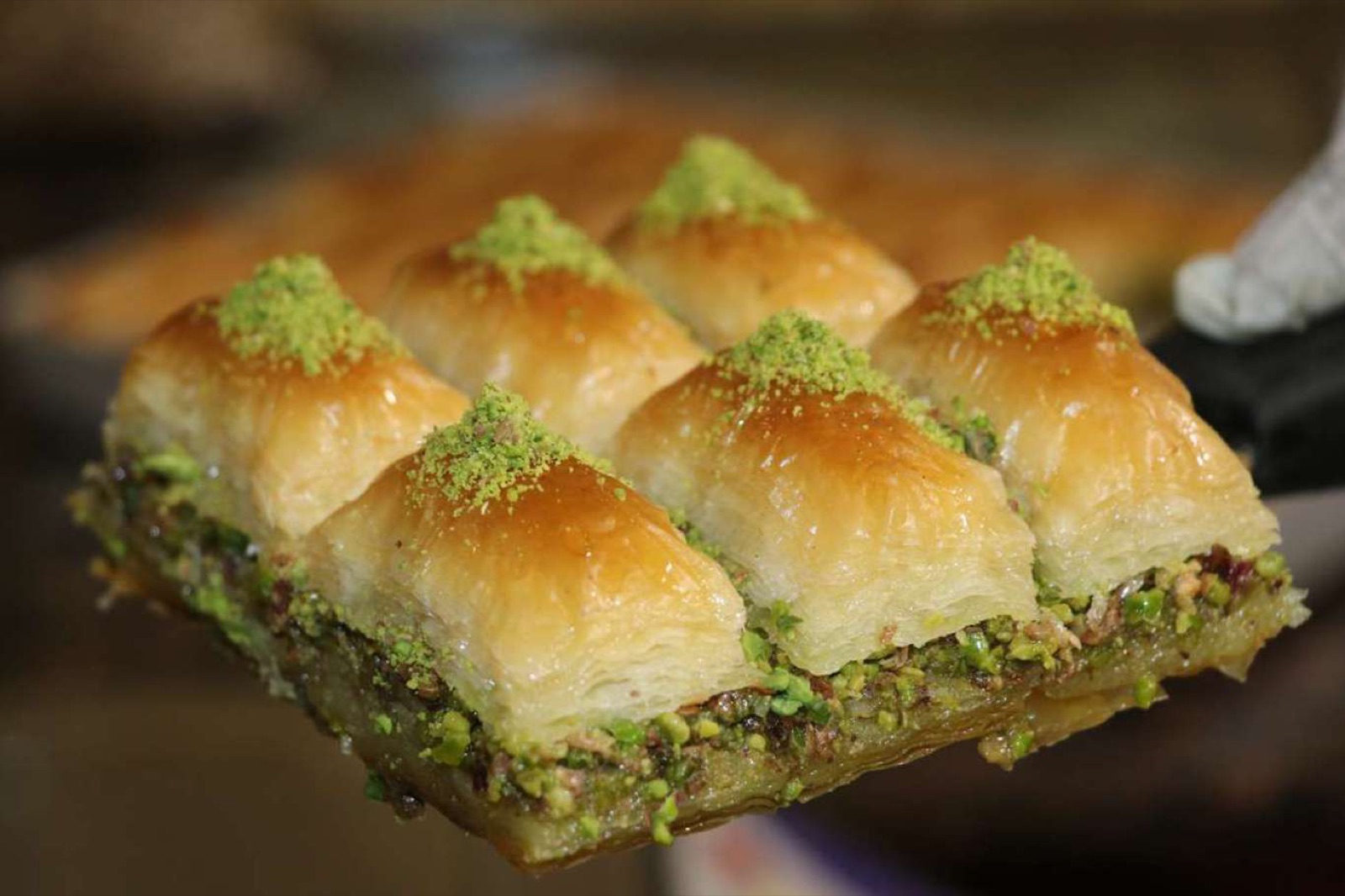
Antep baklava is where paper-thin hand-rolled phyllo, in up to forty layers, meets fresh boz iç Antep pistachio, sheep-and-goat clarified butter (sadeyağ) and pure sugar syrup — the signature dessert through which Gaziantep's cuisine reaches the world. Crisp phyllo, the oily, aromatic intensity of the pistachio and a measured syrup come together in a single bite. Having received a geographical indication from TÜRKPATENT in 2007 (mark of origin, Reg. No 95), Antep baklava also went down in history on 21 December 2013 as the first Turkish product registered as a geographical indication in the European Union.
The identity of this dessert is born from the flawless harmony of a few core elements: thin phyllo rolled to forty layers in a master's hands, emerald-green boz iç Antep pistachio, clarified butter from sheep and goat milk, and pure sugar syrup. Behind it lies intense handwork that must be completed the same day, before the delicate sheets dry out; this mastery is passed down through the master–apprentice bond in the craft of baklava, a tradition in its own right in the city.
This article covers Antep baklava's world of ingredients, its origin in world history, its signature identity in Gaziantep, its geographical-indication protections and its ceremonial place at the city's table.
What Is Antep Baklava and What Is Inside It?
Antep baklava is a pastry made by layering paper-thin sheets of phyllo, spreading plenty of fresh boz iç Antep pistachio between them, baking with clarified butter and finishing with sugar syrup. What sets it apart from ordinary baklava is the crispness of the paper-thin hand-made phyllo and the proportion of pistachio that goes generously inside; in genuine Antep baklava the filling, plain and unadulterated, is the pistachio itself. In the local cuisine it is prepared in several registered forms, from the classic pistachio slice to the "carrot slice," from the rolled dürme to dry baklava.
Core Ingredients
- Hand-rolled phyllo: The backbone of baklava is the thin phyllo, rolled to as many as forty layers from a dough of high-gluten hard-wheat flour. The sheets are opened as small balls, stacked, dusted between with pure wheat starch, and thinned together with long rolling pins often made of pear wood. This handwork gives a lightness and crispness machine phyllo cannot; it is the first distinguishing mark of genuine Antep baklava.
- Antep pistachio: The soul of the dessert is the Antep pistachio harvested early, usually in August, before it fully ripens — known locally as "boz iç," a bright emerald green. Itself geographically indicated and EU-registered, this pistachio gives baklava both its colour and its signature aroma; it is not ground to flour but broken so as to be felt in the bite.
- Clarified butter (sadeyağ): Giving baklava its characteristic scent, golden colour and crispness, this is butter — traditionally from sheep and goat milk — clarified of its water and solids. Cow-milk fat is avoided as it cannot give the sought colour and aroma; margarine and vegetable oil are never used.
- Sugar syrup: The syrup poured over the baked baklava is made of one hundred percent pure sugar, water and fresh lemon juice to prevent crystallisation. Glucose or starch-based syrups are not used. In the Antep style the syrup is kept measured; the aim is not to drown the pastry but to reach a balanced sweetness that brings forward the pistachio and the fine clarified butter.
Registered Forms
The main forms covered by the geographical-indication protection are: the classic pistachio slice, the carrot slice (triangular pieces on a round tray), the dürme rolled into a long log (pistachio roll), and dry baklava. Dry baklava is a separate type whose syrup is boiled longer to lower its moisture, so that it keeps fresh at room temperature for about 20 days; this durability makes it ideal as a gift and for travel.
What determines baklava's colour and scent is the early harvest of the pistachio. Picked before it fully ripens, "boz iç" pistachio is not dull, dark green but a vivid, bright emerald. A late-harvested pistachio darkens and loses its aroma, while boz iç pistachio gives baklava both that unique colour and its intense aroma.
Where Does Baklava Come From? History and Origin
Baklava is not the invention of a single country but the shared heritage of a layered-dough tradition thousands of years old. The idea of folding thin leaves of dough with nuts and a sweetener is traced by some sources as far back as the Mesopotamian and Assyrian world; Persian cuisine, the Arab lauzinaj and Central Asia's layered-bread traditions all fed into it. The paper-thin, many-layered, crisp phyllo form we know today, however, was largely refined in the Ottoman palace kitchens.
The roots of this layered thin-dough art run deep and rest largely on the Turkish culinary tradition: a 13th-century cookbook describes the sweet corresponding to today's sarığıburma with phyllo opened "like tutmaç" and under Turkish names such as "karnıyarık." Baklava is also a shared dessert known across the wider Middle Eastern geography, and by some accounts the idea travelled between regions before reaching Antep; yet the paper-thin, many-layered pistachio form that turned it into a worldwide signature matured in Gaziantep.
Gaziantep's bond with baklava cannot be separated from the fame of its pistachio: Antep pistachio has been prized for centuries, and in the supply records of the 16th-century Ottoman palace kitchen even the pistachio is noted among the goods coming "from Antep."
Baklava's prestige in Ottoman culture is best told by the "Baklava Procession" (Baklava Alayı): on the 15th of every Ramadan, trays of baklava prepared in the palace kitchen were the sultan's gift to the Janissary Corps (one tray for every ten soldiers), carried to the barracks in a procession the public watched. Dating to the reign of Suleiman the Magnificent, the ceremony ended in 1826 with the abolition of the Janissaries. Though this Istanbul palace tradition is not directly linked to Gaziantep baklava, it shows how baklava became, over the centuries, a dessert of "special days" and of sovereignty.
Gaziantep's Signature Baklava
What turned baklava into a world-famous delicacy was the unrivalled ingredients in Gaziantep's hands and its deep-rooted mastery. The city's local oral history and tradesmen's memory show that baklava has been produced by artisan families since the 1870s. When the region's boz iç pistachio, its sheep-and-goat clarified butter and a master–apprentice discipline handed down across generations came together, baklava became a signature bearing Gaziantep's name. For those who want to see this story and the fine points of baklava-making on the spot, the city even has a Baklava Museum.
Today, when you say dessert you think of baklava, and when you say baklava you think of Gaziantep; so much so that in the city centre nearly one shop in three is a baklava maker, and even the planes leaving the city carry baklava aboard. The local saying that "a gram of baklava is a gram of gold" is the shortest summary of this labour and prestige.
Geographical Indication and EU Registration
Antep baklava went through an official registration process to protect its local ingredients and method. On the application of the Gaziantep Chamber of Industry it received a geographical indication from TÜRKPATENT in 2007 (mark of origin, Reg. No 95); then, on 21 December 2013, it became the first Turkish product registered as a geographical indication in the European Union. This European Union registration was won through years of joint effort by the Gaziantep Chamber of Industry and the sector's baklava-producers' associations. These registrations ensure that the name "Antep baklava" may be used only for the product made within the borders of Gaziantep province, with the defined ingredients and method.
Antep baklava is the first Turkish product entered into the European Union's geographical-indication system, in 2013. Like French champagne or Italian parmesan, this status protects the product's name and authenticity at an international level; a dessert made outside Gaziantep cannot legally bear the name "Antep baklava."
Baklava Culture and Ritual in Gaziantep
In Gaziantep baklava is not an everyday dessert but part of special days, hospitality and collective memory. At religious feasts, weddings, engagements and important gatherings baklava crowns the table; "no feast without baklava" is a common saying in the city. Serving baklava to a guest is regarded as one of the highest expressions of Antep hospitality.
Even in folk humour baklava stands apart. In a well-known tale, Nasreddin Hoca, having declared himself full after eating everything at the iftar table, draws back to the table the moment a golden tray of baklava appears; for however full it may be, a table never fails to receive baklava, "the sultan of foods."
The Craft of the Stone Oven
Antep baklava is baked not over a direct fire, like kebab or künefe, but on heavy hand-beaten copper trays lined with pure tin, in the indirect dome heat of stone ovens fired with oak wood. The even spread of heat by the tinned copper and the soft warmth of the stone oven give the phyllo its distinctive, balanced crispness. Production begins early in the morning; the carefully kneaded dough is rolled to a gauze-like thinness, up to the forty layers of phyllo that masters consider ideal are arranged on a buttered tray, with boz iç pistachio scattered between them. Baked in a stone oven fired with oak wood at around 180°C for 40-45 minutes, the baklava is then cut and meets its hot syrup. In the Antep style, hot syrup is poured over the freshly baked, still-hot baklava; this is the secret to the phyllo staying crisp rather than turning doughy. A similar master–apprentice discipline lives on in katmer, the star of the breakfast table; this rich variety of crafts, technically distinct from one another, is among the key reasons Gaziantep was admitted to the UNESCO Creative Cities Network for gastronomy in 2015.
Its Place at the Table and the Gift Tradition
Kept in the right conditions at room temperature, genuine Antep baklava holds its crispness for 3 to 5 days. In Gaziantep table etiquette, the bitter mırra coffee is not served alongside baklava; mırra's dominant bitterness overshadows the pistachio's delicate aroma. By tradition, baklava is accompanied only by a glass of room-temperature water or plain milk. For travel, dry baklava, which keeps for about 20 days, is ideal; on gift platters it often sits alongside other Antep sweets such as pistachio paste and burma kadayıf.
Why You Should Try It
A single bite of Antep baklava brings all of Gaziantep's culinary heritage to the palate: the crispness of paper-thin phyllo, the oily, faintly sweet aroma of boz iç pistachio and the measured sweetness of the syrup arrive at once. This is not an over-sugared dessert but a work of mastery that foregrounds balance, handwork and ingredient quality. To taste baklava in the city where it was born, in the atmosphere of freshly rolled phyllo and the stone oven, is to share in a centuries-old heritage recognised by both the EU and UNESCO. For anyone who wishes to know Gaziantep, Antep baklava is the essential starting point.
Frequently Asked Questions
What is Antep baklava and where is it from?
It is a Gaziantep pastry of paper-thin hand-rolled phyllo layered with plenty of fresh boz iç Antep pistachio, baked with sheep-and-goat clarified butter (sadeyağ) and sweetened with pure sugar syrup.
What is inside Antep baklava?
Hand-rolled phyllo, fresh boz iç Antep pistachio, clarified butter from sheep and goat milk, and pure sugar syrup. The filling is the pistachio itself; no margarine or starch-based syrup is used.
Where does baklava come from?
Baklava is not the invention of a single country but the shared heritage of a layered-dough tradition thousands of years old; its roots are traced as far back as the Mesopotamian–Assyrian world and nourished by Persian and Central Asian traditions. The paper-thin, crisp phyllo form we know today was largely refined in the Ottoman palace kitchens, while the signature pistachio version emerged in Gaziantep.
Does Antep baklava have a geographical indication and EU registration?
Yes. It received a geographical indication from TÜRKPATENT in 2007 (mark of origin, Reg. No 95), and on 21 December 2013 it became the first Turkish product registered as a geographical indication in the European Union.
How can you tell genuine Antep baklava?
By the crispness of its paper-thin hand-rolled phyllo, the generous proportion of boz iç pistachio in the filling, and the aroma of sheep-and-goat clarified butter. Its syrup is restrained, never drowning the pastry but letting the pistachio lead.