 Vegetarian
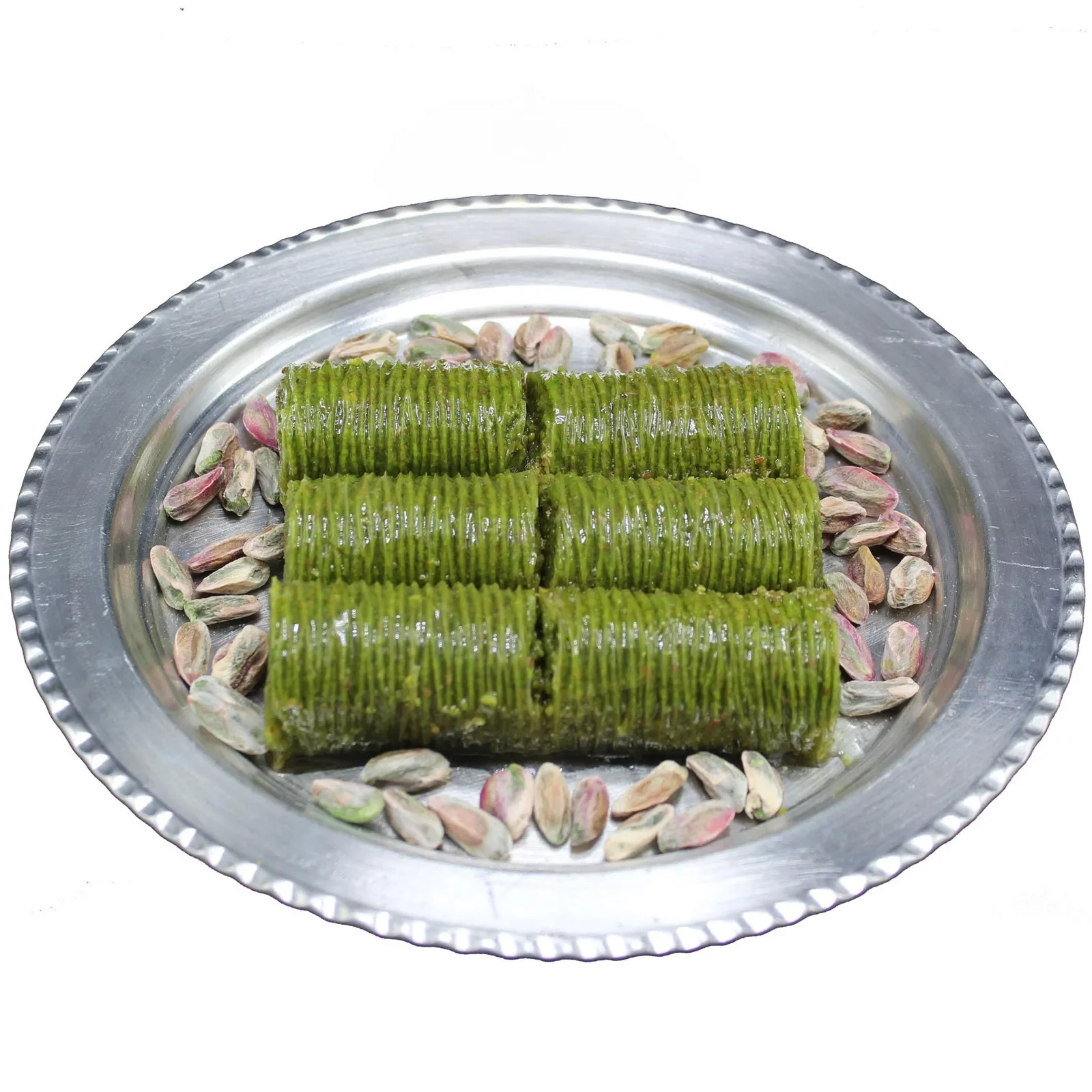
Pistachio roll — fıstıklı sarma, known in Antep as dolama — is a baklava variety in which a single sheet of paper-thin phyllo is rolled tightly around abundant boz-iç Antep pistachio laid along its full length, then cut into fine slices. What sets it apart within the baklava family is the highest green-pistachio ratio of all: in every slice there is more pistachio than dough. Brushed with clarified butter (sade yağ), baked, and sweetened with a light syrup, dolama — with the emerald-green pistachio filling revealed when it is sliced — is one of the clearest expressions of Gaziantep's devotion to the pistachio.
The identity of the dessert springs from the harmony of a few essentials: bright green boz-iç Antep pistachio harvested early; very thin phyllo opened until almost translucent; clarified butter; and a syrup kept lighter than in ordinary baklava. Behind these lies a technique that demands a master's hand: opening the phyllo without tearing it, laying the pistachio evenly along its length, and judging the measure that rolls the cylinder neither too tight nor too loose. Striking this balance makes dolama one of the most labour-intensive varieties of baklava.
This article explores the world of ingredients that shapes pistachio roll, its lengthwise rolling technique, its origins in Gaziantep cuisine, and its place at the table.
What Is Pistachio Roll and What Is in It?
Pistachio roll is a baklava variety made by scattering a generous amount of coarsely crushed boz-iç Antep pistachio along the full length of a single sheet of paper-thin phyllo, rolling the phyllo tightly into a long cylinder, baking it, and then cutting it into fine slices. The Turkish name "sarma" comes from wrapping the phyllo around the pistachio, while "dolama" is the local Antep name for the same motion. Two things set dolama apart from classic tray baklava: rather than the dough being layered sheet by sheet, it is wound around the pistachio in a single move, and less syrup is used than in baklava — so in dolama the syrup recedes and the pistachio dominates. When served, the cross-section of each slice reveals a dense green ring of pistachio at the centre of the coiled dough.
Core Components
- Boz-İç Antep Pistachio: The soul of the dessert is the bright emerald-green Antep pistachio, harvested early — usually in August, before it fully ripens — and known locally as "boz iç." Itself a geographically indicated product, it gives dolama both its colour and its signature aroma. In the roll the pistachio is not ground to a flour but coarsely crushed and used in abundance; this is why dolama has the highest pistachio ratio within the baklava family.
- Very Thin Phyllo: The backbone of the roll is the single sheet of phyllo kneaded from hard-wheat flour, water and salt and opened until almost translucent. The thinness of the phyllo is critical: too thick and it overwhelms the pistachio; too torn and the roll falls apart. This balance makes dolama a master's variety of baklava.
- Clarified Butter (Sade Yağ): The clarified butter brushed onto the phyllo and the tray lets the thin dough bake crisp and golden in the oven. As in traditional Gaziantep baklava-making, the pure butter in dolama gives the dough both flavour and crispness as it bakes.
- Syrup: Dolama's sweetness comes from the syrup drizzled over the cylinder as it leaves the oven. The syrup is used more sparingly than in classic baklava; the aim is not to mask the pistachio's aroma with sugar but to sweeten the dough lightly. For this reason dolama is sweetened more lightly, and with less syrup, than most baklava.
The Geography of Its Service
Pistachio roll is served in fine slices that, when cut, display the pistachio filling; slicing it neatly with a sharp knife makes the presentation more elegant. Because it is made from a single sheet of dough, it tends to release its clarified butter and syrup when heated; for this reason it is usually eaten at room temperature, without reheating. With its dense pistachio and striking cross-section, dolama is one of the favourite varieties on Gaziantep's trays for hospitality and gifting; it is served on the same tray alongside signature sweets such as baklava and şöbiyet. Its classic companion is a plain Turkish coffee or tea that does not compete with strong flavours.
The History and Cultural Origins of Pistachio Roll
The origins of pistachio roll rest both on Anatolia's deep-rooted tradition of thin pastry and baklava and on Gaziantep's abundance of pistachio. The idea of rolling phyllo around pistachio into a cylinder is a known technique in Turkish baklava-making; but the meeting of this technique with the city's bright green pistachio turned dolama into a flavour associated with Gaziantep.
Part of a Deep-Rooted Baklava Tradition
The art of opening thin phyllo and working pistachio-enriched pastry reaches back to Ottoman cuisine and to the centuries-old accumulation of Anatolia. In local accounts, pistachio roll is remembered as a baklava variety once prepared on special days such as religious holidays and weddings, and for honoured guests, because the pistachio was valuable. While these accounts show the dessert's deep-rooted place, a precise starting date is not documented; for this reason dolama is best regarded as part of the region's deep-rooted heritage of baklava-making.
How It Became Identified with Gaziantep
What identifies the roll with Gaziantep is the pistachio in the city's hands and its master-apprentice tradition. When the region's early-harvested boz-iç pistachio and the phyllo-opening technique handed down through generations come together, dolama becomes the variety within the city's baklava culture that uses pistachio most abundantly. Opening the phyllo without tearing it and rolling the cylinder evenly is a skill that apprentices acquire over years.
Registration Status
Many Gaziantep flavours — such as Antep pistachio, Antep baklava and Antep katmer — are registered as geographical indications with TÜRKPATENT. Pistachio roll (dolama), though closely tied to the recipe and technique of these flavours, does not today hold a separate geographical indication of its own; it is made and eaten rather as a variety of the Antep baklava family. This does not change the strong bond dolama has with Gaziantep's registered pistachio and baklava tradition.
The Pistachio Roll Tradition and Ritual in Gaziantep
In Gaziantep, pistachio roll is not merely a dessert; it is part of the city's pride in its pistachio and its baklava-making. With its abundant pistachio and striking cross-section, it has found a place of its own at the tables where sharing and hospitality come to the fore.
A Dessert of Hospitality and Special Days
Because dolama is a variety that uses pistachio so generously, in Gaziantep it is often regarded as a dessert for welcoming guests and for special days. The dense green filling revealed when it is sliced makes the tray on the table striking; for this reason it is favoured during holiday visits and in the hospitality offered to honoured guests. In a culture where the pistachio is held to be precious, offering dolama carries a meaning of abundance and generosity.
The Craft of the Tray and the Oven
Pistachio roll is defined as much by its baking technique as by the abundance of its pistachio. The rolled cylinders are traditionally arranged in a tin-lined (kalaylı) tray and baked in the high heat of a stone oven; the stone oven, heated with oak wood, crisps the outside of the dolama while leaving the inside soft. The handing down through generations of techniques such as opening the phyllo thin by hand and rolling the cylinder evenly is also part of the diversity of crafts that was one reason for Gaziantep's admission to the UNESCO Creative Cities Network in the field of gastronomy in 2015.
Its Place at the Table
In Gaziantep, dolama is the variety on the baklava tray that carries the pistachio in its most concentrated form; it is eaten at room temperature, without reheating, with a plain coffee. Those curious about the relationship Gaziantep cuisine builds with the pistachio can follow the nut's journey from dessert to kebab in signature dishes such as pistachio kebab and Gaziantep baklava.
Why You Should Try It
A single slice of pistachio roll carries Gaziantep's devotion to the pistachio to the palate in one bite: the crispness of the paper-thin phyllo and the oily, dense aroma of the boz-iç pistachio arrive at once. Because it carries less syrup than baklava, the pistachio's flavour is not masked by sugar but comes forward in its purest form. For anyone who wants to taste the baklava variety with the highest green-pistachio ratio, dolama shows its true identity best when it is eaten fresh from the tray in the city where it was born.
Frequently Asked Questions
What is pistachio roll (dolama)?
It is the baklava variety with the highest green-pistachio ratio: a single sheet of paper-thin phyllo rolled tightly around abundant boz-iç Antep pistachio along its length, then sliced. In Antep it is also known as "dolama."
What is in pistachio roll?
It uses boz-iç Antep pistachio, very thin phyllo, clarified butter and syrup. The syrup is kept more sparing than in classic baklava, so the pistachio comes forward in the taste.
Does pistachio roll have a geographical indication?
Dolama does not have a separate geographical indication of its own; it is made as a variety of the Antep baklava family. Antep pistachio and Antep baklava, however, are registered separately.
Why is pistachio roll eaten without reheating?
Because it is made from a single thin sheet of dough, it tends to release its clarified butter and syrup when heated. For this reason it is usually served at room temperature, in fine slices.
How does pistachio roll differ from baklava?
In baklava the dough is layered sheet by sheet in a tray, whereas in dolama the phyllo is wound around the pistachio in a roll. Dolama has more pistachio and less syrup.