 Vegetarian
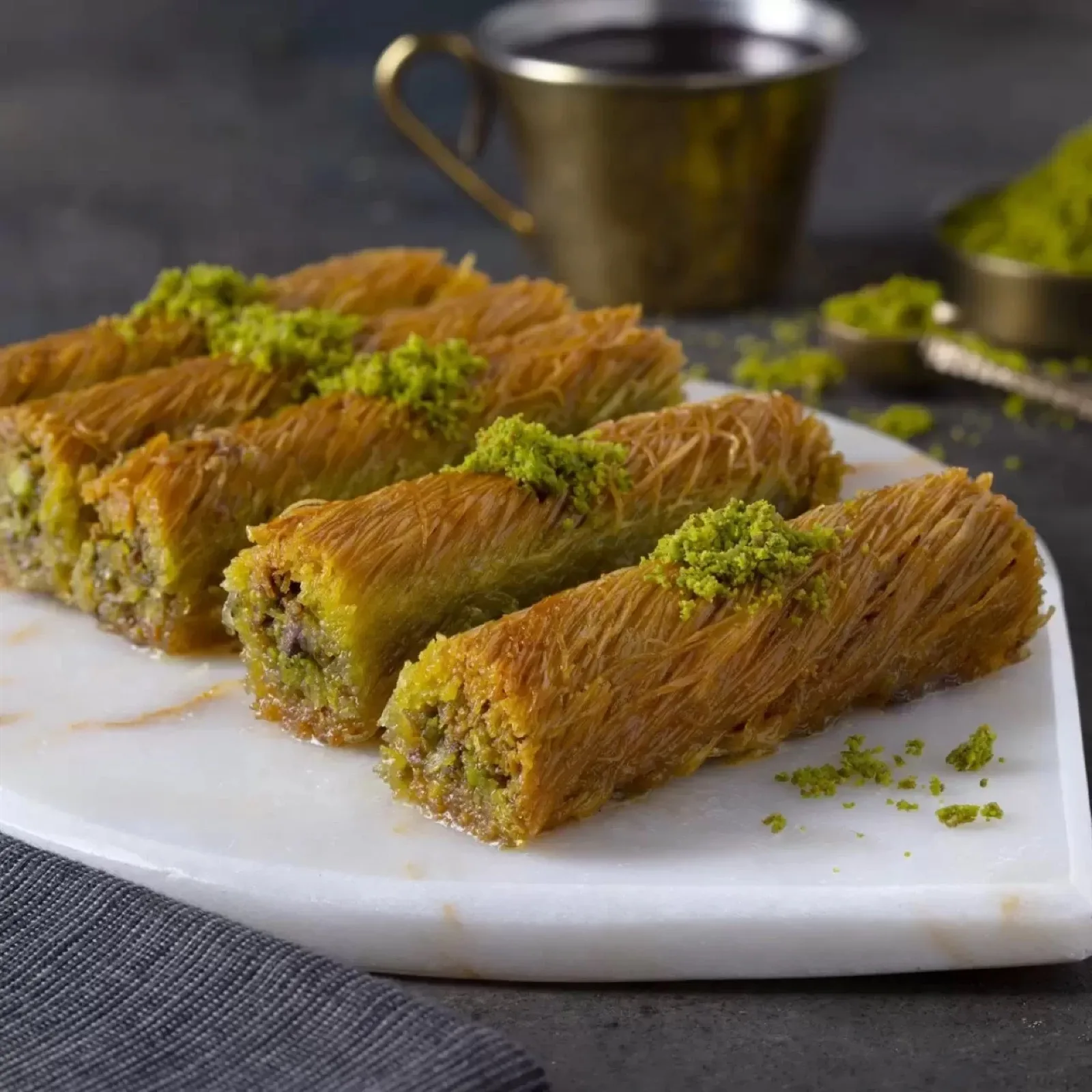
Burma kadayıf is a syrup-soaked pastry made by brushing fine, hair-like tel kadayıf (shredded pastry) with clarified butter, filling it with plenty of boz-iç Antep pistachio, rolling and twisting it around a rolling pin, baking it until crisp and then pouring cold syrup over it. It takes its name from this twisting motion: the kadayıf is wound around the pin and scrunched toward the center with both hands until it forms a coiled roll. The crisp strands, the oily pistachio inside and the absorbed syrup come together in a single bite. In Gaziantep, burma kadayıf meets the city's abundant pistachio and its deep-rooted kadayıf craft to take a firm place alongside the baklava family as a classic pistachio dessert.
The dessert's identity comes from the harmony of a few core elements: freshly drawn tel kadayıf, emerald-green boz-iç Antep pistachio, clarified butter and sugar syrup. Behind it lies a brisk hand skill at the workbench; oiling the kadayıf, filling it with pistachio, winding and twisting it around the pin and arranging it in the tray is done within minutes — the real mastery lies in coiling the roll with a balanced twist that is neither too tight nor too loose.
What Is Burma Kadayıf and What Is Inside It?
Burma kadayıf is a kadayıf dessert made by tossing hair-thin tel kadayıf with melted clarified butter, scattering coarsely crushed Antep pistachio over it, rolling it into a cylinder around a rolling pin or thin rod, scrunching it toward the center with both hands as it is wound — and, after baking, soaking it in syrup. The word "burma" (twisted) takes its name directly from this winding-and-scrunching technique; as it bakes it develops a coiled, twisted texture. Burma kadayıf is a syrup-based dessert: cold sugar syrup is poured over the roll while it is still hot from the oven, and the dessert is left to rest for a few hours so it draws in the syrup. Before serving it is usually finished with a scattering of finely chopped pistachio.
Core Components
- Tel Kadayıf: The backbone of the dessert is tel kadayıf, obtained by drizzling a fluid batter through a perforated vessel onto a hot griddle in hair-thin strands. Made from wheat flour and water, this fine thread gives burma kadayıf its crisp outer surface and coiled texture; fresh kadayıf, wound while still soft rather than left to dry, can be twisted without snapping.
- Antep Pistachio: The soul of the dessert is the bright emerald-green Antep pistachio, usually early-harvested and known locally as "boz iç." Itself a registered geographical indication, this pistachio gives burma kadayıf both its oily aroma and its color; it is coarsely crushed rather than ground to a powder and tucked among the strands, so a distinct sense of the grain remains in every slice.
- Clarified Butter: Before rolling, the tel kadayıf is rubbed through thoroughly with melted clarified butter. The butter lets the strands turn golden and crisp in the oven; traditional accounts favor clarified butter precisely because it gives an even browning without leaving dark spots on the strands.
- Sugar and Syrup: The sweetness of burma kadayıf comes from syrup. Water and sugar are boiled with a little lemon juice and cooled to make the syrup, which is poured cold over the hot-baked roll. The hot-pastry, cold-syrup contrast lets the strands keep their crispness while drawing the syrup inward.
The Geography of Serving
Burma kadayıf, like baklava, is a long-keeping and portable dessert; once it has drawn in its syrup it lasts for days in a cool, dry place, so it is also sent in boxes as a gift. In Gaziantep it is one of the constant products of baklava and kadayıf counters, sold sliced on a plate or as a whole roll. In cold weather, warming it gently before serving brings out its butter and aroma. The pistachio scattered on top and the plain tea served alongside are the classic companions that balance the rich, syrupy texture. Burma kadayıf is not unique to Gaziantep; it shares the same craft tradition as tel-kadayıf and pistachio desserts such as Antep baklava and the nightingale's nest.
The History and Cultural Origin of Burma Kadayıf
The origin of burma kadayıf is tied not to a single city but to the centuries-old shared culinary history of kadayıf. According to historical sources, shredded and flat kadayıf appeared early in Middle Eastern cuisine and spread through the Seljuk and Ottoman periods into Anatolia and to palace tables. Burma kadayıf is one branch of this wide kadayıf family, shaped by winding and twisting the strands around a rolling pin.
A Deep-Rooted Kadayıf Tradition
Kadayıf workmanship is part of the centuries-old accumulation of Anatolian and neighboring regional cuisines. Buttering tel kadayıf and filling it with pistachio to wind it into various shapes is a craft shared across many cities of the region; burma kadayıf is a widespread form within this common repertoire. Today this dessert is produced in different cities of Southeastern and Eastern Anatolia, and details of presentation and filling vary from place to place.
Its Meeting with Pistachio in Gaziantep
What brings burma kadayıf to the fore in Gaziantep cuisine is the ingredients at the city's disposal and its master-apprentice tradition. When the region's boz-iç pistachio, clarified butter and the fine-pastry-and-syrup mastery inherited from baklava-making come together, burma kadayıf becomes a natural part of the city's pistachio dessert repertoire. In Gaziantep the dessert is mostly produced beside the baklava counter, in the same language of pistachio and syrup.
Geographical Indication Status
Burma kadayıf is a kadayıf variety that does hold a geographical indication registration in the country; however, that registration was made under a specific city name, and there is no geographical indication registered under Gaziantep in the form of "Antep burma kadayıf." For this reason the burma kadayıf produced in Gaziantep is regarded, separately from the city's registered products, as a culinary heritage dessert prepared with local raw materials such as Antep pistachio and clarified butter. The dessert's tie to the city comes not from a registration certificate but from the city's deep-rooted relationship with the pistachio and kadayıf craft.
The Burma Kadayıf Tradition and Consumption Ritual in Gaziantep
In Gaziantep, burma kadayıf is a familiar part of both the everyday dessert table and special occasions. Within the city's dessert culture it holds its own place as a second pistachio option alongside baklava.
The Craft of the Counter and the Twisting Technique
Burma kadayıf is defined as much by its winding technique as by its filling. The master spreads the buttered tel kadayıf on the workbench, distributes coarse pistachio over it, and winds it around a rolling pin, scrunching it toward the center with both hands; the resulting coiled roll is slid off the pin and arranged in the tray — traditionally in a round tray as a spiral from the center outward, or side by side in a long tray. The rolls are baked, usually at medium-high heat, until golden; cold syrup is then poured over them and the dessert is left to rest for a few hours to draw in the syrup. Winding and twisting the strands around the pin, and preparing the syrup to the right consistency, are hand skills passed from generation to generation. This craft mastery, working with tel kadayıf, pistachio and syrup, is also part of the craft diversity that was among the grounds for Gaziantep's admission to the UNESCO Creative Cities Network in the field of gastronomy in 2015.
Its Place at the Table
In Gaziantep, burma kadayıf answers both the festive and invitation table and the everyday need for something sweet; though less showy than baklava, it is a well-loved option for its crisp strands and pronounced pistachio. Being long-keeping and portable also makes it a constant part of the gift boxes sent out of the city. Those curious about Gaziantep cuisine's relationship with the pistachio can follow the same ingredient's journey from dessert to kebab in signature flavors such as pistachio kebab and Antep katmer.
Why You Should Try It
A slice of burma kadayıf carries Gaziantep's bond with the pistachio to the palate in a syrupy form: the crispness of the strands twisted on the pin, the oily aroma of the coarse boz-iç pistachio and the sweetness of the absorbed sugar syrup all arrive at once. Prepared with a plainer workmanship than baklava, burma kadayıf gains a distinct texture from its crisp outer surface and full strands. Because it keeps well, it is one of the few desserts that can be carried home from Gaziantep; even so, it is at its most delicious freshly coiled and just after it has drawn in its syrup.
Frequently Asked Questions
What is burma kadayıf?
It is a syrup-soaked kadayıf dessert made by brushing tel kadayıf with clarified butter, winding it with plenty of Antep pistachio around a rolling pin, baking it and soaking it in cold syrup.
What is inside burma kadayıf?
It uses tel kadayıf, boz-iç Antep pistachio, clarified butter and sugar syrup. As with baklava, the sweetness comes from the syrup.
Why is it called "burma"?
It takes its name from its making technique: the buttered, pistachio-filled tel kadayıf is wound around a rolling pin and scrunched toward the center with both hands.
Does burma kadayıf have a geographical indication under Gaziantep?
No. Although burma kadayıf has a registered variety in the country, there is no registration under Gaziantep; in Gaziantep it is a culinary heritage dessert made with Antep pistachio.
How is burma kadayıf stored and served?
It keeps for days in a cool, dry place; it is served sliced with pistachio scattered on top. In cold weather, warming it gently brings out its aroma.