 Vegetarian
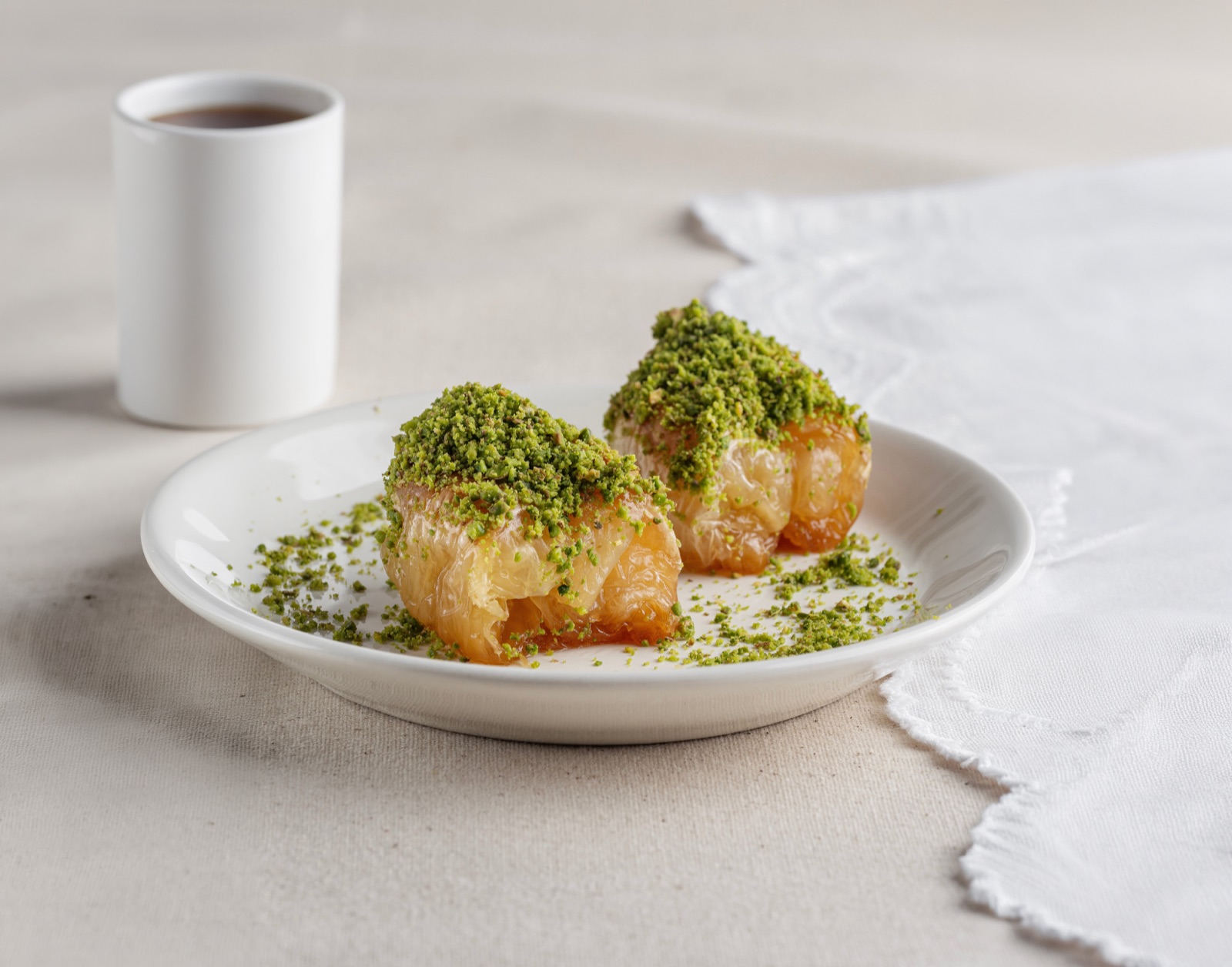
Nightingale's Nest (Bülbül Yuvası) is a syrup-soaked baklava-family dessert in which paper-thin, hand-rolled phyllo is gathered along a rolling pin into a ring, its central hollow packed with boz-iç Antep pistachio, baked with clarified butter and sweetened with sugar syrup. It takes its name from its round, hollow-centred shape, which recalls a bird's nest. Having received a geographical indication registration from TÜRKPATENT in 2022 (Geographical Indication / Mahreç İşareti, Reg. No: 1063), it is one of Gaziantep's finely worked baklava-family sweets, distinguished by its high ratio of pistachio.
Its identity comes from reshaping baklava's ingredients into a nest form: thin phyllo opened in the master's hands, emerald-green boz-iç Antep pistachio, sheep-and-goat clarified butter, and a measured sugar syrup. What sets it apart from the classic diamond-cut baklava is not its contents but its form — phyllo wound into a ring, with pistachio placed generously into the hollow at its centre.
This article explores the ingredients that shape the nightingale's nest, its origins in Gaziantep cuisine, its geographical indication protection, and its place at the city's table.
What Is Nightingale's Nest and What Is in It?
Nightingale's nest is an open-centred pastry dessert formed by gathering thin baklava phyllo around a rolling pin (or a slender rod) so that it bunches up, then joining the two ends into a ring. Unroasted ground or crushed Antep pistachio is placed into the hollow at its centre; after baking, the dessert is finished with sugar syrup. Whereas in the classic diamond-cut baklava the filling lies as a horizontal layer between stacked sheets, here the pistachio is gathered vertically and visibly in the hollow of the nest. What sets it apart from ordinary baklava is the fine handwork of this form and the high ratio of pistachio at its centre.
Core Components
- Hand-Rolled Phyllo: The backbone of the nest, as with baklava, is thinly opened phyllo. The dough is generally kneaded from wheat flour, egg, starch and water; opened into small sheets, it is then gathered and bunched along the rolling pin and brought into a ring. This winding gives the nest both its crispness and its distinctive ruffled texture once baked — fine handwork that machine phyllo cannot reproduce, and the first hallmark of a genuine nightingale's nest.
- Antep Pistachio: The soul of the dessert is the bright emerald-green Antep pistachio, harvested early — usually in August, before it fully ripens — and known locally as "boz iç." Itself protected under a geographical indication, it is packed generously into the centre of the nest; rather than ground to a flour, it is used ground or crushed so its presence is felt in the bite. Here pistachio is not merely a filling but the visible face and aromatic centre of the dessert.
- Clarified Butter (Sadeyağ): The clarified butter that gives the nest its distinctive aroma, golden colour and crispness is traditionally made by purifying sheep-and-goat-milk butter of its water and sediment. During baking it works between the layers to build the crispness. Margarine and vegetable oils are avoided, as they cannot give the aroma sought in traditional production.
- Sugar Syrup: The syrup is made with sugar (traditionally beet sugar), water and a little fresh lemon juice to prevent crystallisation. In the Antep manner it is kept measured: the aim is not to drown the dessert but to strike a balanced sweetness that lets the pistachio and the fine clarified butter come forward. Its balance over the hot nest also determines whether the phyllo stays crisp rather than turning soggy.
The Geography of Its Service
Today the nightingale's nest is a constant in Gaziantep's baklava shop windows, often served on the same tray as classic pistachio baklava diamonds and burma kadayıf, as part of mixed platters. Because the nest stands upright in tray and plate arrangements, its green pistachio centre on show, it is valued as a visual element of balance. Among the city's geographically indicated baklava varieties, it is one of the forms that brings the pistachio most visibly to the fore.
The History and Cultural Origins of Nightingale's Nest
The origins of the nightingale's nest rest on Gaziantep's deep-rooted tradition of baklava and thin pastry. The nightingale's nest is regarded as one of the forms that emerged as baklava diversified over time in the city's master workshops; it is a reinterpretation of the same world of ingredients and technique in search of a different shape.
A Member of the Baklava Family
The art of rolling thin phyllo and working layered pastry is part of the centuries-old accumulation of Anatolian cuisine. In Gaziantep, baklava was never confined to a single shape; it branched into many varieties, from the classic pistachio diamond to the carrot-slice cut, from the roll to şöbiyet. The nightingale's nest is one product of this diversification: masters wound the same phyllo-and-pistachio heritage into a nest, gathering the pistachio at the centre. Its name, drawn from the resemblance to a bird's nest, reflects the shape-based naming tradition in Turkish dessert culture (alongside "lady's lips," "lady's navel" and "lady's thigh").
How It Became a Baklava Variety of Gaziantep
What gave the nightingale's nest its present identity is the unique ingredients in Gaziantep's hands and its deep-rooted tradition of mastery. When the region's boz-iç pistachio, its fine sheep-and-goat clarified butter, and the master-apprentice discipline handed down through generations came together, the nest form earned a lasting place in the city's baklava repertoire and entered the ranks of registered products bearing the name of Gaziantep.
Geographical Indication Registration
The nightingale's nest went through an official registration process to protect its region-specific ingredients and method of production. Through an application by the Gaziantep Metropolitan Municipality, it received a geographical indication registration from TÜRKPATENT in 2022 (Geographical Indication / Mahreç İşareti, Reg. No: 1063). This registration guarantees that the name "Gaziantep nightingale's nest" may be used only for a product made within the boundaries of Gaziantep province, with the defined ingredients and method. Its production and use are monitored by an inspection mechanism coordinated by the Gaziantep Metropolitan Municipality.
Gaziantep Nightingale's Nest is registered by the Turkish Patent and Trademark Office (TÜRKPATENT) under Geographical Indication (Mahreç İşareti) status (Reg. No: 1063, registration date 6 April 2022). The registrant is the Gaziantep Metropolitan Municipality. This status legally confirms that the product's region-specific qualities are protected only when it is produced within the geography of Gaziantep; Gaziantep is among the leading provinces in Türkiye for the number of geographically indicated products.
The Tradition and Ritual of Nightingale's Nest in Gaziantep
In Gaziantep, the nightingale's nest lives on as an extension of baklava culture; it is not an everyday snack but a member of the dessert platter that belongs to special days and to hospitality. At the city's sweet table, it holds a place of its own alongside classic baklava.
A Member of the Mixed Baklava Platter
At religious holidays, weddings, engagements and important gatherings, what comes to the Gaziantep table is most often not a single baklava variety but a mixed baklava platter. On this platter the nightingale's nest appears alongside the classic pistachio diamond, şöbiyet and burma kadayıf; the nest form adds variety to the plate in both shape and pistachio intensity. Offered to a guest who comes to one's home together with assorted baklavas, the nightingale's nest is part of the city's understanding of hospitality and its display of generosity.
The Craft of the Stone Oven
Like classic baklava, the nightingale's nest is not cooked over direct coal or open fire; in traditional workshops it is arranged on heavy copper trays lined with pure tin and baked by the oven's indirect heat. The tin-lined copper distributes heat evenly to the base, and the oven's measured heat gives the gathered phyllo its crispness. Pouring syrup over the hot nest fresh from the oven, in the Antep manner, is the essential condition for the phyllo to stay crisp. This handwork demands a long master-apprentice training; the rich diversity of Gaziantep's dessert crafts is one of the key reasons the city was admitted to the UNESCO Creative Cities Network for gastronomy in 2015.
Its Place at the Table and the Gift Tradition
Containing no kaymak that could spoil, the nightingale's nest is comparatively more durable than the classic pistachio diamond and, stored properly, keeps its freshness for several days; for this reason it often appears on gift platters. In Gaziantep table etiquette, baklava-family desserts are generally accompanied not by mırra coffee — whose dominant bitterness would overshadow the pistachio's aroma — but by a glass of room-temperature water or plain tea. In the mixed baklava boxes carried out of the city, the nightingale's nest often appears alongside other Antep sweets such as baklava diamonds and pistachio paste.
Why You Should Try It
A single bite of nightingale's nest carries baklava's accumulation of ingredients to the palate in a different form: the crispness of the gathered phyllo, the oily and faintly sweet aroma of the boz-iç pistachio at its centre, and the measured sweetness of the syrup arrive at once. Because the pistachio concentrates in the centre, it is one of the baklava varieties in which the pistachio aroma is most pronounced. This is not an overly sugary dessert but a work of mastery built on form, handwork and ingredient quality. To taste it in the city where it was born, amid freshly rolled phyllo and the stone oven, is to share in a culinary heritage protected by a geographical indication — and for anyone who wishes to know Gaziantep's world of baklava, it is one of the varieties that must be tried.
Frequently Asked Questions
What is nightingale's nest?
A syrup-soaked baklava-family dessert in which thin, hand-rolled phyllo is gathered around a rolling pin into a ring, its centre packed with Antep pistachio, baked with clarified butter and finished with sugar syrup.
What is in nightingale's nest?
It has four core components: thin hand-rolled phyllo, boz-iç Antep pistachio packed into the centre, sheep-and-goat-milk clarified butter (sadeyağ), and a measured sugar syrup of sugar, water and a little lemon juice.
Is nightingale's nest a registered geographical indication?
Yes. Through an application by the Gaziantep Metropolitan Municipality, it received a geographical indication registration from TÜRKPATENT in 2022 under Mahreç İşareti status (Reg. No: 1063, 6 April 2022).
Why is nightingale's nest shaped like a nest?
Thin phyllo is gathered around a rolling pin, then its two ends are joined into a ring. Unlike diamond-cut baklava, the pistachio sits vertically and visibly in the hollow at the centre.
How and when is nightingale's nest eaten?
Not an everyday snack, it belongs to the mixed baklava platter served at holidays, weddings and important gatherings. It is accompanied by room-temperature water or plain tea.
How can you tell an authentic nightingale's nest?
By the ruffled phyllo gathered through fine handwork that machine phyllo cannot reproduce, and by the high ratio of bright emerald-green boz-iç Antep pistachio packed into the centre.