The Baklava Museum is a museum set inside the historic Millet Han that treats Gaziantep's world-famous dessert not merely as a flavour but as a craft and a piece of cultural heritage. Alongside displaying the traditional tools used in baklava-making, it makes the mastery behind the sweet visible through a live baklava-making demonstration carried out before the visitor's eyes. A non-profit, privately owned venue, it is one of the rare private initiatives in Gaziantep to hold museum status.
The museum is built on the logic of a workshop rather than a row of display cases: by watching the movements of a master rolling out the dough by hand behind the glass, the visitor grasps on the spot why baklava is considered a matter of patience and skill. This article covers the museum's founding and the Millet Han that hosts it, its exhibition logic, the sections worth seeing and a discovery guide for visitors. To consider it alongside the city's other specialist museums, the Museums of Gaziantep page is a good starting point.
Millet Han and the Founding of the Museum
The Millet Han that hosts the museum is one of the city's ancient trading inns, set within Gaziantep's historic bazaar fabric. Built of cut stone in the traditional courtyard-inn style, the structure served the city's commerce and crafts for centuries. The Baklava Museum occupies a space arranged on the inn's upper floor; in this way a historic commercial building has become a cultural stop where the city's best-known flavour is told.
The museum was founded on the initiative of Dr. Oğuzhan Saygılı, an eye doctor. Inspired by a chocolate museum he had seen in Germany, Saygılı wished to keep Gaziantep's baklava tradition alive in a similar venue; the space first opened to visitors as a baklava house in 2015, and after a thorough preparation process gained museum status in 2018. The museum was born as a personal contribution to the city's gastronomy tourism and is run as a non-profit institution.
The originality of the venue lies in placing exhibited objects side by side with living production: on one side, the tools belonging to baklava's past; on the other, the live demonstration of a craft still practised today. In this respect the museum, rather than freezing baklava as a museum object, presents it as a tradition that still breathes.
Exhibition and Curation
The museum frames the story of baklava in a sequence of sections. In the first sections, the traditional tools used in baklava-making are displayed: the long rolling pins (oklava) that allow the dough to be opened into thin sheets, baklava trays, the vessels used for syrup, and the other kitchen implements regarded as an extension of the master's hand. These objects make tangible the technical knowledge behind baklava's structure of hundreds of layers of paper-thin pastry.
At the heart of the exhibition is the live baklava-making. Behind a glass partition, an experienced baklava master prepares baklava step by step with sheets opened entirely by hand, without resorting to a dough machine; the visitor can sit at the wooden tables directly opposite and watch the whole process and put questions to the master. From rolling the dough to paper-thinness to scattering the pistachios and pouring on the syrup, this demonstration is the museum's most memorable experience.
Sections You Must See
The Tools Section
The museum's first sections are devoted to the "toolkit" of the art of baklava. Here are displayed the oklava, indispensable for opening thin sheets, baklava trays in various sizes and the vessels for pouring syrup. These plain-looking implements in fact tell why baklava is a master's work: the dough reaching paper-thinness, the right cut on the right tray and the syrup poured at the right consistency all depend on how these tools are handled in the master's hand.
The Live Demonstration
The museum's most popular section is the live demonstration in which the master makes baklava before the visitor's eyes. The dough being opened one sheet at a time with a pinch of starch and layered on top of one another, melted clarified butter brushed between the layers, Antep pistachios scattered over, and the syrup drizzled over the sweet as it comes out of the oven — all of this takes place before the visitor's eyes. This scene shows in the clearest way that baklava is not a factory product but a handicraft passed down from generation to generation.
The Tasting Experience
Another aspect that sets the museum apart from other exhibition spaces is that the visitor can taste the product of the mastery they have just seen. Tasting the baklava prepared before one's eyes turns the museum's "watch and understand" approach into a "watch, understand and taste" experience; thus the exhibition becomes a gastronomy stop that appeals to all five senses at once. To read the cultural story of baklava in more depth, the Baklava page is a complementary resource.
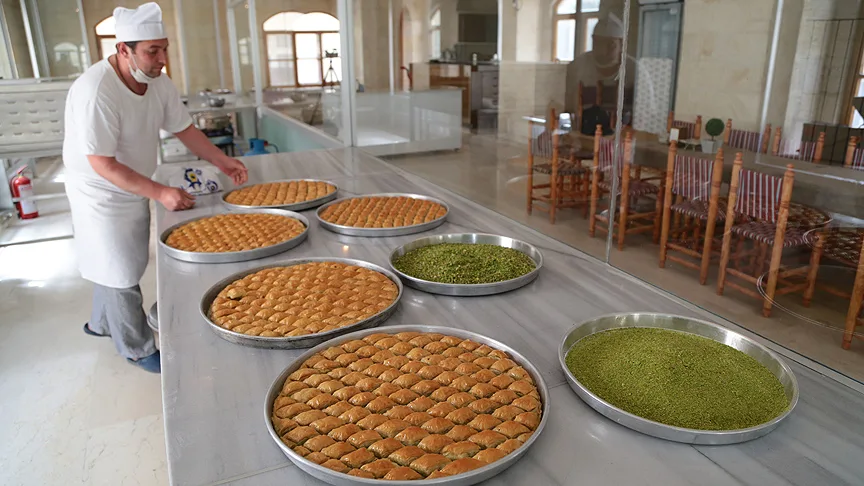
The most distinctive feature of the Baklava Museum is that it keeps the tradition it displays alive at the same time. Here baklava is not a display object but a craft still produced; the visitor sees up close the labour behind the sweet they have tasted at the city's countless baklava shops. You can explore the whole of Gaziantep's dessert culture on the Antep desserts page.
A Visitor's Discovery Guide
- Read the tools first: Before moving on to the live demonstration, examine the rolling pin, trays and syrup vessels; watching the movements of the master's hand once you know these tools makes the demonstration far more meaningful.
- Watch the demonstration with patience: The dough reaching paper-thinness takes time; watching this slow, painstaking process is the best lesson in why baklava is a matter of patience.
- Ask the master questions: The most valuable aspect of the museum is that you can put questions directly to the experienced master; you can learn the secrets of subtleties such as opening the dough, choosing the pistachios and the consistency of the syrup first-hand.
- Add it to an old-city route: Millet Han lies in the historic city centre; you can comfortably tour the museum in the same day as an old-city walk covering Gaziantep Castle and the surrounding bazaars.
- Complete it with a taste: Rounding off the mastery you have seen in the museum with a slice of fresh baklava at the city's baklava shops turns your visit into a gastronomy experience.
Summary and Cultural Value
The Baklava Museum is an original venue that, by turning Gaziantep's world-famous dessert into a museum subject, contributes to the city's gastronomic identity through a personal initiative. Set on the upper floor of the historic Millet Han, placing displayed tools side by side with a living baklava workshop carries the museum beyond an ordinary exhibition space. Here baklava is not a frozen past but a living tradition still opened in the master's hand, adorned with pistachios and completed with syrup. For a visitor wishing to know Gaziantep through its cuisine, the museum sums up why the city is regarded as a gastronomy capital in the story of a single sweet. Visited together with the Emine Göğüş Culinary Museum, which views the city's culinary culture as a whole, this narrative is completed.
Frequently Asked Questions
When was the Baklava Museum founded?
The venue opened to visitors as a baklava house in 2015 and, after a preparation process, gained museum status in 2018. It was founded on the initiative of Dr. Oğuzhan Saygılı, an eye doctor.
Which building does the museum occupy?
It occupies the upper floor of Millet Han, one of the ancient trading inns within Gaziantep's historic bazaar fabric. The cut-stone, courtyard-style traditional inn hosts the museum.
What is displayed in the museum?
The first sections display the traditional tools used in baklava-making (rolling pins, trays, syrup vessels); at its heart is the live demonstration in which an experienced master prepares baklava step by step, opening the dough by hand.
Can you watch baklava being made in the museum?
Yes. Behind a glass partition, the baklava master prepares baklava with sheets opened entirely by hand, without using a dough machine; visitors can watch the process from the wooden tables opposite and put questions to the master.
Why is the Baklava Museum a private museum?
Rather than a public institution, it is run as a non-profit private body founded through a personal initiative, and it is one of the rare private venues in Gaziantep to hold museum status.
Where is the museum?
It is located in the historic Millet Han, within the bazaar fabric near Gaziantep Castle, in the historic centre of Gaziantep.