 Vegetarian
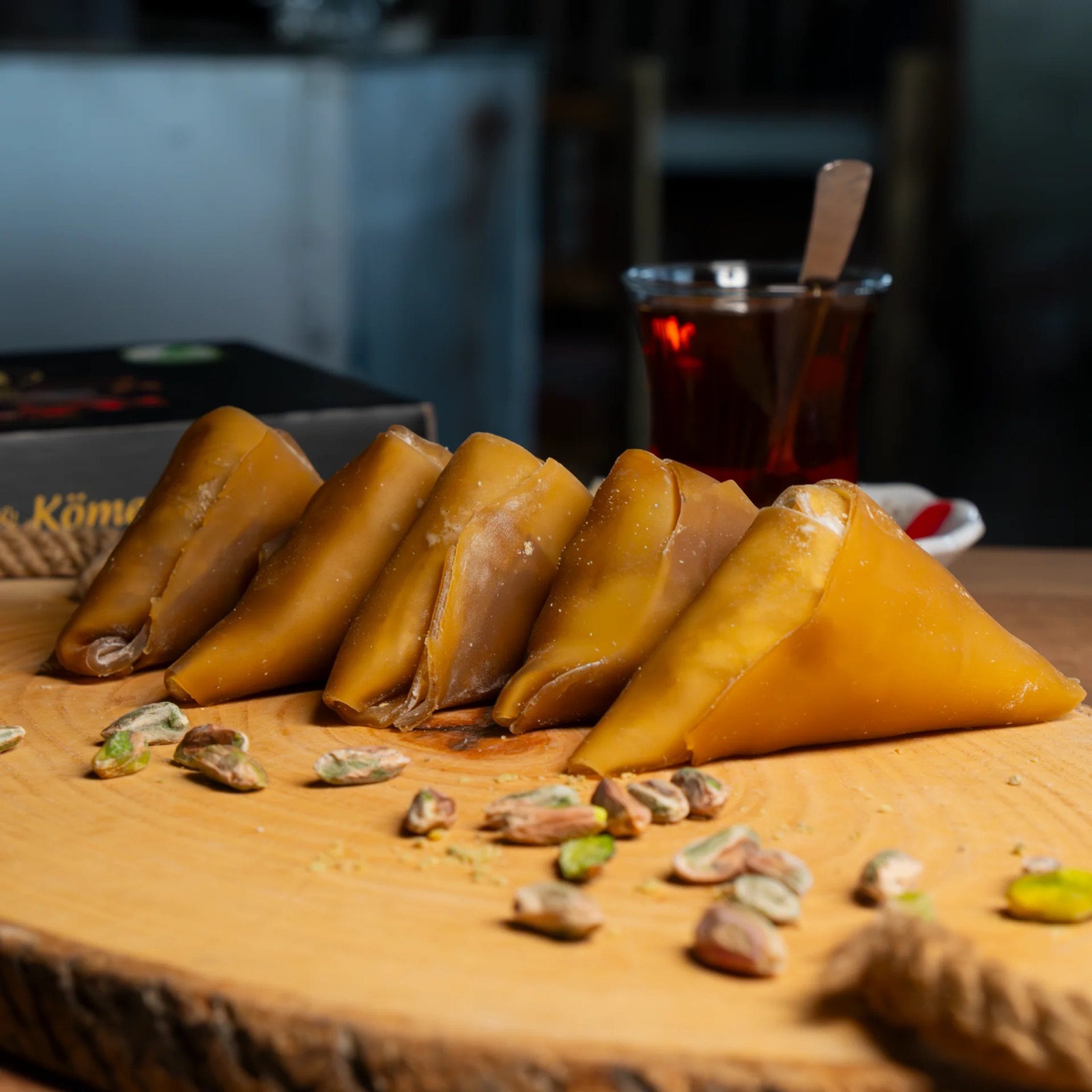
Muska, officially Antep Muskası, is a traditional Gaziantep confection made by placing a filling of boz-iç Antep pistachio, powdered sugar and starch onto a thin sheet of grape pestil (grape leather) and folding it into a triangle. The triangular "muska" form from which it takes its name is born of the pestil strip wrapped fold over fold; each piece brings together the oily aroma of the pistachio and the natural sweetness of the grape. The product received a geographical indication registration from TÜRKPATENT on 13 June 2018 (Geographical Indication / Mahreç İşareti, Reg. No: 360), through an application by the Gaziantep Chamber of Commerce.
The identity of muska springs from the harmony of a few essentials that leave no room for additives: early-harvested boz-iç Antep pistachio, pestil made from the grapes of Gaziantep's vineyards, powdered sugar, wheat starch, and a dab of honey that locks the fold. This is what sets the sweet apart from the syrup-soaked pastries of the baklava family; muska has neither phyllo nor syrup, and the filling is wrapped directly in dried-fruit leather.
This article explores the world of ingredients that shapes the identity of Antep muska, its origins in Gaziantep cuisine, its geographical indication protection, and its place at the city's table.
What Is Muska and What Is in It?
Muska is a pestil-based sweet made by placing a pistachio filling onto a strip of thinly spread, dried grape leather and folding the strip into a triangle from one end. According to the registration definition, about 5 grams of filling go onto each strip, and once the folding is complete the result is a single three-cornered bite weighing 32-35 grams. What sets it apart from ordinary pestil or walnut "sucuk" is the high pistachio ratio of its filling and the handwork of the fold: the pestil both wraps the pistachio and acts as a natural sweetener, so no sugar syrup needs to be added. In this respect muska is a branch of confectionery as deep-rooted in Gaziantep cuisine as baklava and pistachio paste, yet technically quite distinct from both.
Core Components
- Boz-İç Antep Pistachio: The soul of muska is the kernel pistachio, which makes up 55-72% by weight of its filling. The registration requires the pistachio to comply with the TS 1280 standard and to be picked during the early-harvest period known locally as "boz iç." Gathered before it fully ripens, this pistachio keeps its bright emerald-green colour and intense aroma; it gives muska both its colour and its signature taste. It is not thinned to a flour but ground so that its presence is felt in the filling.
- Grape Pestil: The outer layer of muska is pestil made only from grapes grown in Gaziantep province and its districts; the registration recommends the Dökülgen, Hönüsü and Antep İrikara varieties. The pestil is both the wrapper of the filling and the sweet's natural sugar source. For this reason no syrup is added to muska; the sweetness comes directly from the grape itself.
- Powdered Sugar: It makes up 14-18% by weight of the filling. By holding the ground pistachio together it gives the filling a sliceable consistency, and by combining with the pistachio's oil it keeps the filling from falling apart.
- Starch: The wheat starch that makes up 13-16% of the filling gives the filling its binding. Starch is also dusted over the dried pestil sheets, once peeled, to keep them from sticking to one another.
- Honey: Once the folding is complete, the open end of the triangle is sealed with a small piece of honey in a local technique called "dıbıklama." This keeps muska from unravelling and lets it hold its form while being carried.
The Geography of Service
The geographical indication protection of Antep muska binds both the raw material and the place of production to Gaziantep province. The registration requires the pistachio to be Antep pistachio harvested in the boz-iç period, the pestil to be made from the grapes of Gaziantep's vineyards, and all production to take place within the province. The use of flavourings or preservatives other than citric acid is prohibited. These rules guarantee that the name "Antep muska" is used only for a product made in the region with the defined method.
The History and Cultural Origins of Muska
The origins of muska lie at the point where two of Gaziantep's great agricultural riches meet: Antep pistachio and viticulture. The tradition of combining pistachio with dried-grape products is a deep-rooted method developed to keep produce for a long time when the harvest was abundant; muska is one of the most refined forms of this pestil culture.
Viticulture and the Pestil Tradition
Alongside pistachio, Gaziantep also holds a centuries-old accumulation of viticulture. In the region, grapes were turned into dried products such as pekmez (grape molasses), pestil, sucuk and bastık and stored for winter, in addition to being eaten fresh. Bringing grape must to a set consistency in copper cauldrons and spreading it in thin layers on cloth to dry is one of the basic preservation methods of the regional kitchen; muska emerged when pistachio was added to this pestil tradition, standing out for both its keeping quality and its nutritional value.
A Confectionery Craft That Meets the Pistachio
In the periods when Gaziantep's confectionery and baklava-making crafts developed, pistachio took a leading role in many regional dishes, from syrup-soaked desserts to pistachio kebab, as well as in dried-fruit products. Because the plain sweetness of grape pestil and the oily aroma of pistachio balance one another, muska, which brings the two together, spread among the region's artisans. Over time the triangular folding became the product's distinguishing signature, and the name "muska," drawn from this form, became settled on the sweet.
Geographical Indication Registration
Antep muska went through an official registration process to protect its region-specific ingredients and method of production. Through an application by the Gaziantep Chamber of Commerce dated 14 July 2017, the product received a geographical indication registration from TÜRKPATENT on 13 June 2018 (Geographical Indication / Mahreç İşareti, Reg. No: 360). The official name of the registration is recorded as "Antep Muskası (Gaziantep Muskası)," and the product is classified in the chocolate-and-confectionery group.
Antep muska is a geographically indicated Gaziantep product registered with TÜRKPATENT as a Geographical Indication (Mahreç İşareti, No: 360, 13.06.2018). This status legally guarantees that the name "Antep muska" is used only for a product made within Gaziantep province and its districts, with the defined ingredients and method. A European Union geographical indication application has also been filed for the product, and the application was published in the EU Official Journal in early 2026, entering the review process.
The Tradition and Ritual of Muska in Gaziantep
In Gaziantep cuisine, muska is generally a single-bite sweet eaten on its own and easy to carry. The absence of syrup and its dry pestil structure make it both durable and a practical offering and gift.
At the Guest Table and Beside Coffee
In Antep homes, muska appears on the offering tray alongside pistachio paste and other dry confections. Its intense pistachio aroma and measured sweetness make it a balanced companion beside plain Turkish coffee. A single muska, despite its small size, is a satisfying bite thanks to its high pistachio ratio, making it a practical option for a quick craving during the day.
The Pestil Craft and Handwork
The making of muska rests on a craft entirely different from the stone-oven discipline of baklava. Grape must or pekmez is brought to a set consistency in copper cauldrons, spread on cloth to a thickness of about 2-3 millimetres, and rested in drying rooms for around 20 hours. The dried pestil sheets are then peeled and divided into strips averaging 6.5 centimetres wide and 20-27 centimetres long. Pistachio filling is placed on each strip, the strip is folded by hand into a triangle, and the open end is sealed with a dab of honey by "dıbıklama." This handwork and the mastery of making the pestil are another branch of Gaziantep's dried-fruit tradition as deep-rooted as baklava, feeding the rich culinary diversity behind the city's admission to the UNESCO Creative Cities Network in the field of gastronomy in 2015.
Durability and the Gift Tradition
Thanks to its syrup-free, dry structure, muska keeps its freshness for a long time under the right conditions. The registration calls for the product to be stored in cool, well-ventilated places away from moisture, odour and sunlight. This durability makes muska an ideal Gaziantep gift to take out of the city; on gift platters it often appears alongside other Antep sweets such as pistachio paste and baklava. Its structure, resistant to being crushed during transport, also makes it well suited for the road.
Why You Should Try It
A single bite of muska brings together two of Gaziantep's fundamental flavours, pistachio and grape, in one layer: the oily, faintly sweet aroma of the boz-iç pistachio and the natural grape sweetness of the pestil arrive at once. This is not a dessert weighed down with syrup; it is an intense yet plain confection balanced by its own natural sugar. To try muska is to see that Gaziantep cuisine rests not on baklava and kebab alone, but on a deep-rooted tradition of pestil and dried fruit as well. For anyone who wishes to know the city's culinary diversity, this geographically registered triangular bite is a complement that must be tried alongside baklava.
Frequently Asked Questions
What is Antep Muskası?
A traditional Gaziantep confection made by placing a pistachio filling on a strip of grape pestil and folding it into a triangle. Unlike baklava, it has no phyllo or syrup.
What is in muska?
The outer layer is grape pestil made from Gaziantep grapes; the filling is 55-72% by weight boz-iç Antep pistachio, with powdered sugar and wheat starch. No syrup is added.
Is Antep Muskası a registered geographical indication?
Yes. Antep Muskası received a geographical indication registration from TÜRKPATENT on 13 June 2018 (Mahreç İşareti, Reg. No: 360), classified in the chocolate-and-confectionery group.
How is muska made and folded?
Dried grape pestil is cut into strips; about 5 grams of pistachio filling goes on each, and the strip is folded by hand into a triangle weighing 32-35 grams.
How can you tell an authentic Antep Muskası?
It has a filling of 55-72% by weight early-harvest boz-iç pistachio, an outer layer made only from Gaziantep grapes, and no syrup. All production must take place within Gaziantep province.