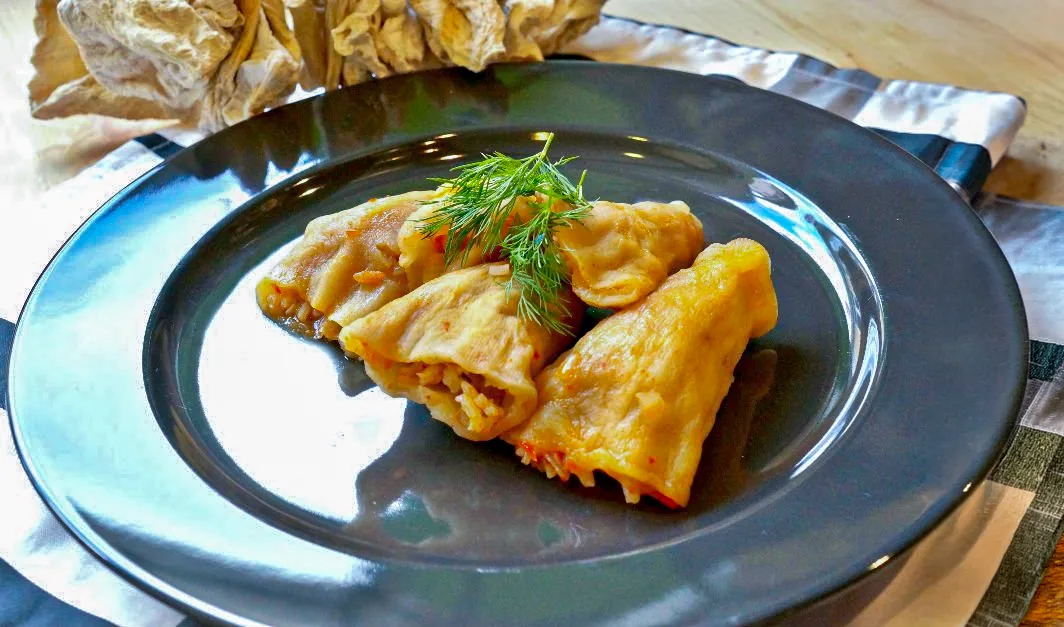
Haylan squash dolma (Haylan Kabağı Dolması) is a registered Antep dolma made by hollowing out "haylan squash" — a local Gaziantep gourd also called sıyırma kabağı ("scraping squash") because its thin, pale skin is scraped off with a knife — and stuffing it with a spiced meat-and-rice filling. The squash is used both fresh and dried-and-reconstituted; this is what lets the dish escape the short late-summer harvest and carry into the cold months, a deep-rooted flavour of the Gaziantep–Kilis area.
The identity of this dolma springs from two things: the local gourd that has long grown around Haylan, the locality it is named after, and the spiced meat-and-rice filling it holds. The fresh version comes to the table in August and September, the dried in autumn and winter; strings of dried gourd — hardened and bright white — are a familiar sight in Antep's spice and aktar (herbalist) shops. Haylan squash dolma is a place-bound Gaziantep dish, registered with a geographical indication by the Turkish Patent and Trademark Office.
What Is Haylan Squash Dolma and What Is in It?
Haylan squash dolma is a regional Gaziantep dolma made by hollowing out the centre of a haylan squash, filling it with a meat-and-rice mixture, and cooking it. Its character comes both from the distinctive nature of the gourd itself and from the spice balance of the fatty-meat-and-rice filling inside. In the registered recipe the filling is built on rice, fatty ground meat, onion and garlic, tomato and pepper paste, and spices; its sourness comes from sumac sour or lemon. In this respect it is a filling, place-bound meat dish.
Core Components
- Haylan Squash (Fresh or Dried): The body of the dolma is the hollowed-out haylan squash. The fresh gourd is hollowed directly; the dried gourd is first soaked in hot water until pliable, then stuffed.
- Fatty Ground Meat: The main element of the registered filling is fatty ground meat; the registry allows up to about a quarter of the meat to be tail fat (kuyruk yağı). This fat lends the dolma body and a local richness.
- Rice: The second core component of the filling is rice; as it cooks inside the gourd it absorbs the juices of the meat and the spices, giving the dolma its texture.
- Onion, Garlic and Paste: The filling is seasoned with tomato and pepper paste, onion and garlic, and spiced with black pepper and red pepper.
- Sourness (Sumac Sour or Lemon): Sumac sour (sumak ekşisi) or lemon is used to give the dolma a balanced sourness; salt completes the flavours.
What Haylan Squash Is — Fresh and Dried
Haylan squash is a local Gaziantep gourd of the bottle-gourd family (Lagenaria siceraria); because its thin, pale skin is scraped off with a knife, it is also known locally as sıyırma kabağı ("scraping squash"). It takes its name from Haylan, a locality near Antep, and is abundant in August and September. This gourd enters the dolma in two forms: the fresh one is hollowed and stuffed directly, while the dried one follows a different path. The dried gourd hardens and turns a bright white and is strung up for storage; before being stuffed, it is soaked in hot water for about half an hour to become pliable again. This drying tradition is the very method that carries haylan squash dolma into autumn and winter after the short summer season.
The History and Cultural Origins of Haylan Squash Dolma
Haylan squash dolma takes its name from Haylan, a locality near Antep, and from the local gourd that has grown there for many years. Abundant around Gaziantep and Kilis, this gourd has a short harvest window limited to August and September. It is precisely this short season that gave rise to a strong dried-gourd tradition in the area; drying and storing the gourd made haylan squash dolma a fixture of the cold months. The dolma has no documented inventor or precise starting date; it is an Antep tradition shaped naturally by the local gourd and the rhythm of the seasons.
Dried Gourd and the Winter Tradition
The short harvest season of haylan squash gave rise to the habit of drying the gourd to spread it across the year. Gourds gathered at the end of summer are hollowed and dried; hardened and bright white, they are strung up for storage and seen hanging in Antep's aktar shops. In the cold months these dried gourds are softened in hot water and stuffed, so haylan squash dolma comes to the table in autumn and winter too, when the fresh gourd is gone. In this respect, the dried-and-reconstituted form of haylan squash dolma is the most characteristic version of the dish.
Haylan squash dolma is registered with a geographical indication (Mahreç İşareti) by the Turkish Patent and Trademark Office (TÜRKPATENT). The official name of the registration is "Gaziantep Haylan Kabağı Dolması / Antep Haylan Kabağı Dolması," with number No 1065; the application dates to 04.07.2020 and registration to 07.04.2022, with the registrant being the Gaziantep Development Foundation (Gaziantep'i Geliştirme Vakfı). It is worth remembering that the same gourd has three separate registrations: the dolma (No 1065) is a dish; the dried raw gourd "Haylan Kabağı Kurusu" (No 1067) and the sweet preserve "Haylan Kabağı Reçeli" (No 1589) are separate registrations, distinct from the dolma.
The Haylan Squash Dolma Tradition and Ritual in Gaziantep
In Gaziantep, haylan squash dolma is a dish that changes form with the seasons. The dolma made from the fresh gourd comes to the table in August and September, when the squash is abundant. Once summer passes, the dried gourd takes over: in Antep's aktar shops and spice sellers, strings of haylan gourds — hardened and bright white — herald the cold months. These dried gourds are softened in hot water and stuffed, so the dolma is made throughout autumn and winter; locally, this dried-gourd form is the best-known version of the dish.
How It Is Served
Haylan squash dolma, like other Antep dolmas such as Nakışlı Dolma, Bean Stuffed Zucchini and Damat Dolması, comes to the table warm, as a main dish at home. Because it is a filling dish with its meat-and-rice filling, it is often served with yogurt; this is a common accompaniment that balances the dolma's full, spiced taste. With the fresh gourd, the squash's fresh flavour comes to the fore; made from the dried gourd, it is the deep flavour that drying lends. In both forms, the dolma reaches its strongest when served hot.
Why You Should Try It
A plate of haylan squash dolma carries Gaziantep's seasonal rhythm and a local gourd straight to the palate: whether made from the fresh gourd or from the dried gourd in winter, the spice balance of the fatty-meat-and-rice filling and the distinctive nature of the squash come together. After seeing the dried gourds hanging in Antep's aktar shops, knowing that they come back to life in hot water and arrive at the table as a dolma makes the dish all the more meaningful. The truest way to taste it is hot, in Gaziantep, with yogurt alongside.
Frequently Asked Questions
What is haylan squash?
Haylan squash is a local Gaziantep gourd of the bottle-gourd family (Lagenaria siceraria). Because its thin, pale skin is scraped off with a knife, it is also known locally as "sıyırma kabağı" ("scraping squash"); it takes its name from Haylan, a locality near Antep, and is abundant in August and September.
Is haylan squash dolma made from the fresh or the dried gourd?
It is made from both. The fresh gourd is hollowed and stuffed directly in August and September; the dried gourd is soaked in hot water for about half an hour until pliable, then stuffed, carrying the dolma into autumn and winter. The dried-gourd form is the most characteristic version of the dish.
Does haylan squash dolma have a geographical indication, and how does it differ from the jam and the dried gourd?
Yes; it is registered with a geographical indication (Mahreç İşareti) as No 1065 by the Turkish Patent and Trademark Office (07.04.2022). The same gourd has three separate registrations: the dolma (No 1065) is a dish, "Haylan Kabağı Kurusu" (No 1067) is the dried raw gourd, and "Haylan Kabağı Reçeli" (No 1589) is a sweet preserve.
When is haylan squash dolma eaten?
The dolma made from the fresh gourd is eaten in August and September; the one made from the dried-and-reconstituted gourd is eaten throughout autumn and winter. In the cold months, the dried-gourd form is the more characteristic one in the region.