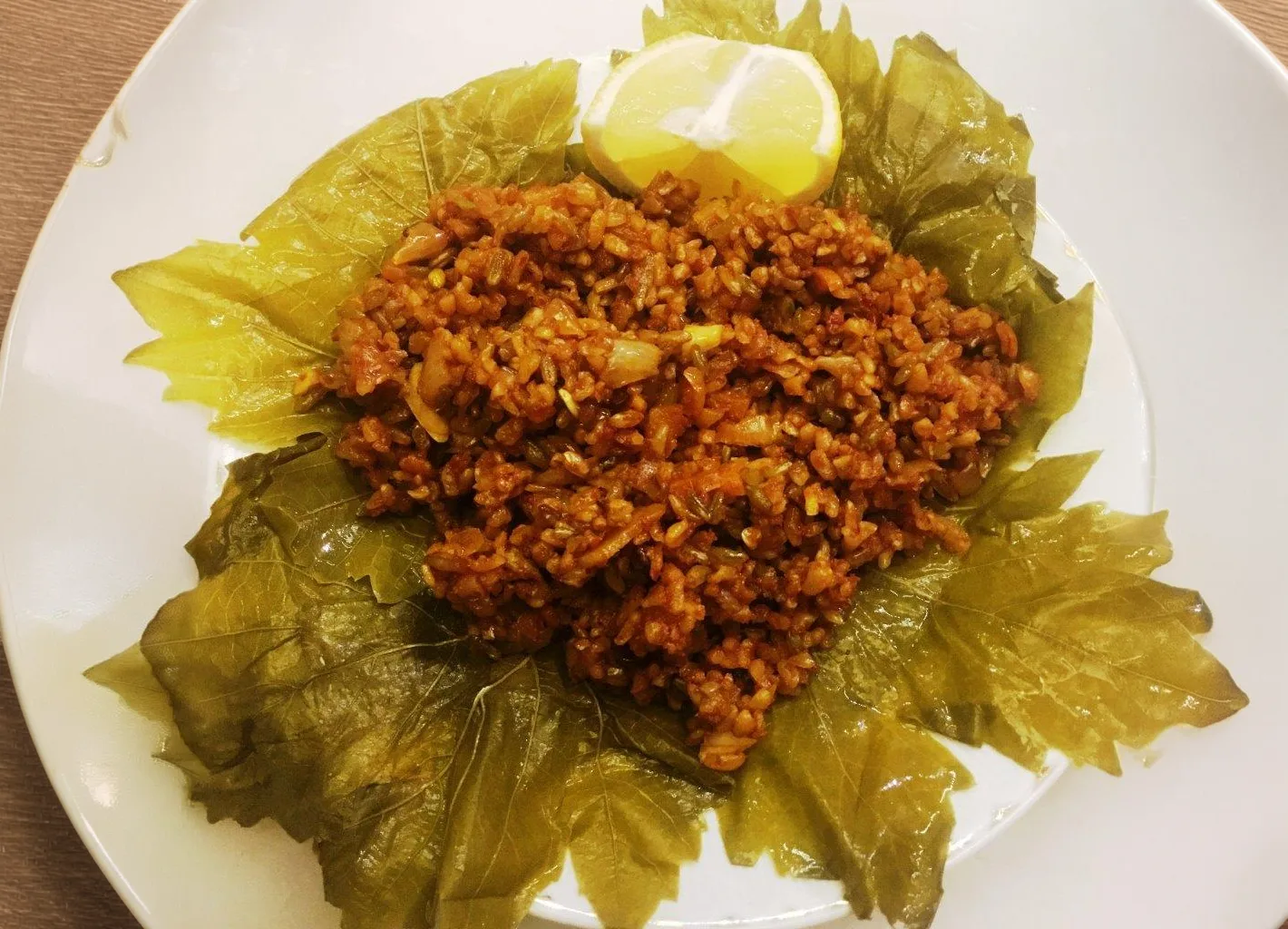
Tene Katması (Antep Tene Katması) is a traditional delicacy particular to Gaziantep: fine bulgur kneaded at length in a tray with tomato/pepper paste, fat and spices, with no water added at all. With its appearance and kneading technique it recalls çiğ köfte (raw kneaded bulgur), and locally it is sometimes also called "Antep kısırı." It is not a hot pot dish but a kneaded preparation in which the bulgur softens as it draws in the paste and fat; it is eaten cold with a spoon, or served wrapped in brined vine leaves. Its best-loved form is the version made with plenty of fatty minced meat.
The identity of tene katması springs from the harmony of a few essentials: fine bulgur that softens as it draws in paste and fat, the density of tomato and pepper paste, the aroma of onion and garlic, the heat of chilli flakes, and — when desired — plenty of fatty minced meat. Behind these lies a kneading technique that demands patience and a master's hand: opening the bulgur with no water, using only the moisture of the paste and fat. Tene katması was registered as a geographical indication under the name "Gaziantep Tene Katması / Antep Tene Katması" by TÜRKPATENT in 2021.
What Is Tene Katması and What Is in It?
Tene katması is a kneaded bulgur preparation in which fine bulgur, together with melted fat or fatty minced meat, tomato and pepper paste, chilli flakes and black pepper, is kneaded at length in a tray without water, the bulgur softening as it draws in the moisture of the paste; it is eaten cold. Although it is likened to çiğ köfte in everyday speech and is sometimes called "Antep kısırı," tene katması has its own identity through its distinctive texture, the fact that it is eaten cold, and its serving wrapped in vine leaves.
Core Components
- Fine Bulgur: The body of tene katması is built from fine bulgur (köftelik bulgur). Rather than water, the bulgur is opened and softened by the moisture of the paste and fat; for this reason the fineness and quality of the bulgur used directly determine the texture of the dish.
- Fatty Minced Meat (Preferred): Tene katması can be made with or without minced meat; the form best known locally and associated with the geographical indication is the version with meat. Plenty of fatty minced meat both enriches the flavour and makes the knead more filling.
- Fat (Clarified Butter / Olive Oil / Tail Fat): When minced meat is not used, or alongside it, clarified butter, olive oil or sheep's tail fat is added. This fat is the essential element that allows the bulgur to soften and lends the knead body.
- Tomato and Pepper Paste: The colour, density and dominant taste of tene katması come from tomato and pepper paste. The main moisture that opens the bulgur in place of water also comes largely from the paste.
- Onion and Garlic: Finely chopped or pounded onion and garlic add sharpness and aroma to the knead; they are part of the signature scent of tene katması.
- Chilli Flakes and Black Pepper: Red chilli flakes provide the heat, while black pepper gives the spiced depth. They are worked thoroughly into the bulgur during kneading.
- Salt, Lemon or Pomegranate Sour: Salt balances the dish; lemon juice or pomegranate sour (nar ekşisi), added during kneading or at serving, gives the knead freshness and a gentle tartness.
The Art of Kneading Without Water
The defining element of tene katması is not so much its ingredients as its kneading technique and the skill it demands. As with çiğ köfte, the bulgur here never meets water; it is kneaded at length using only the moisture of the paste and fat, so that each grain of bulgur softens by drawing in the paste and the fat. It is precisely this patient, hands-on kneading — rubbing and opening the bulgur until it comes to the right consistency — that shapes the character of the knead. Kneading without water, and opening the bulgur with paste, is the most defining feature that sets Antep tene katması apart from an ordinary bulgur salad.
The History and Cultural Origins of Tene Katması
Tene katması is described as a Gaziantep delicacy with a past extending far back and a production that requires master craftsmanship. In Antep, where wheat and bulgur are a cornerstone of the kitchen, it developed as one of the ways of turning bulgur into a dish enriched with meat and vegetables in the most economical manner; it became a skill cherished in homes, especially at crowded tables and when hosting guests.
The Origin of the Name
The name "tene katması" comes from the union of the word "tene" (tane), used locally mostly in the sense of a grain of wheat / a grain of bulgur, with the word "katma," meaning to bring together, to add in and knead. The name describes the making of the dish directly: the kneading of bulgur grains together with paste, fat and spices. In this sense the name positions tene katması not as a "katmer" or a work of rolled dough, but as a work of grains kneaded by hand.
A Skill of the Bulgur Kitchen
The history of tene katması, intertwined with bulgur, binds it to Gaziantep's deep-rooted wheat and bulgur culture. In a kitchen where bulgur is roasted and pounded, and where winter provisions are carefully set aside, tene katması became one of the hand skills that turn bulgur into a delicacy; it has been passed from generation to generation, most often in the hands of the women of the house.
Tene katması was entered into the TÜRKPATENT geographical indications register on 20.04.2021 under the name "Gaziantep Tene Katması / Antep Tene Katması" as a Geographical Indication (Mahreç İşareti) with No 731. The application was made on 07.07.2020 (file no C2020/176). The registration guarantees that this name may be used only for a product tied to Gaziantep and made with the defined ingredients and method.
With its fine bulgur kneaded without water and its consistency opened by hand, tene katması shares the same culinary logic as çiğ köfte; for this resemblance it is often described in everyday speech as something like "a kısır with minced meat and paste." Even so, being eaten cold and served wrapped in vine leaves earns it a place all its own at the Gaziantep table.
The Tene Katması Tradition and Ritual in Gaziantep
In Gaziantep, tene katması is not merely a food; it is part of the home table, of crowded gatherings and of sharing. Prepared in a single tray and set in the middle of the table, where everyone takes from the same dish with a spoon, it is counted among the dishes that bring the table together.
Served in a Brined Vine Leaf
Tene katması is eaten locally with a spoon; but its best-loved presentation is to be served placed inside a fresh vine leaf prepared by the brining method known locally as "soldurma." The slightly tart, softened texture of the leaf wraps the paste-rich, spiced density of the bulgur, lending each bite its own balance. In this form tene katması takes its place at the table both as a meze and as a filling main delicacy.
Tene Katması in Popular Custom
In popular custom, tene katması is remembered as a delicacy eaten over a long stretch and shared amid conversation, much like çiğ köfte; it is said to be prepared especially when guests arrive or at crowded family tables. Being served cold makes it an option easily eaten in the warmer seasons too; in this respect it is a dish that can be seen at the table all year round, unbound by season.
Its Place at the Table
Rich in paste and spices, tene katması is eaten cold with lemon or pomegranate sour drizzled over it; pickles are always wanted alongside, because the tartness of the pickle balances the rich, oily nature of the knead. Arriving in the middle of the table in its vine-leaf wrapping, tene katması is eaten by sharing. Those curious about the other deep-rooted bulgur-based flavours of Gaziantep cuisine can follow the city's grain and bulgur culture in dishes such as simit stew.
Why You Should Try It
A single plate of tene katması carries Gaziantep's bulgur culture and its tradition of sharing to the palate in one bite: bulgur softened by drawing in paste and fat, the richness of plenty of fatty minced meat, the sharpness of onion and garlic and the heat of chilli flakes are balanced by the freshness of lemon or pomegranate sour drizzled on at the last moment. And the truest way to taste it is to share it at an Antep table, wrapped in a vine leaf, with pickle on the side, in the city where it was born; for the city's other registered flavours you can also explore the Gaziantep gastronomy page.
Frequently Asked Questions
What is tene katması and where is it from?
It is a traditional bulgur delicacy particular to Gaziantep, made by kneading fine bulgur with paste, fat and spices without water, usually with minced meat, and eaten cold.
What is in tene katması?
Fine bulgur, fatty minced meat (preferred), clarified butter/olive oil/tail fat, tomato and pepper paste, onion, garlic, chilli flakes, black pepper, salt, and lemon or pomegranate sour.
Is tene katması a çiğ köfte or a kısır?
It shares the same culinary logic and is locally also called "Antep kısırı"; but with its cold serving, its dense paste-rich texture and its serving wrapped in vine leaves, it is a dish of its own.
Does tene katması have a geographical indication?
Yes. "Gaziantep Tene Katması / Antep Tene Katması" was registered as a Geographical Indication (Mahreç İşareti) with No 731 by TÜRKPATENT on 20.04.2021.
How is tene katması eaten?
Cold, with a spoon or wrapped in a brined vine leaf; with pickles on the side and lemon or pomegranate sour drizzled over it.