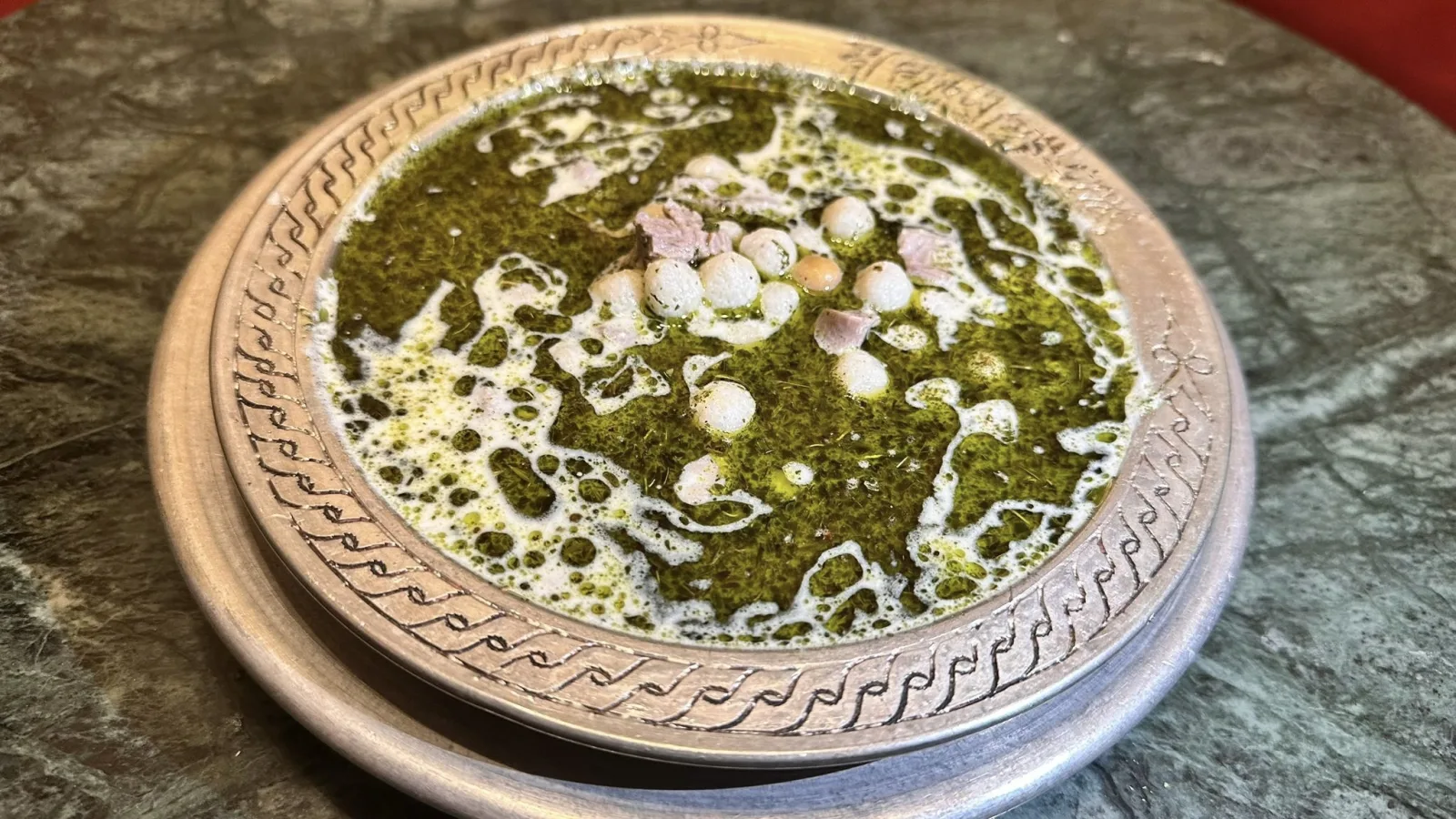
Yuvalama (also spelled yuvarlama) is a traditional Gaziantep dish that sits midway between a soup and a stew: tiny rice-and-meat köftes the size of a chickpea, cooked together with boiled meat and chickpeas in a yogurt-based broth and finished with mint-infused butter. It is the iconic Eid al-Fitr (Ramazan Bayramı) dish of Gaziantep, eaten on the first morning of the holiday after the bayram prayer. It takes its name from the act of rolling (yuvarlamak) the tiny köftes one by one by hand.
The identity of yuvalama springs from the harmony of three separate components: the chickpea-sized rice-and-meat köftes, a broth of boiled meat and chickpeas, and the tempered yogurt sauce that binds it all together. Because rolling hundreds of the tiny köftes is so labour-intensive, the dish is traditionally prepared communally — with family and neighbours, in the imece tradition — which makes it as much a ritual of sharing as a meal. Yuvalama is not merely a dish but a tradition of socialising.
What Is Yuvalama and What Is in It?
Yuvalama is a Gaziantep dish midway between a soup and a stew, born of the harmony of three components: tiny chickpea-sized rice-and-meat köftes, a broth enriched with bone-in meat and chickpeas, and the tempered yogurt sauce that binds them together. Mint-infused butter is drizzled over the top; it is eaten hot, as a hearty soupy main.
Core Components
- Rice: The body of the tiny köftes is rice — preferably pilaf rice or broken rice.
- Meat: The köftes use lean raw meat (lamb or mutton); the official geographical indication text specifies young male or virgin female lamb. For the broth, bone-in meat is preferred — incik (shank), often with a marrow bone.
- Chickpeas: Simmered in the broth, the chickpeas give the dish body and texture.
- Strained Yogurt and Egg: The tempered sauce that binds the dish is built on strained (kese/süzme) yogurt and egg, sometimes with a little flour.
- Butter and Dried Mint: Butter, clarified butter (sadeyağ) or olive oil is brought together with dried mint (kuru nane) and drizzled over the dish, adding its signature aroma. It is seasoned with black pepper and salt.
The signature of yuvalama is the rolling of the chickpea-sized köftes one by one by hand; traditionally the rice for the köftes was pounded in a stone mortar (dibek) rather than machine-ground. Because rolling hundreds of the tiny köftes is so labour-intensive, the work is shared communally, with family and neighbours, in the imece tradition.
The History and Cultural Origins of Yuvalama
Yuvalama is a centuries-old Gaziantep festival tradition. On the first day of Ramazan Bayramı it has long been customary for households across the city to cook yuvalama, often alongside dolma. It takes its name from the act of rolling (yuvarlamak) the tiny köftes one by one by hand.
A Deep-Rooted Festival Dish
Yuvalama is a deep-rooted part of Gaziantep's bayram culture: a once-a-year, labour- and cost-intensive dish historically prepared communally with neighbours and relatives. However, precise dated origins — a founding date, or a single source pinpointing its invention — are not known; it is best described as an old, traditional Antep festive dish rather than one with a fixed documented invention date. Its modern formal recognition is the 2017 TÜRKPATENT geographical-indication registration.
"Antep Yuvarlaması / Antep Yuvalaması" is registered with TÜRKPATENT under registration No. 208, dated 13 January 2017, as a Mahreç İşareti (geographical indication of origin), registered by Gaziantep Metropolitan Municipality (Gaziantep Büyükşehir Belediyesi). It is verified on the official portal ci.turkpatent.gov.tr. A few press reports give 20 January 2017 for the registration ceremony, but the official registration date on TÜRKPATENT is 13 January 2017.
Yuvalama is not merely a dish but a tradition of socialising. The chickpea-sized köftes are rolled one by one by hand; the laboriousness of rolling hundreds of them is why it became an imece (communal) dish. Mothers and daughters, neighbours and relatives gather, and while their hands roll, they chat and ask after each other's families, jobs and troubles.
Yuvalama is the rich, restorative dish that breaks the festive morning after a month of fasting and brings the extended family together around one table. The older method is still recalled today: the rice for the köftes was traditionally not machine-ground but pounded by hand in a stone mortar (dibek) together with the raw meat, onion, pepper and salt — a detail older Antep cooks cite as the marker of authentic, old-style yuvalama before meat grinders became common.
The Yuvalama Tradition and Ritual in Gaziantep
In Gaziantep, yuvalama is above all a festival dish: it is the traditional Eid al-Fitr (Ramazan Bayramı) breakfast eaten on the first day of the holiday, after the bayram prayer, with the whole family gathered. It holds a ceremonial place of its own at the city's holiday table.
The Crown of the Bayram Table
On the bayram morning, after the bayram prayer, virtually every Gaziantep household cooks yuvalama for the holiday; it is often called the "sultan" or "crown" (baş tacı) of the bayram table. It is frequently accompanied by şehriyeli (vermicelli) pilaf and a milk pudding (sütlaç).
Imece and a Once-a-Year Dish
Because it is laborious and relatively costly, yuvalama was historically made only once a year, for the bayram. Today it is also prepared to honour important guests and at significant gatherings, and is served year-round in some Gaziantep restaurants. It is eaten hot, as a hearty soupy main, often alongside şehriyeli (vermicelli) pilaf.
Why You Should Try It
A bowl of yuvalama carries Gaziantep's bayram culture onto a single plate: the softness of the chickpea-sized rice köftes, the velvety texture of the tempered yogurt sauce, and the bright aroma of the mint-infused butter all arrive at once. The truest way to taste it is in the city where it was born, in the sharing spirit of the bayram morning, eaten hot and freshly cooked.
Frequently Asked Questions
What is yuvalama and where is it from?
It is a Gaziantep dish midway between a soup and a stew, in which chickpea-sized rice-and-meat köftes are cooked with boiled meat and chickpeas and bound in a tempered yogurt sauce.
What is in yuvalama?
It uses tiny rice-and-meat köftes, boiled bone-in meat, chickpeas, strained yogurt, egg and mint-infused butter on top. It is seasoned with salt and black pepper.
When is yuvalama eaten?
Traditionally it is the breakfast eaten on the first day of Ramazan Bayramı (Eid al-Fitr), after the bayram prayer, with the whole family; it is often served with vermicelli pilaf.
Does yuvalama have a geographical indication?
Yes. "Antep Yuvarlaması / Antep Yuvalaması" is registered with TÜRKPATENT as a Mahreç İşareti under No. 208, dated 13 January 2017.
Are yuvalama and ekşili ufak köfte the same?
No. Both are Gaziantep dishes, but they differ: yuvalama is a dish of köftes — rice flour kneaded with meat and chickpeas, then rolled — cooked in a yogurt-based broth; ekşili ufak köfte is a separate dish of small bulgur köftes cooked in a broth soured with pomegranate molasses or lemon.