You will find the texture of Gaziantep not only in its stone caravanserais, copper workshops and spice-scented bazaars, but also along the edge of a pure-white cloth folded with care at the bottom of a bridal chest. Antep İşi is an openwork white embroidery born when threads are drawn out of the fabric one by one and woven anew on the tip of a needle, letting light pass through the cloth itself. Speaking the language of patience, manual skill and patterns whispered from one generation to the next, this needlework is today one of Gaziantep's most elegant signatures, carrying both a geographical indication and a place on UNESCO's Representative List of the Intangible Cultural Heritage of Humanity.
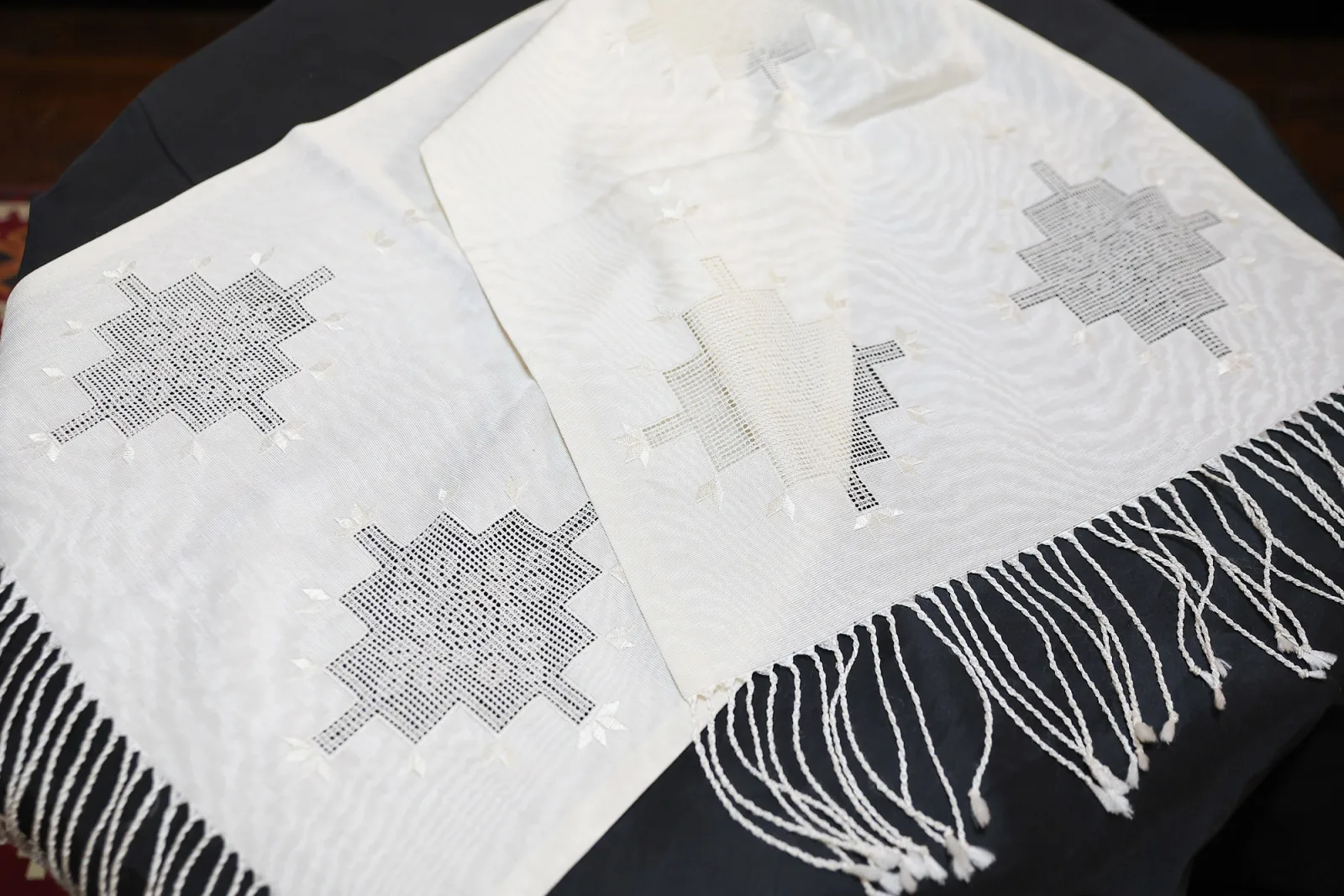
At first glance, Antep İşi looks like a plain white cloth; but as you lean closer, tiny windows, weavings as fine as a spider's web and light-catching voids appear within the fabric. This is not simple ornament but a technique that re-engineers the cloth itself. What sets it apart from many other embroideries is that the design is not added on top of the fabric but created from the fabric, by drawing out threads and emptying the weave.
Worked traditionally in white thread on white cloth, this needlework became, in the hands of Gaziantep's women, both a domestic art and an expression of identity. Birds, flowers, fruits and geometric patterns quietly tell the story of a woman's dreams, wishes and skill.
What is Antep İşi?
Antep İşi is a form of embroidery applied in the Gaziantep region on tightly woven linen, silk and cotton fabrics whose threads can be counted. According to the fabric and thread used, it falls into two main groups: "antique Antep İşi," worked in white, yellow and cream silk and cotton threads on white or cream cloth, and "colourful Antep İşi," embellished with various coloured threads through susma and openwork patterns.
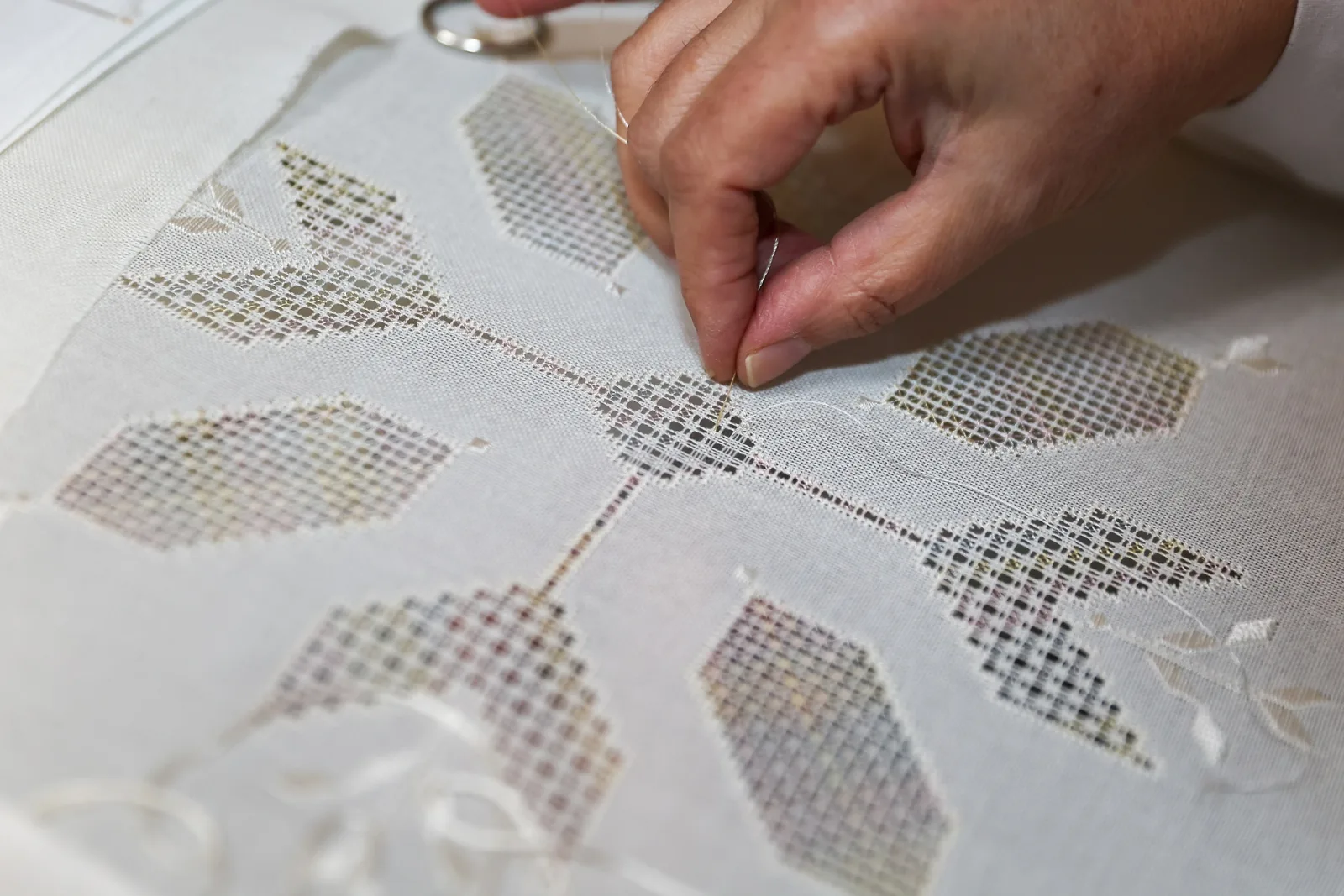
The most distinctive feature of this needlework is that threads are first drawn out of the fabric for the design, after which these emptied threads are wrapped and reshaped with needle and thread. Once completed it cannot be undone, and it relies entirely on handwork; even the smallest piece demands weeks, often months, of labour.
Thread-drawing, susma and ajur: the language of the technique
At the heart of Antep İşi lie three core operations. The first is tel çekme (thread drawing): with the help of a razor blade and embroidery scissors, the warp and weft threads of the cloth are emptied one by one according to the desired design. The second is susma, the counting and working of the fabric's own threads; the third is ajur (openwork), in which the drawn threads create voids in the cloth that are then wrapped and woven.
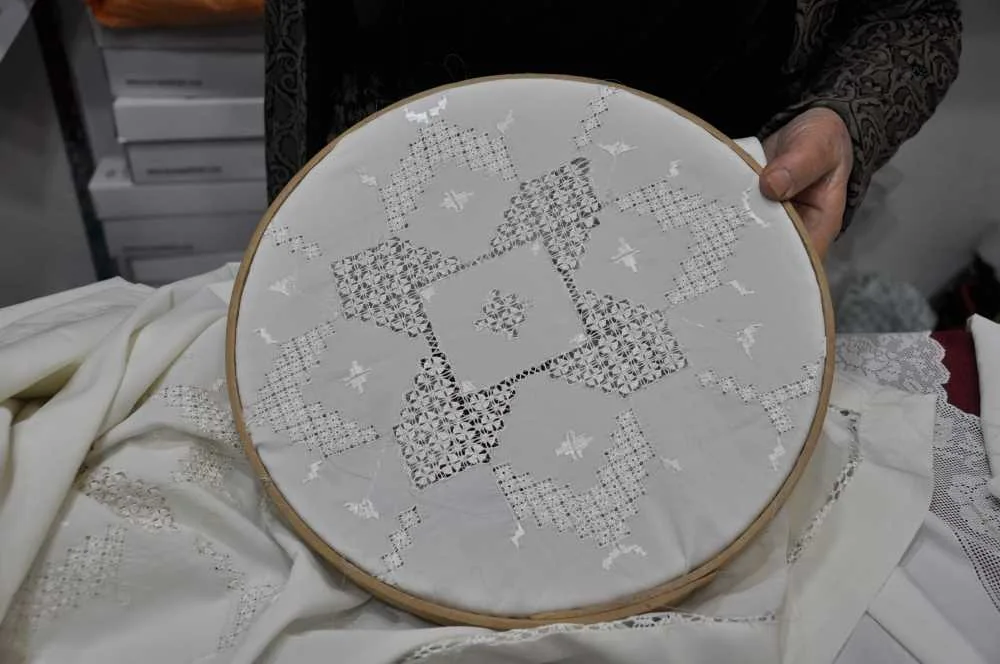
Ajur opens onto a rich world of its own. Artisans use different openwork families known by names such as mercimek (lentil), ciğerdeldi, cemelyan, örümcek (spider), kartopu (snowball), çitime, badem (almond) and muşabak. Two masters working with the same basic needle techniques can produce entirely different and original designs; for this reason many keep their own patterns like a secret.
Antep İşi is worked on fabric stretched over a wooden frame called a gergef or kasnak. The artisan keeps one hand above the cloth and the other below it, passing the needle up and down; much of the work's delicacy springs from this simultaneous, rhythmic movement of both hands.
From the trousseau chest to the city's identity
The spread of Antep İşi reaches back to the 19th century. Young women in Gaziantep adorned the trousseaus they prepared before marriage with this embroidery: cloths, bed sets, handkerchiefs, collars and cuffs, and room ensembles were all dressed in the elegant voids of white work. A trousseau chest was, at the same time, a showcase of a woman's hand and patience.
For this reason Antep İşi is not merely a textile technique but a cultural expression bound deeply to regional and urban identity. Knowledge and experience are passed mostly from grandmothers and mothers to younger generations orally, by demonstration and by working together; in this way the embroidery also becomes a carrier of family memory. The dowry room of the Hasan Süzer Marriage and Life Culture Museum explains step by step how a dowry chest was prepared, laid out for display, and what it contained.
Geographical indication and UNESCO heritage
Owing to its distinctly Gaziantep character, Antep İşi is a product that has received a geographical indication; the registration formally protects the embroidery's link to the Gaziantep region and its method of production. This registration safeguards both the product's name and its traditional manner of making.
In 2025 this protection moved to a far wider stage: Antep İşi embroidery was inscribed on UNESCO's Representative List of the Intangible Cultural Heritage of Humanity at the 20th session of the Intergovernmental Committee for the Safeguarding of the Intangible Cultural Heritage, held in New Delhi on 11 December 2025. With this inscription, the total number of Türkiye's elements across UNESCO's Intangible Cultural Heritage lists reached 32, and the country retained its position, after China, as the nation with the second-most elements.
Where does Antep İşi live today?
Today Antep İşi is both a handcraft sustained in homes and a cultural heritage kept alive with conscious effort. In courses opened through cooperation between the Provincial Directorate of Culture and Tourism and public education centres, fabric and thread are provided to those who wish to learn, and the fine points of the embroidery are taught; in this way the craft is passed to new generations and becomes a source of income for many women.
This embroidery is part of Gaziantep's rich handicraft tradition. For those who want to know the city's weaving and embroidery tradition more closely, kutnu fabric, the silk weave that comes to mind whenever the city's textiles are mentioned, is a good next stop; together with Antep İşi, it forms one of the two elegant faces of Gaziantep's textile culture.
Sources
- T.C. Dışişleri Bakanlığı (2025). No: 249, 11 Aralık 2025 — Antep İşi Nakışının UNESCO İnsanlığın Somut Olmayan Kültürel Mirası Temsili Listesi'ne Kaydedilmesi Hakkında.
- UNESCO Türkiye Millî Komisyonu. "Antep İşi Nakışı" UNESCO İnsanlığın Somut Olmayan Kültürel Mirası Temsili Listesi'ne Kaydedildi.
- T.C. Kültür ve Turizm Bakanlığı, Yaşayan Miras. Antep İşi Nakışı.
- Gaziantep Büyükşehir Belediyesi, Coğrafi İşaretli Ürünler. Antep İşi (Coğrafi İşaret Tescil No. 200).
Frequently Asked Questions
What is Antep İşi?
Antep İşi is an openwork white embroidery specific to the Gaziantep region, made by drawing threads out of tightly woven linen, silk and cotton fabrics. It is traditionally worked in white thread on white cloth, creating light-passing voids in the fabric.
How does Antep İşi differ from other embroidery?
The most basic difference is that the design is not added on top of the cloth but created by drawing threads out of the fabric itself. Threads are first drawn with a razor and scissors, then these emptied threads are wrapped with needle and thread and rewoven using the susma and ajur techniques.
What do susma and ajur mean?
Susma is the counting and working of the fabric's own threads. Ajur (openwork) is the creation of voids in the cloth with the drawn threads and the wrapping and weaving of those voids. There are many ajur varieties known by names such as lentil, spider, snowball and almond.
Does Antep İşi have a geographical indication?
Yes. Owing to its distinctly Gaziantep character, Antep İşi holds a geographical indication; this registration protects the embroidery's link to the region, its name and its traditional production method.
Is Antep İşi on the UNESCO list?
Yes. Antep İşi embroidery was inscribed on UNESCO's Representative List of the Intangible Cultural Heritage of Humanity on 11 December 2025, at the 20th session of the UNESCO Intergovernmental Committee in New Delhi. With this inscription, the total number of Türkiye's elements across UNESCO's Intangible Cultural Heritage lists reached 32.
What was Antep İşi used for?
It was traditionally an important part of trousseaus: cloths, bed sets, handkerchiefs, collars and cuffs, and room ensembles were adorned with this embroidery. A trousseau chest was also a measure of the skill and patience of the woman who made it.