Where the shimmer of a shell drawn from the depths of the sea meets the warmth of dark walnut, Gaziantep mother-of-pearl inlay is born. Known locally as sedefkârlık or sedef kakmacılığı, this craft sinks the lustre of mother-of-pearl into wood and then enriches it with the fine lines of silver and brass wire, turning a plain surface into geometric stars, gardens of blossom and endless interlacing knots. Demanding patience, a sharp eye and the transformation of an ordinary steel pen into a tool of art, it stands today among Gaziantep's handicrafts protected by a geographical indication.
Mother-of-pearl is the hard, paper-thin layer that forms on the inner surface of certain sea shells, refracting light into rainbow hues. The sedefkâr cleans away the dull outer skin of the shell to reveal the lustrous nacre, then cuts it into tiny pieces and beds them into recesses opened in the wood. The finished work is both smooth to the touch and shifting in depth: depending on the angle of light, the same surface turns pearl-white one moment and a glow of pink and green the next.
In Gaziantep this is not merely a decorative technique but a tradition of patience and discipline passed from one generation to the next. A single box or console is often the product of weeks of labour, of thousands of minuscule cuts, each set perfectly in its place.
What Is Mother-of-Pearl Inlay?
Mother-of-pearl inlay is the art of decorating a wooden surface by setting lustrous materials such as nacre or ivory into it. In Gaziantep the craft is worked mostly on walnut; at times hornbeam and, rarely, rosewood are used. The dark, warm tone of walnut forms a striking contrast with the white shimmer of the shell, making the pattern stand out.
The inlaid shell is usually joined by the art of telkâri (fine wirework): silver or brass wires are laid into thin channels to draw the outlines and inner lines of the design. The broad luminous fields of nacre thus meet the bright, crisp lines of metal in a single composition. Typical pieces include trousseau and jewellery chests, boxes, consoles, mirrors, chess and backgammon sets, and decorative furniture such as turban stands and telephone tables.
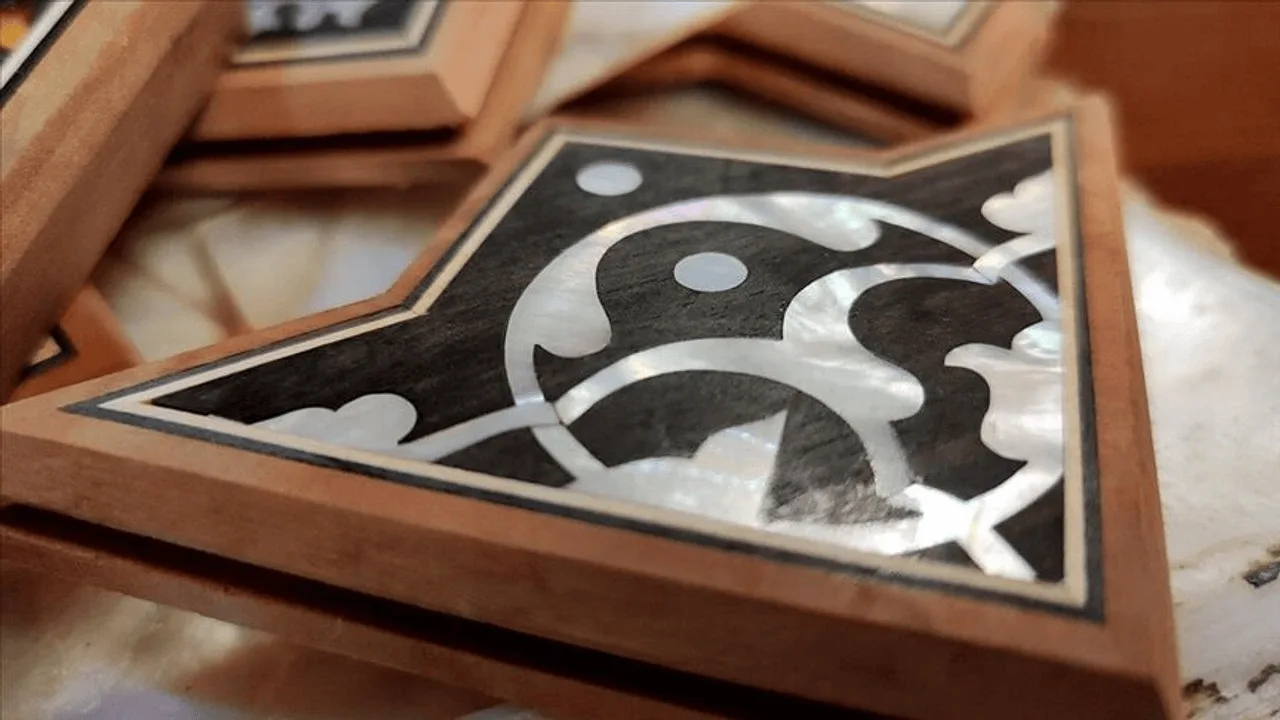
Pieces decorated with geometric mother-of-pearl inlay on a walnut ground.
Materials and Techniques: Inlay, Veneer, Filling
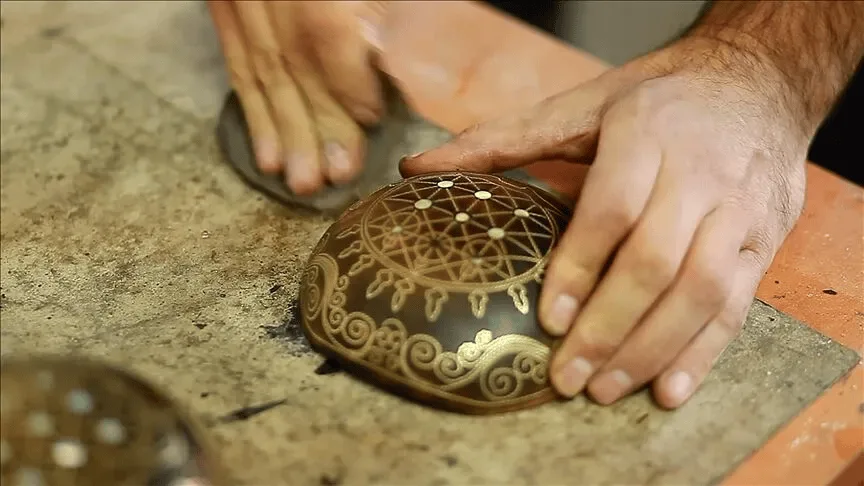
Three core techniques lie at the heart of the craft. In the inlay (gömme/kakma) method the master carves the exact line of the design into the wood with a steel pen, then beds a matching piece of shell into the recess so that it sits flush with the surface. In the veneer (kaplama) method larger areas are covered with thin sheets of shell. Filling (macunlama) is the stage in which the carved channels and remaining gaps are filled with a special paste to set the pattern firmly and smooth the ground.
The hardest part is the millimetric precision of cutting and carving: the piece of shell and the recess in the wood must fit one another flawlessly, leaving no gap. The principal tool for this is the steel pen, which becomes an extension of the master's hand. Mother-of-pearl is brittle and easily broken, demanding patience; each piece is therefore shaped, sanded and polished one at a time.
Working mother-of-pearl together with telkâri gives Gaziantep craftsmanship a character all its own: shimmering fields of nacre are framed by the fine lines of silver and brass wire. For the neighbouring craft where wirework meets precious metals, see the page on Gaziantep goldsmithing.
Motifs and the World of Pattern
The sedefkâr's repertoire draws on the deep heritage of Turkish-Islamic ornamental art. Seljuk and Ottoman motifs form the backbone of the craft: geometric interlace built from interlocking stars and polygons, rûmî and hatâyî scrolls spreading through branches and curves, flowering garden compositions, and the knot-and-braid patterns that symbolise infinity. The master brings these motifs together with techniques such as curling, branching, binding, crossing and knotting.
The power of these designs lies in the harmony created by symmetry and repetition. Even on the lid of a small box, dozens of pieces are arranged like a star opening from a single centre; as the eye follows the pattern, it is drawn into a rhythm that seems never to end.
The History of Sedefkârlık in Gaziantep
The roots of mother-of-pearl inlay run deep; during the Ottoman period, especially after the 15th century, it became a distinguished branch of Turkish-Islamic art. From the doors and cabinets of Topkapı Palace to the door panels and window shutters of the Süleymaniye Mosque, many masterpieces carry the refinement of this art. The Damascus (Syrian) school also played an important part in spreading the craft across Anatolia.
The wider practice of the craft in Gaziantep is comparatively recent: drawing on living sources, its emergence is said to point to 1963. It is recounted that the craft first appeared in the city on the grips of old pistols, alongside the repair of firearms; the shellwork on these grips served as a model and was in time carried over to furniture and decorative objects. From the 1960s onward, with pieces such as consoles, chests, mirrors and boxes, the craft's development accelerated. Gaziantep's masters developed this work, akin to the Damascus school, with their own interpretations to create original pieces.
Geographical Indication and the Present Day
Gaziantep mother-of-pearl inlay is registered as a mark of origin with the Turkish Patent and Trademark Office (TÜRKPATENT); the application was made by the Gaziantep Coppersmiths' Chamber, bringing the craft under geographical-indication protection. This registration officially defines the region-specific standard of workmanship, described as "mother-of-pearl or ivory worked as inlay with special steel pens on walnut, hornbeam and occasionally rosewood, enriched with silver or brass wires with the support of the art of telkâri."
Today Gaziantep is one of Türkiye's leading centres for this craft, sustained by numerous mother-of-pearl workshops. These workshops both carry on the transfer of knowledge through the master-apprentice relationship and produce souvenir and decorative pieces for local and foreign visitors. Those who wish to see the city's traditional handicraft fabric in person can visit the Coppersmiths' Bazaar, where copper and other crafts live side by side. Sedefkârlık is, with its shimmer, among the most eye-catching strands of Gaziantep's rich handicrafts heritage.
Sources
- TÜRKPATENT Coğrafi İşaretler Portalı — Gaziantep Sedef El İşlemeciliği (Mahreç İşareti, Tescil No 160)
- TDV İslâm Ansiklopedisi — "Sedefkârlık" maddesi
- T.C. Kültür ve Turizm Bakanlığı, Kültür Portalı — Gaziantep Sedef El İşlemeciliği
- Gaziantep Üniversitesi GÜGEMER — Geleneksel El Sanatlarını Geliştirme ve Eğitim Merkezi, Sedef Kakma
Frequently Asked Questions
What is mother-of-pearl inlay?
It is the art of decorating a wooden surface by setting lustrous materials such as nacre or ivory into it. In Gaziantep it is worked mostly on walnut and enriched with telkâri wirework.
Which techniques are used in mother-of-pearl inlay?
There are three main techniques: inlay (gömme/kakma), veneer (kaplama) and filling (macunlama). In inlay the shell is set into a recess carved with a steel pen; veneer covers the surface with thin shell sheets; filling closes the gaps with a special paste.
Is mother-of-pearl inlay a registered geographical indication?
Yes. Gaziantep Mother-of-Pearl Inlay is registered as a mark of origin with TÜRKPATENT; the application was made by the Gaziantep Coppersmiths' Chamber.
When did mother-of-pearl work become widespread in Gaziantep?
Drawing on living sources, the craft's spread in Gaziantep is said to point to 1963. It first began on weapon grips and, after the 1960s, moved on to furniture and decorative objects.
What woods and materials are used in the craft?
The wood is mostly walnut, sometimes hornbeam and rarely rosewood. The surface is inlaid with mother-of-pearl or ivory, and silver or brass wires are added through telkâri.
What objects are made with mother-of-pearl inlay?
Trousseau and jewellery chests, boxes, consoles, mirrors, chess and backgammon sets, and decorative furniture such as turban stands and telephone tables are made with this craft.