 Vegetarian
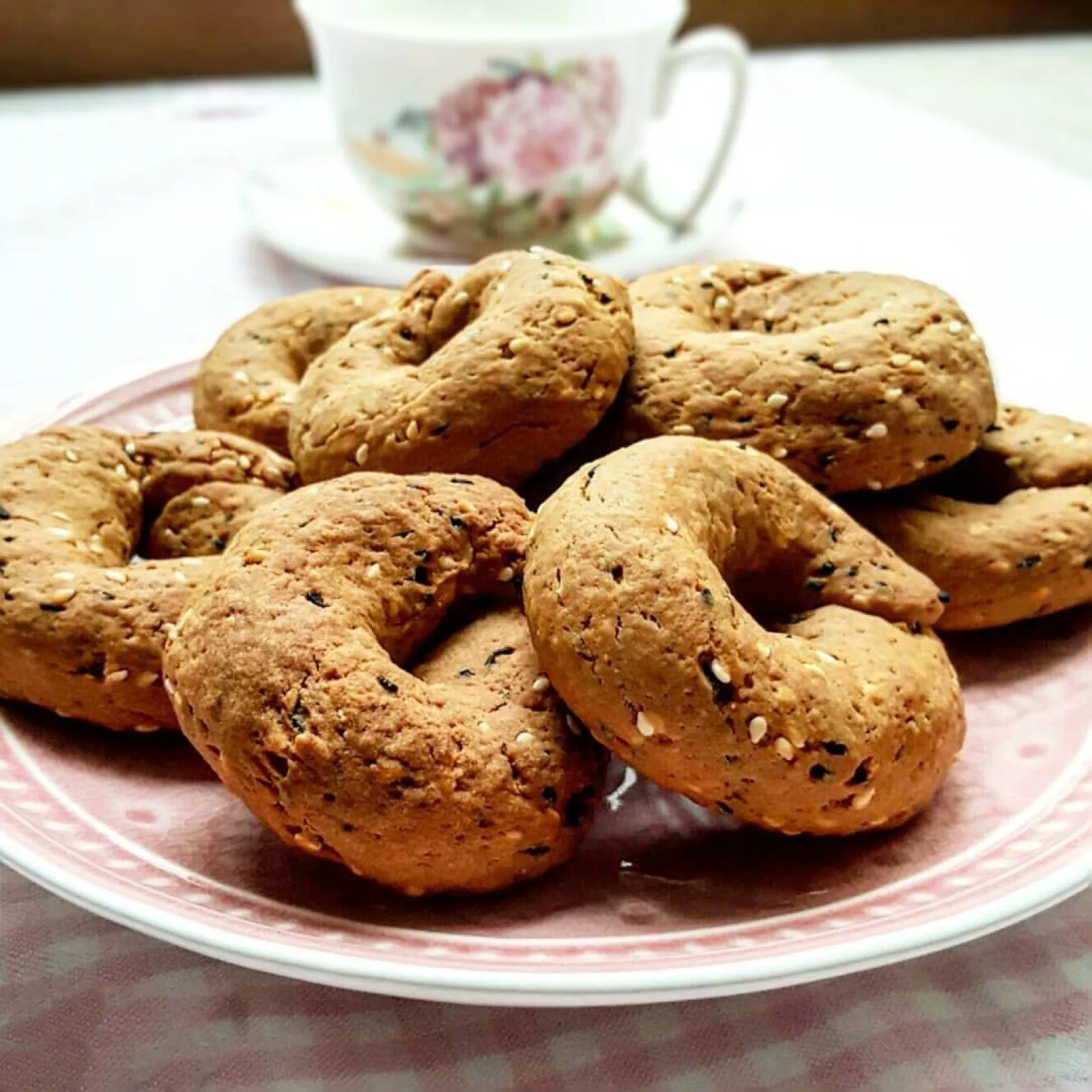
Köylü kahkesi (village kahke) is a crumbly Gaziantep pastry made by leavening a dough of kahke flour, semolina, cream and spices — black cumin, sesame, cinnamon and fennel — with chickpea yeast, shaping it into small rings and baking it in the oven. Lightly sweetened and long-keeping, this kahke is eaten mostly alongside tea and on holiday tables, and is counted among the city's nostalgic flavours. Under the name "Antep Köy Kahkesi (Gaziantep Köy Kahkesi)," it was registered as a geographical indication by TÜRKPATENT on 25 December 2017, following an application by the Gaziantep Chamber of Commerce (Geographical Indication / Mahreç İşareti, Reg. No: 291).
The identity of the kahke springs from the harmony of a few essentials: specially milled kahke flour, semolina, cream and chickpea yeast, together with spices such as black cumin, sesame, cinnamon and fennel. Behind these lies a cycle that demands patience and a master's hand — a careful fermentation of the leaven spread over hours rather than days, the shaping of the dough into rings one by one, and baking at a measured oven heat.
This article explores the world of ingredients that shapes köylü kahkesi, its traditional leavening and baking technique, its origins in Gaziantep cuisine, its geographical indication protection, and its place at the city's tea table.
What Is Köylü Kahkesi and What Is in It?
Köylü kahkesi is a crumbly pastry made by leavening a spiced dough with chickpea yeast, shaping it into small rings (hollow circles), brushing the surface with egg and baking it in the oven. The word "kahke" comes from the Arabic name for this ring-shaped baked good; the distinctive feature of the dessert is that it is leavened with chickpea yeast rather than baker's yeast and is never soaked in syrup. Its sweetness comes from the sugar worked into the dough, while the spices and sesame give the kahke its characteristic aroma. Köylü kahkesi is not a heavy, syrup-soaked dessert like baklava but a lightly sweet, crisp treat eaten bite by bite alongside tea.
Core Components
- Kahke Flour and Semolina: The backbone of the kahke is the specially milled kahke flour together with semolina. In the geographical indication recipe, around 1,500 grams of kahke flour and 800 grams of semolina go into roughly eight kilograms of main dough; the semolina gives the kahke a faintly sandy, crisp texture.
- Chickpea Yeast: The element that sets köylü kahkesi apart from its relatives is the chickpea yeast (nohut mayası) used in place of baker's yeast. Prepared from crushed chickpeas through a fermentation of several hours in a warm environment, this leaven lightens the dough and gives the kahke its melt-in-the-mouth texture and long shelf life.
- Cream and Sugar: The cream (süt kreması) worked into the dough gives the kahke softness and a full mouthfeel; the recipe includes around 600 grams of cream and 2,800 grams of sugar for the main dough. The sweetness comes not from syrup but from this sugar added directly to the dough, which is why the kahke is measured in its sweetness.
- Spices: The aroma of the kahke is built by black cumin, cinnamon and fennel (known locally as mayana); the registration recipe uses around 250 grams of black cumin, 250 grams of cinnamon and 130 grams of fennel for the main dough. In traditional practice, fragrant spices such as mahlep and anise are also added; these spices define the kahke's characteristic scent.
- Sesame: Worked into the dough and often scattered on the surface as well, sesame gives the kahke its toasted aroma and its appearance; the recipe specifies around 1,000 grams of sesame for the main dough. The egg brushed on the surface gives the kahke its golden colour and faint sheen as it bakes.
The Geography of Its Service
Köylü kahkesi is a pastry that need not be eaten hot and fresh; on the contrary, because it keeps for a long time it can be stored. According to the geographical indication record, it preserves its melt-in-the-mouth structure and freshness for three to four months. This durability makes the kahke one of the easiest of Gaziantep's flavours to take home as a gift; visitors to the city often leave with a box of it. Its classic companion is strong brewed tea; the kahke's spiced, crisp texture is completed beside it. It also takes its place at breakfast, next to cheese and olives.
The History and Cultural Origins of Köylü Kahkesi
The origins of köylü kahkesi rest both on the exchange Gaziantep has maintained with neighbouring cuisines to the south over centuries and on the city's own baking tradition. The ring-shaped kahke is a deep-rooted product of Eastern Mediterranean and Levantine cuisine; in Gaziantep, by meeting chickpea yeast, local spices and the master-apprentice tradition, it gained an identity particular to the city.
A Tradition Brought from Aleppo
According to the widely told account, kahke was brought to Gaziantep from Aleppo by Antep masters at the beginning of the 1900s. As the accounts relate, kahke was at first a sweet treat made especially during the month of Ramadan, to encourage children to take up fasting willingly. Blended over time with the city's baking heritage, kahke became a fixed part of Ramadan and religious-holiday tables. While this origin account points to the kahke's regional past, the precise date and details are passed down through oral tradition; for this reason the kahke is best regarded as part of the region's deep-rooted heritage of pastry-making.
How It Became a Signature Pastry of Gaziantep
What identifies the kahke with Gaziantep is the ingredients in the city's hands and the method built on chickpea yeast. When the dough lightened with chickpea yeast, the scent of local spices and the laborious handwork of shaping each ring individually come together, the kahke becomes a pastry that bears the city's name. This handwork makes the kahke hard to imitate exactly by mass production.
Geographical Indication Registration
Köylü kahkesi went through an official registration process to protect its region-specific ingredients and method. Under the name "Antep Köy Kahkesi (Gaziantep Köy Kahkesi)," the application by the Gaziantep Chamber of Commerce concluded with a geographical indication registration by TÜRKPATENT on 25 December 2017 (Geographical Indication / Mahreç İşareti, Reg. No: 291). The registration guarantees that this name may be used only for a product tied to the Gaziantep region and made with the defined ingredients and method.
Köylü kahkesi was entered into the TÜRKPATENT geographical indications register under the name "Antep Köy Kahkesi (Gaziantep Köy Kahkesi)" as a Geographical Indication (Mahreç İşareti, Reg. No: 291, file C2017/059) on 25 December 2017; the application was made by the Gaziantep Chamber of Commerce. The registration document defines the method of production, from preparing the chickpea yeast, to the proportions of kahke flour, semolina and spices, to shaping the dough into rings and baking it at around 180 degrees for 20-25 minutes.
The Köylü Kahkesi Tradition and Ritual in Gaziantep
In Gaziantep, köylü kahkesi is not merely a pastry; it is part of the tea hour, of the holiday table and of welcoming guests. It holds a quiet place of its own in the city's daily fabric.
The Flavour of the Tea Hour and the Holiday
The kahke's best-known place in Gaziantep culture concerns tea hours and religious holidays. Eaten bite by bite beside strong brewed tea, the kahke is a fixed offering at the long conversations held in homes. Prepared in homes and bakeries especially before the holidays, it is offered to guests during holiday visits and is also known as the "holiday simit." Because it keeps for a long time, it is set out ready on plates and offered to every guest who arrives.
The Craft of the Oven
The kahke is defined as much by its shaping and baking technique as by the leavening of its dough. The dough leavened with chickpea yeast is divided into small pieces and shaped by hand into rings; according to the geographical indication record, each kahke weighs around 17 grams. The rings, brushed with egg on the surface, are baked at around 180 degrees for 20-25 minutes, until they take on a light golden colour. The measured heat crisps the outside of the kahke while keeping the inside dry and light enough to melt in the mouth. The handing down through generations of techniques such as the use of chickpea yeast and ring-shaping is also part of the diversity of crafts that was one reason for Gaziantep's admission to the UNESCO Creative Cities Network in the field of gastronomy in 2015.
Its Place at the Table
In Gaziantep, the kahke most often takes its place with tea or, at breakfast, next to cheese and olives; because it is not a heavy dessert, it suits any hour of the day. Those curious about the relationship Gaziantep cuisine builds with flour, cream and spice can trace it in signature flavours where the same ingredients take other forms, such as Gaziantep katmer and Gaziantep baklava.
Why You Should Try It
A handful of fresh köylü kahkesi carries Gaziantep's tea-hour culture and its bond with spice to the palate in one plain bite: the crispness of the outside, the melt-in-the-mouth crumb and the toasted aroma of black cumin and sesame all arrive together. Sweetened only by the sugar in the dough rather than drenched in syrup, the kahke is a light flavour rather than a heavy one. Because it keeps its freshness for a long time, it ranks among the first of Gaziantep's flavours to take home as a gift; but its truest taste is found in the city where it was born, beside a glass of strong brewed tea.
Frequently Asked Questions
What is köylü kahkesi and where is it from?
It is a crumbly Gaziantep pastry made by shaping a chickpea-yeast-leavened spiced dough into rings and baking it; it is eaten mostly with tea and at religious holidays.
What is in köylü kahkesi?
It uses kahke flour, semolina, cream, chickpea yeast and sugar, with black cumin, cinnamon, fennel and sesame. No syrup is used; its sweetness comes from the sugar in the dough.
Does köylü kahkesi have a geographical indication?
Yes. Under the name "Antep Köy Kahkesi (Gaziantep Köy Kahkesi)," it was registered as a geographical indication by TÜRKPATENT on 25 December 2017 (Mahreç İşareti, Reg. No: 291).
How and when is köylü kahkesi eaten?
It is eaten mostly with strong brewed tea or at breakfast. Because it keeps for a long time, it is also common as a holiday offering and as a gift.
Why does köylü kahkesi keep for so long?
The use of chickpea yeast instead of baker's yeast, and baking it into a low-moisture, crisp form, let it keep its freshness for three to four months.