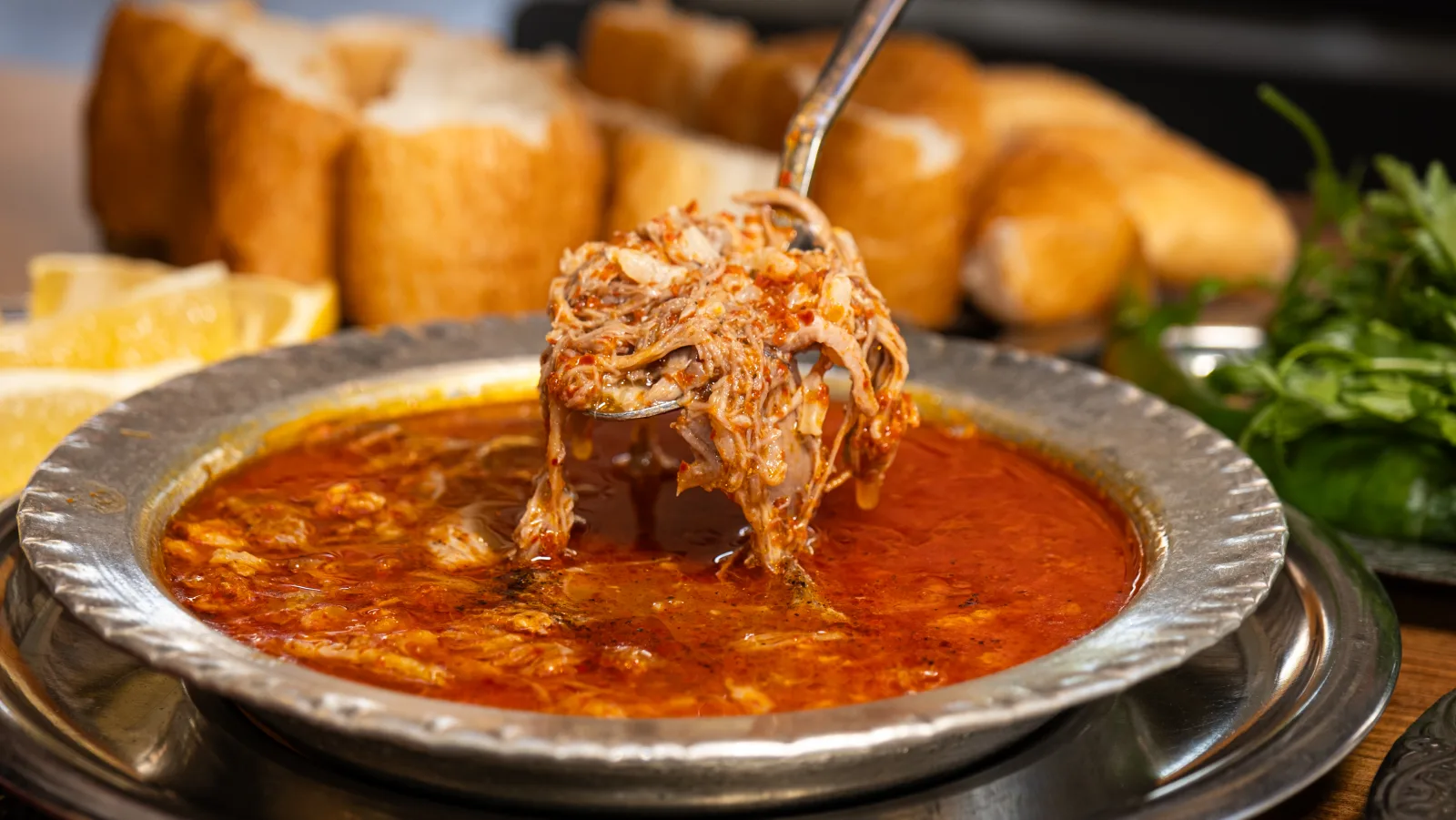
Beyran (Antep Beyranı) is a traditional meat dish particular to Gaziantep: prepared with lamb or mutton and rice, rich in garlic, spicy and deeply nourishing. People in Gaziantep usually describe beyran not as a "soup" but as a hot dish served in a copper sahan (a single-portion copper pan) over a roaring flame, and it is classically eaten in the very early hours of the morning, at first light. Tender slow-cooked meat, plainly boiled rice, plenty of fresh garlic and red chilli flakes come together with rich meat stock; beyran is then eaten with a spoon, with lemon squeezed over it.
The identity of beyran springs from the harmony of a few essentials: tender lamb/mutton shredded into fine strands, the rich meat stock drawn from marrow bones, plainly boiled rice (known locally as "kel pilav"), plenty of fresh garlic and hot red chilli flakes. Behind these lies not a process spread over days but a preparation begun the day before and a skill that rests on the moment of searing in the sahan. Beyran was registered as a geographical indication under the name "Antep Beyranı" by TÜRKPATENT in 2017, protecting both its name and its authentic method.
What Is Beyran and What Is in It?
Beyran is a meat dish in which slow-cooked lamb or mutton, shredded by hand into fine strands, comes together with plainly boiled rice, pounded fresh garlic, red chilli flakes and black pepper in a single-portion copper sahan, where rich meat stock meets a roaring flame and it is served piping hot with lemon squeezed over it. Although the term "beyran soup" is common in everyday speech, the people of Gaziantep stress that, by its technical and local definition, it is "not a soup but a dish."
Core Components
- Lamb or Mutton: The body of beyran is built from lamb or mutton; traditionally the neck and shoulder/dewlap cuts of a young (toklu/şişek) sheep are preferred. These cuts are the most gelatinous and flavourful for long cooking; once done, the meat is shredded by hand into fine strands while still hot.
- Marrow Bone: The richness and character of the stock come from the marrow bone that boils alongside the meat for a long time. The bone both enriches the stock and lends beyran depth with its marrow.
- Rice (Kel Pilav): In beyran the rice is boiled separately and plainly, without spices; this plainly boiled rice is known locally as "kel pilav." It is placed in the sahan together with the shredded meat and draws the stock into itself.
- Plenty of Fresh Garlic: The signature taste of beyran comes from plenty of crushed and pounded fresh garlic. Meeting the boiling stock in the sahan, the garlic gives the dish its sharp and dominant aroma.
- Suet / Sheep's Tail Fat: The traditional recipe adds suet or sheep's tail fat to the dish; some recipes use butter. This fat gives beyran richness and body.
- Red Chilli Flakes and Black Pepper: Red chilli flakes provide beyran's heat, while black pepper gives its spiced depth. They are added over the meat and rice in the sahan and seared with the boiling stock.
- Meat Stock, Salt and Lemon: The meat stock obtained from the long cooking of bone and meat fills the sahan and is balanced with salt. Squeezing fresh lemon over it at serving is the final touch that balances beyran's rich, spicy character.
The Art of Searing in the Sahan
The defining element of beyran is not so much its ingredients as its production technique and the skill it demands. The long, slow cooking of the meat overnight yields both tender meat and a rich stock; this patient preparation is the foundation of beyran's character. The true mastery, however, lies in the moment of service: in a single-portion copper sahan, the shredded meat, plain rice, plenty of garlic and chilli flakes come together and froth into a rapid boil over a roaring flame, giving beyran both its heat and its distinctive aroma. The long cooking and the searing in the sahan are what set Antep beyranı apart from similar dishes.
The History and Cultural Origins of Beyran
Beyran's commercial history in Gaziantep dates to the end of the 19th century. The dish emerged in Antep, where sheep-raising was widespread, and became part of the tradesmen-and-market culture of Ottoman-era Gaziantep. Its long cooking time and the skill it requires positioned beyran from the start as a market dish that demands a master's hand.
The Origin of the Name
The name "beyran" comes from the Persian word "biryān," which describes meat (kebab) fried or roasted over fire without water, in a pan. The Persian biryān derives from the verb biriştan, meaning "to fry/to roast." The word passed into Turkish as "büryan" and turned into "beyran" in the Gaziantep dialect. This root makes beyran a relative of Siirt's pit-cooked "büryan" and the Indian-origin "biryani"; however, these are different dishes that share the same root and should not be confused with one another. The name is sometimes linked to the Persian word "beyn," but this is not correct; the true root is the Persian biryān.
A Dish Born in the Market
Beyran's history, intertwined with market culture, binds it to Gaziantep's daily life. For market tradesmen, porters and produce dealers who start work before sunrise, beyran became the way to begin the day full and energetic; in this way the dish has been carried from generation to generation as a tradition belonging to the very early hours of the morning.
Antep beyranı was entered into the TÜRKPATENT geographical indications register on 13.01.2017 as a Geographical Indication (Mahreç İşareti) with No 207. The application was made on 08.05.2015 (file no C2015/020) by the Gaziantep Metropolitan Municipality. The registration guarantees that the name "Antep Beyranı" may be used only for a product tied to Gaziantep and made with the defined ingredients and method.
The first beyran shop in Gaziantep opened within the market in 1885; the dish has been associated ever since with its long cooking time and the skill it requires.
The Beyran Tradition and Ritual in Gaziantep
In Gaziantep, beyran is not merely a dish; it is part of the morning and of market life. Eaten almost only in the mornings — indeed at sunrise — beyran is tightly bound to the city's daily rhythm; it is hard to find a place selling beyran in the afternoon.
A Dish Eaten at Sunrise
Beyran is traditionally eaten in the very early hours of the morning. Market tradesmen, porters and early risers turn to beyran to start the day full; thanks to its high-protein, filling nature it is considered a meal that "keeps you full all day." Long-established beyran houses open their doors at first light, so beyran lives on as a morning dish intertwined with breakfast.
Beyran in Popular Belief
In popular belief, beyran's spicy and dense character is said to make it "healing," to warm the body on cold winter days and to be good against colds; it is also said to have a sobering effect on mornings after a late night. These are not a documented medical fact but a widespread folk belief and hearsay; even so, they help explain why beyran is more in demand in the winter months and in cold weather.
Its Place at the Table
Rich in chilli and garlic, beyran is eaten piping hot from its copper sahan with a spoon, with fresh lemon squeezed over it. It is usually served with bread and turnip pickle (şalgam) or other pickles on the side. Those curious about the other deep-rooted morning flavours of Gaziantep cuisine can follow the city's early-hour tastes in signature dishes such as liver kebab and Gaziantep katmer.
Why You Should Try It
A single sahan of beyran carries Gaziantep's morning culture and its market tradition to the palate in one bowl: the tenderness of meat cooked overnight, the depth of the rich stock, the sharpness of plenty of garlic and the heat of chilli flakes are balanced by the freshness of lemon squeezed on at the last moment. Arriving frothing over a roaring flame, the sahan is a filling, warming meal. And the truest way to taste it is to spoon it from a beyran maker's sahan in the city where it was born, at sunrise.
Frequently Asked Questions
What is beyran and where is it from?
It is a traditional meat dish particular to Gaziantep, prepared with lamb/mutton and rice in a copper sahan over a roaring flame, rich in garlic and chilli.
What is in beyran?
Lamb or mutton, marrow bone, plainly boiled rice (kel pilav), plenty of garlic, suet, red chilli flakes, black pepper, meat stock, and lemon squeezed over it at serving.
Is beyran a soup?
No. Although it is called "beyran soup" in everyday speech, the people of Gaziantep define it not as a soup but as a dish served in a copper sahan over a roaring flame.
Does beyran have a geographical indication?
Yes. Antep beyranı was registered as a Geographical Indication (Mahreç İşareti) with No 207 by TÜRKPATENT on 13.01.2017.
When is beyran eaten?
Almost only in the mornings, at sunrise; it is hard to find beyran in the afternoon. Market tradesmen and early risers eat it to start the day full.