 Vegetarian
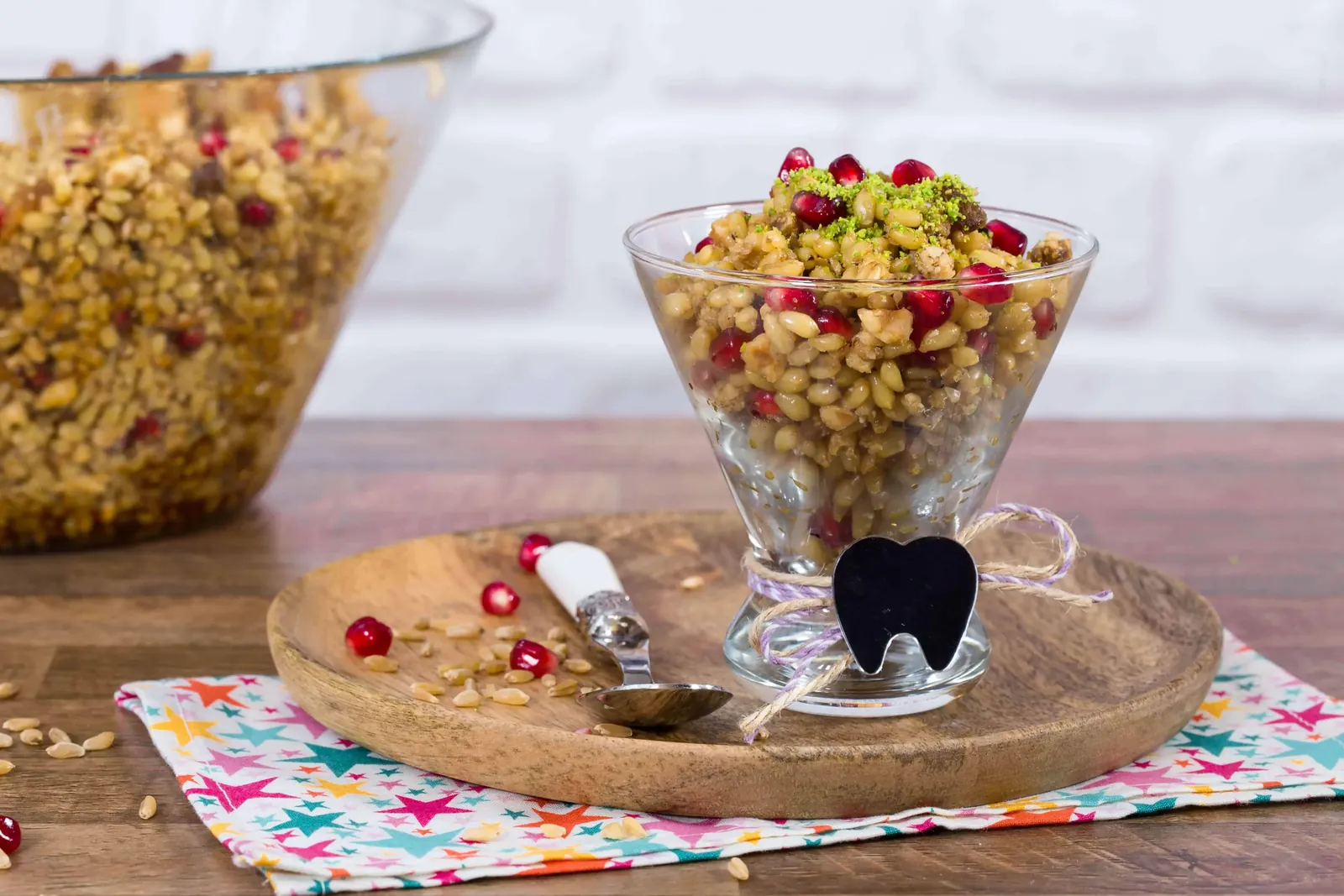
Diş hediği is a traditional dish cooked in Gaziantep when a baby's first tooth appears, made by boiling aşurelik wheat and chickpeas until the grains burst open and the water is absorbed. The "hediği" in its name is a form of "hedik," a word for boiled wheat; the hedik cooked for a first tooth is called "diş hediği" (diş means tooth), and the dish is also known locally as diş aşı, diş buğdayı and diş bulguru.
The basic ingredients of diş hediği are wheat, chickpeas and water; salt or fennel may also be added during cooking if desired. When it is served, toppings such as Antep pistachios, walnuts, granulated sugar, cinnamon or pomegranate seeds may be added. The dish was registered by TÜRKPATENT in 2026 as a Geographical Indication (Mahreç İşareti) under the name "Gaziantep Diş Hediği."
What Is Diş Hediği and What Is in It?
Diş hediği is a grain dish (aş) of wheat and chickpeas boiled together in the same pot; it comes to the table once the cooking water has been absorbed. Listed in the register under the "meals and soups" group, the dish is also served as a sweet treat, with sugar, cinnamon and nuts added on top as desired.
Core Components
- Aşurelik Wheat: The body of the dish is aşurelik wheat, the wheat used for aşure (a sweet grain pudding); pounded to remove its husk, it is also known locally as "dövme" or "yarma." The same wheat is also the main ingredient of Gaziantep's registered öz soup.
- Chickpeas: The chickpeas are boiled in the same pot as the wheat. In Anatolia's first-tooth traditions the main ingredient is wheat, and in various regions chickpeas or beans may also be added; in Gaziantep's registered recipe, however, chickpeas are one of the three ingredients, together with water and wheat.
- Water: The wheat and chickpeas are boiled in water; cooking continues until the grains burst open and the water in the pot has been absorbed.
- Salt and Fennel (Optional): Salt or fennel may be added during cooking to give the dish flavour.
Cooking That Calls for Skill
Although its ingredients are simple, diş hediği needs care in the cooking. Cooking the pre-soaked wheat and chickpeas in the same pot over a low heat, skimming off the foam and stirring from time to time, is what makes the grains soften fully and burst open. The registration record particularly stresses that preparing and cooking the dish requires skill, and it cites this skill as the basis of the reputation that links diş hediği to Gaziantep.
In one published Gaziantep recipe, a little Antep grape molasses (pekmez) is also added to the cooking water, giving the hedik a light honey colour. The registered recipe, however, makes no mention of sugar, honey or grape molasses at the cooking stage; they are listed only among the optional toppings added when serving.
At the Table
Once cooked, diş hediği is left to rest for a while before it is served. It is topped with Antep pistachios, walnuts, other nuts, Turkish delight, granulated sugar, cinnamon, pomegranate seeds, honey or grape molasses; because all of these are optional, the same hedik takes on a different look from table to table. Diş hediği can be eaten hot or cold. In the Gaziantep recipe mentioned above, the hedik is offered in small bowls with a spoon, and sugar and cinnamon are set beside it in a separate bowl so that anyone who wishes can sweeten it to taste.
The History and Cultural Origins of Diş Hediği
Diş hediği has a long history in Gaziantep province, and preparing it has been a custom for many years. The name is made up of two words: "diş" refers to the coming of the first tooth, and "hedik" to the aşurelik wheat boiled for the occasion.
What Is Hedik?
"Hedik" is a dialect word for boiled grains such as wheat, bulgur, maize or chickpeas, and it lives on in many parts of Anatolia, including Gaziantep's Nizip district. In Gaziantep the word is also used in the making of Antep bulgur: the wheat cooked in large cauldrons until its starch is fully gelatinised is called hedik. In the Antep dialect, the expression "hedik vurmak" means to cook hedik.
Hedik and Hediye
Although they sound alike, "hedik" and "hediye" are listed in dictionaries as separate words: "hedik" is a dialect word for boiled grains, while "hediye" means "gift."
Gaziantep Diş Hediği was entered into the TÜRKPATENT geographical indications register on 06.10.2026 as a Geographical Indication (Mahreç İşareti) with No 1905. The application was made on 28.11.2025 (file no C2025/000459) by the Gaziantep Metropolitan Municipality; in the register the product falls under the "meals and soups" group, and its geographical boundary is Gaziantep province. The registration guarantees that the name "Gaziantep Diş Hediği" may be used only for a product tied to Gaziantep and made with the defined ingredients and method (aşurelik wheat, chickpeas and water).
The Diş Hediği Tradition and Ritual in Gaziantep
The tradition of celebrating a first tooth with boiled wheat lives on under different names in many parts of Anatolia; in Gaziantep, the tradition's dish is known by its registered name, diş hediği. The dish has historically been prepared especially so that a baby's family and relatives can celebrate the appearance of the first tooth.
The Joy of the First Tooth
Cooked when a baby's first tooth is spotted, diş hediği is eaten together with the family and close relatives in a festive atmosphere. It is recounted that relatives bring the child presents, some of them made of iron in the hope that the teeth to come will be strong. Behind the cooking of hedik lies the belief that the child's teeth will come through as close-set and even as grains of wheat. By folk custom, the person who first spots the baby's first tooth is expected to buy the child a present; if they do not, it is believed that the other teeth will be slow to come. It is also said that in some families thirty-two grains of bulgur are threaded on a string and hung on the child's shoulder so that all of the child's teeth will be strong.
The Plate Sent to the Neighbours
Diş hediği is not eaten only at home; it is said that the hedik, prepared in plenty, is offered to everyone who calls and sent on plates to neighbours and relatives with the words "This is our child's diş hediği." It is also recounted that the families who receive hedik return the plate with presents for the child placed inside.
Scissors, Pen and Hammer
It is said that in the past a small test would also be held while the hedik was being offered. The baby would be seated on the floor, with a pair of scissors, a pen and a hammer placed a little way off. If the child reached for the scissors, this would be taken as a sign of a future tailor; if for the hammer, a craftsman; and of a child who reached for the pen, people would say, "This one will study and become a civil servant." Similar practices, in which objects are placed before a child to foretell the future, are also found in other first-tooth traditions across Anatolia.
From the Everyday Table to Outings
According to the registration record, diş hediği is served "especially at the birthday ceremonies" of babies whose first tooth has appeared and when hosting guests; it is also prepared for everyday meals and at events such as festivals. It is recounted that, being a well-loved treat, it is served at tea gatherings and also cooked when people set out on a sahre, that is, an outing. In an example recorded from the Antep dialect, a mother-in-law tells how she said to her daughter-in-law, "Kak acı bi hedik vurda Allebene gedek," that is, "Get up, cook a little hedik and let's go to Alleben"; Alleben, named in this example, is known as a place for outings in the city.
Why You Should Try It
A bowl of diş hediği tells, in a single taste, how a family in Gaziantep welcomes the first tooth of its youngest member: wheat and chickpeas patiently cooked until they burst open; pistachios, walnuts and cinnamon scattered on top; and a joy shared with family and relatives. The dish shows how Antep cuisine can set a celebratory table from a few handfuls of grain. The truest way to taste it is as a guest at a first-tooth celebration or at an Antep table in Gaziantep.
Frequently Asked Questions
What is diş hediği?
It is a traditional, registered dish made by boiling aşurelik wheat and chickpeas in water, cooked in Gaziantep to celebrate a baby's first tooth with family and relatives.
Why is it called "diş hediği"?
Boiled wheat is called "hedik" in folk speech; the hedik cooked for a baby's first tooth (diş) is "diş hediği." Dictionaries list "hedik" and "hediye" (gift) as separate words.
What is in diş hediği?
The registered recipe contains water, aşurelik wheat and chickpeas; salt or fennel may be added. Antep pistachios, walnuts, sugar, cinnamon or pomegranate seeds may be sprinkled on top.
Is diş hediği made only in Gaziantep?
The first-tooth custom with boiled wheat lives on under different names in many parts of Anatolia; the name "Gaziantep Diş Hediği" and its registered recipe belong to Gaziantep.
Does diş hediği have a geographical indication?
Yes. Gaziantep Diş Hediği was registered by TÜRKPATENT as a Geographical Indication (Mahreç İşareti) with No 1905 on 06.10.2026.
When is diş hediği made?
Traditionally it is cooked when a baby's first tooth appears; it is also prepared when hosting guests, for everyday meals and at events such as festivals.