In Gaziantep's narrow-laned old city stood a building that everyone passed by yet no one recognized for years. Behind thick stone walls thought to be a thread factory's depot, an entire three-aisled, three-apsed church lay hidden. Brought back to light in 2005 during the municipality's road works, the Aziz Bedros (Surp Bedros) Church was restored and given a completely new life as the Ömer Ersoy Culture Center. This is the story of a place once believed lost, then reborn.
When people think of Gaziantep, hans, bathhouses and covered bazaars usually come to mind. Yet within the city's old fabric there are also buildings that carry the traces of different faiths. The Aziz Bedros Church is one of the most striking of these — because it is not merely an old place of worship, but a building that was forgotten for years and then rediscovered, saved from disappearing at the very last moment.
Known today as the Ömer Ersoy Culture Center, this place has become a lively address in the cultural and artistic life of Gaziantep's residents, while its stone walls still whisper the story of its true identity.
What it is and where it stands
The Aziz Bedros Church is a historic Armenian church in the Şahinbey district of Gaziantep, set among the old neighborhoods that still preserve the city's traditional fabric. The building sits right in the heart of the old city, surrounded by narrow lanes and courtyard stone houses; together with the nearby hans, bazaars and religious buildings, it forms part of the city's many-layered past.
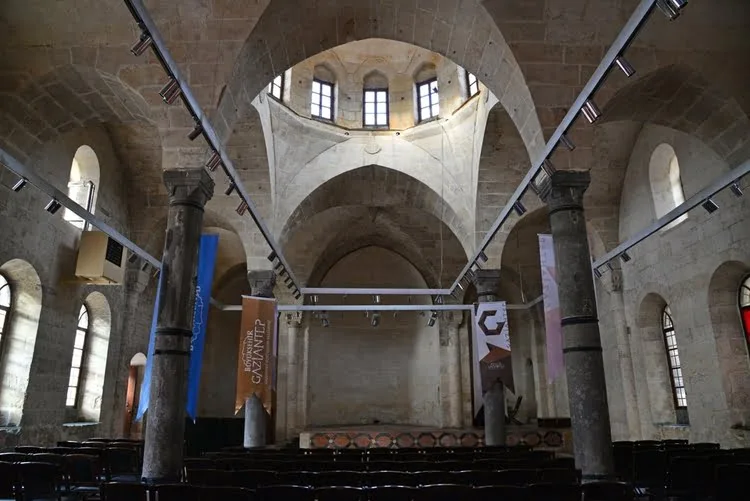
Built of cut stone, the rectangular structure measures roughly 21 by 13 meters. Its west facade has two main entrance doors. Inside, the space follows a basilica plan, divided into three aisles by two rows of columns; this arrangement — comprising the naos (main hall), narthex (entrance hall), atrium and side corridors — is a fine example of classical church architecture.
History: a hidden church
Sources do not fully agree on when the church was built. It is commonly stated to have been constructed in 1723, while some sources suggest the building rose in a later period. Since there is no precise dated inscription, it is most accurate to say the church was built during the Ottoman era, in the centuries when a large Armenian community lived in the city.
What is truly striking, however, is the building's recent history. After the community left the city, the structure lost its function and over time became the depot of a thread factory. Walls were built up over the years, doors were sealed, and the church all but vanished from sight — so much so that passersby could not tell a place of worship stood here at all.
The church came to light in 2005 during road-opening works carried out by the Gaziantep Metropolitan Municipality. When an entire church emerged from behind walls thought to belong to a depot, the building was registered, purchased by the municipality, and the restoration process began.
The restoration project was carried out with the approval of the Adana Board for the Protection of Cultural and Natural Heritage, and the work was completed in 2008. Thus a structure used as a depot for decades finally regained its true identity.
What is worth seeing: architecture and ornament
What makes the Aziz Bedros Church special are the refined details behind its plain exterior. The building has three apses and is generally well preserved. On the cut-stone walls, pink marble and basalt were used as decorative elements; the combination of the two-colored stone creates a pleasing visual rhythm that also echoes Gaziantep's traditional stonework.
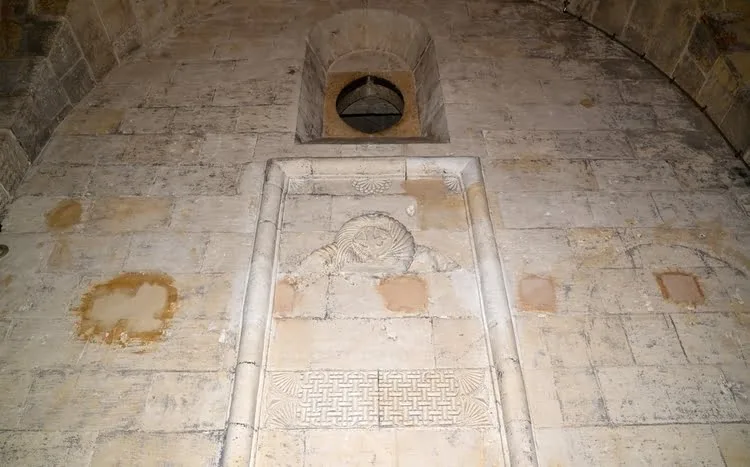
At the entrance, careful eyes are rewarded with delicate stone carving: bird and angel figures, pine-tree motifs and cross ornaments are worked into the stone. These motifs offer quiet but clear clues to the building's original identity. Inside, the aisles divided by rows of columns lend the space an airy, balanced atmosphere.
Its place in city life
Today the Aziz Bedros Church is a lively part of Gaziantep's cultural and artistic calendar. Serving under the name Ömer Ersoy Culture Center, the building hosts concerts, meetings, exhibitions and various cultural events. A concert heard within these historic stone walls offers an unusual and moving experience.
The building's reuse is, for Gaziantep, not merely a restoration but also a sign of the will to protect and keep alive the city's many-layered past. That a church once used as a factory depot now breathes life into the city's cultural scene neatly sums up Gaziantep's relationship with its own history.
Today and how to visit
Located in the heart of the old city, the Aziz Bedros Church sits in a spot that can easily be explored together with the surrounding historic buildings. Considering both its architecture and its story at the same time makes the visit far more meaningful.
For those curious about how religious buildings were transformed in the city's past, the most natural next stop is the Kurtuluş Mosque, which was also originally built as an Armenian church and later converted into a mosque. Visitors who want to explore the old city's streets can wander among the courtyard stone houses of the historic Bey Quarter, and to see traditional domestic architecture they can take a look at the Traditional Antep Houses page. For a broader itinerary, the Historic Buildings category and the Culture Atlas make good starting points.
Frequently Asked Questions
Where is the Aziz Bedros Church?
It is in the Şahinbey district of Gaziantep, among the old neighborhoods that preserve the city's traditional fabric, right in the heart of the old city surrounded by narrow lanes and stone houses.
When was the Aziz Bedros Church built?
Sources do not fully agree; it is commonly stated to have been built in 1723, while some sources suggest a later date. As there is no precise dated inscription, it is most accurate to say it was built during the Ottoman era.
Why was the church unnoticed for so long?
After the community left, the building was used as a thread factory's depot. Because walls were built up and doors sealed over the years, it could not be recognized as a church from outside. It came to light in 2005 during the municipality's road works.
What is the Aziz Bedros Church used for today?
Restored and completed in 2008, the building now serves as the Ömer Ersoy Culture Center, hosting concerts, meetings and various cultural events.
What are the building's architectural features?
It is a cut-stone basilica-plan structure of about 21 by 13 meters, divided into three aisles by two rows of columns. It has three apses; pink marble and basalt were used in its decoration, and bird, angel, pine-tree and cross motifs are carved at the entrance.
Are there other historic buildings to see nearby?
Since it is in the heart of the old city, there are many historic buildings around it. The Kurtuluş Mosque, another former Armenian church, the historic Bey Quarter and the traditional Antep houses can all be seen comfortably on the same outing.