In the heart of Gaziantep, tucked among narrow old streets, Boyacı Mosque is one of those rare buildings that looks modest from the outside yet astonishes you the moment you step in. Also known as Kadı Kemalettin Mosque and Boyacıoğlu Mosque, it guards behind its centuries-old stone walls a wooden treasure with few equals anywhere in the world: a walnut minbar that slides out on iron rails for the Friday sermon and then tucks itself back into the wall. With its layered history, its architecture, and the poignant monument in its courtyard, this mosque is far more than a place of worship; it is a living record of both Gaziantep's faith and its resistance.
Boyacı Mosque rises in the Şahinbey district of Gaziantep, in the very neighborhood that bears its name, at the point where Kutlar Street meets Hamdi Kutlar Avenue. Sitting right inside the historic core of the city, within walking distance of the old bazaars and caravanserais, this location has kept the mosque at the center of neighborhood life for centuries.
The mosque goes by several names: in inscriptions and among locals it is called Boyacı Mosque ("Painter's Mosque"), Boyacıoğlu Mosque, and Kadı Kemalettin Mosque, the last after a learned judge (kadı) who once served here. These multiple names hint at the building's long and layered past.
History: an uncertain beginning, a dated minbar
The exact construction date of Boyacı Mosque is not known, and sources offer different dates. A common account holds that the building's foundations were laid in the early 13th century, in an effort traditionally attributed to Kadı Kemalettin Bey, with the mosque taking its present form over time. The minbar's own dating is debated: by one reading it bears the date 1358 (AH 759), which would make it one of the oldest wooden minbars in Anatolia, while the inscription legible on it today reads 1550 (AH 957). Later, in 1575, it was extensively repaired by Mehmet Pasha, the governor of Aleppo.
For this reason it would be misleading to pin the mosque's history to a single year; what we have is a structure built, repaired, and reshaped over the course of centuries. Even the minbar's date varies between sources, and the rest is passed down through accounts that differ from one source to another.
What to see: the sliding minbar and the architecture
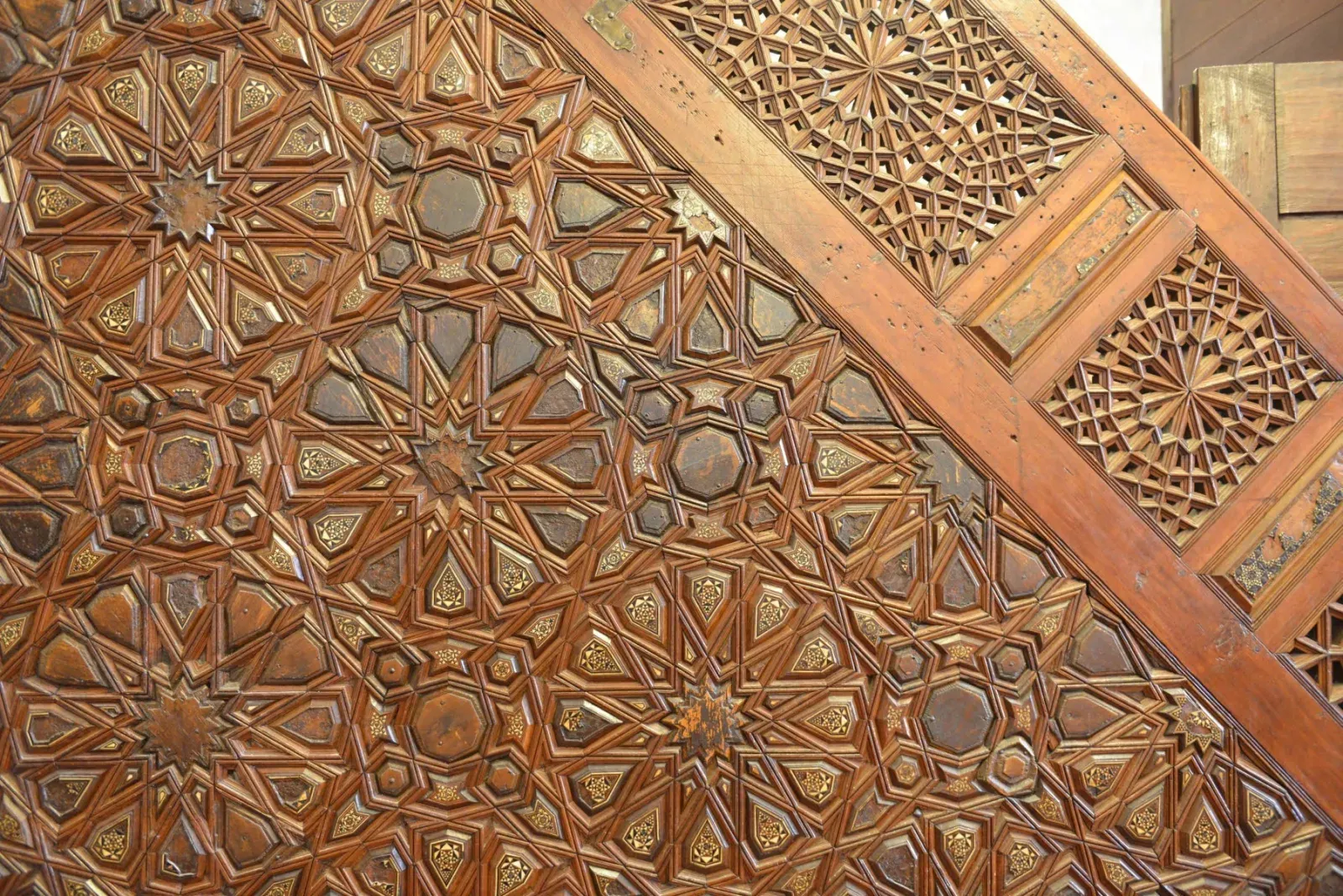
The mosque's most talked-about feature is its minbar (pulpit), which has few equals anywhere in the world. Carved from walnut wood in the genuine kündekâri technique, it is adorned with stars, palmettes, rosettes, and many-sided geometric motifs. Its truly surprising quality, though, is that it moves: the minbar rests on iron wheels and two rails, tucked into a recess in the wall. When the Friday sermon is to be delivered, it is drawn out along the rails, and afterwards it is pushed back flush against the wall.
This unusual solution actually grew out of a practical need. Many of Gaziantep's mosques are narrow and shallow in depth; a fixed minbar would have carved up an already small prayer hall. The sliding minbar is a clever answer that both preserves tradition and saves space. According to known records, this is the oldest movable minbar in Anatolia. One intriguing detail: in the kündekâri technique the pieces usually interlock without nails, yet because this minbar moves, nails were added to keep the parts from working loose under vibration.
In the narrow-plan mosques of Antep, a fixed minbar would have divided the space. The minbar of Boyacı Mosque rolls out on rails and tucks back in, keeping the Friday-sermon tradition alive while leaving the prayer hall open and airy. It is one of the details that most intrigues visitors.
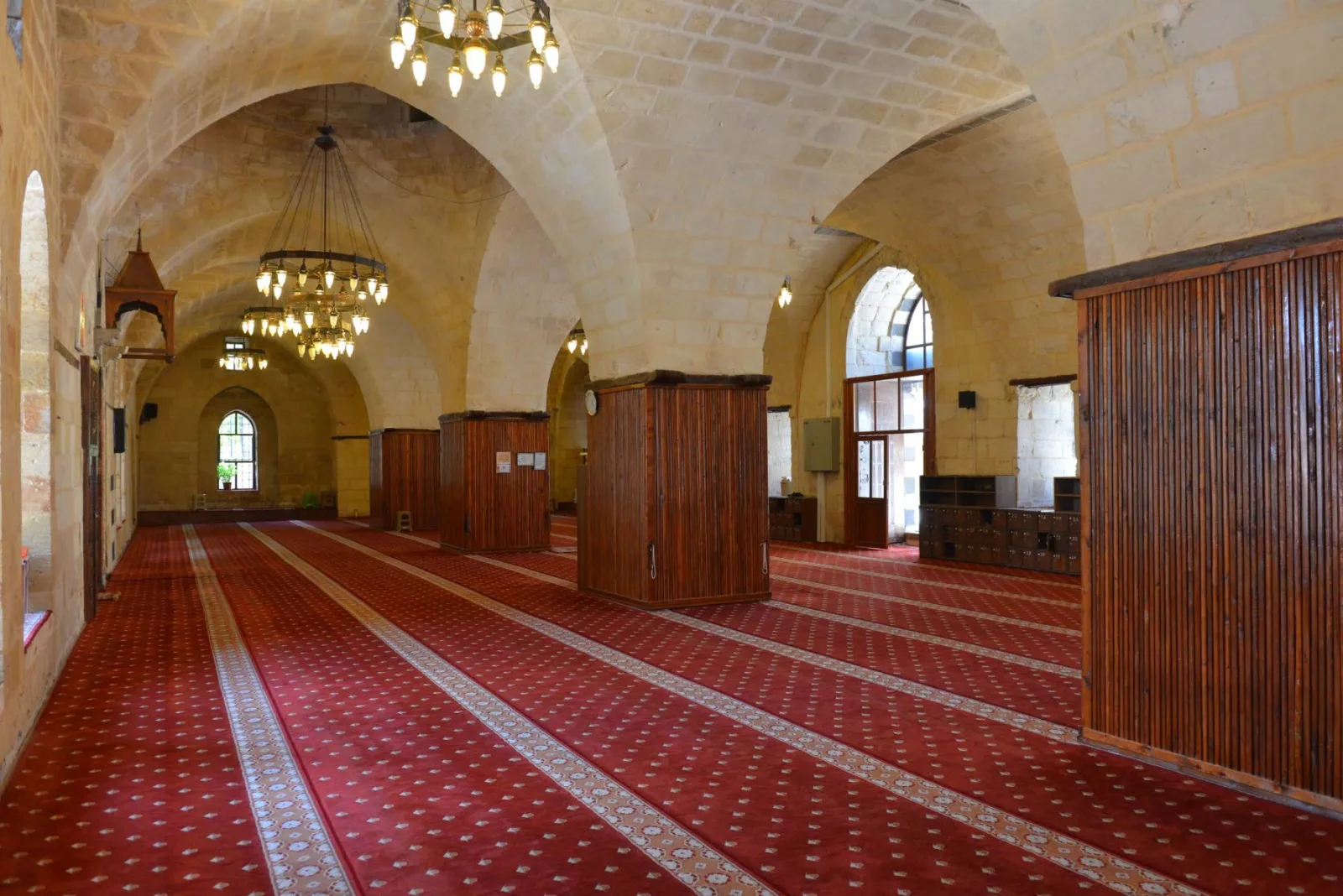
Another element nearly as striking as the minbar is the woodwork and stonework around the mihrab, decorated with twelve-pointed stars and geometric compositions. The building itself is constructed of cut stone; its transverse rectangular plan is divided into two parallel sections by four pillars. The area in front of the mihrab is covered by a dome, while the remaining sections are roofed with vaults. The polygonal-bodied minaret rising beside the courtyard entrance is a type rarely seen in Anatolia; it was renovated in the late 19th century.
In the city's memory: a hospital, a cemetery, a monument
For the people of Gaziantep, Boyacı Mosque is not merely an old mosque; it is a place that witnessed the painful days of the national struggle. During the defense of Antep the mosque was used as a hospital, and women who lost their lives here were buried in its small cemetery. For those curious about the city's heroic years, the The Defence of Antep page offers the wider frame of this story.
To keep this memory alive, a Women Martyrs Monument was erected in the mosque's courtyard, beside the cemetery, in 2017. The work of sculptor Cahide Erel, the monument honors the women who fell as martyrs in the defense of Antep; the names of 83 women martyrs are inscribed on its base. It is recognized as the first monument in Türkiye dedicated to women martyrs, and it quietly reminds visitors at what cost the city earned its title of "Gazi" (warrior).
The mosque today and how to visit
Boyacı Mosque is still an active, living neighborhood mosque open for worship today. Visitors can both pray and look closely at that unique minbar, the mihrab craftsmanship, and the monument in the courtyard. It should be remembered that this is a place of worship; it is best explored quietly, in modest dress, and with respect for prayer times.
The building is a natural stop on walking routes through Gaziantep's historic center and pairs beautifully with the city's other long-standing religious buildings. Those who want to taste Antep's mystical atmosphere and its classical Ottoman–Mamluk architecture should add the nearby Sheikh Fethullah Mosque and Complex and the magnificent Kurtuluş Mosque, originally built as a church and later converted into a mosque, to their route. Seen together, these three buildings give a far fuller sense of the layered religious heritage Gaziantep has woven over the centuries.
Frequently Asked Questions
Where is Boyacı Mosque located?
The mosque is in the Şahinbey district of Gaziantep, in the Boyacı neighborhood that bears its name, at the intersection of Kutlar Street and Hamdi Kutlar Avenue, within the city's historic center.
When was Boyacı Mosque built?
Its exact construction date is unknown and sources give differing dates. A common account places its foundations in the early 13th century, while the minbar's date is debated — one reading gives 1358 (AH 759) and the inscription legible today reads 1550 (AH 957). The mosque was repaired in 1575 by Mehmet Pasha, the governor of Aleppo.
Why is Boyacı Mosque famous?
It is best known for its walnut kündekâri minbar that moves on rails. Drawn out for the Friday sermon and then tucked back into the wall, it is the oldest known movable minbar in Anatolia. The mosque is also notable for its polygonal minaret and the women martyrs monument in its courtyard.
Why does the mosque have several names?
It is known as Boyacı Mosque, Boyacıoğlu Mosque, and Kadı Kemalettin Mosque, the last after a learned judge (kadı) who once served there. These multiple names reflect the building's long, layered history.
What is the Women Martyrs Monument in the courtyard?
During the defense of Antep the mosque was used as a hospital, and women who died there were buried in its cemetery. To honor this, a monument by sculptor Cahide Erel was erected in the courtyard in 2017; the names of 83 women martyrs are inscribed on its base, and it is regarded as the first monument in Türkiye dedicated to women martyrs.
Is Boyacı Mosque open to visitors?
Yes, it is still an active, living neighborhood mosque open for worship. Visitors can see the minbar, the mihrab craftsmanship, and the courtyard monument; it is best explored quietly, in modest dress, and with respect for prayer times.