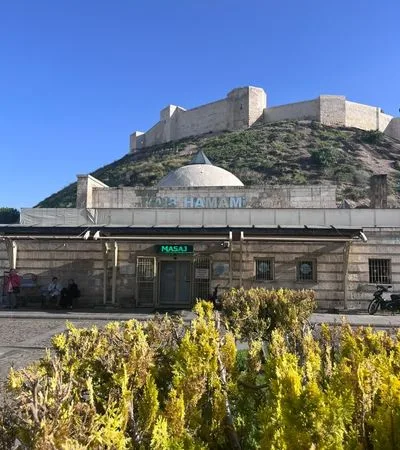
Right at the foot of Gaziantep Castle, in the narrow lanes of the old tannery quarter, sits a low, domed building that is easy to miss from the street: the Naip Bath. For centuries it washed and warmed the people of Antep, witnessing the gossip of bath day, the drum of the bridal hammam and the steam rising over scrub-mitt and soap. It is counted among the city's least-altered Ottoman baths. Step through its door and you are met by the classic Turkish-bath sequence of cool, warm and hot rooms, and by a centuries-old ritual that still turns around the heated central stone.
The Naip Bath stands in the oldest core of Gaziantep, around the Tabakhane (tannery) quarter on the southern slope below the castle. This neighbourhood, once defined by tanners, dye-houses and water running through its springs and channels, is the bath's natural home: water, heat and street life are tightly woven together here.
The bath was not conceived as a stand-alone building. It was built as part of a külliye, a complex that also included a dervish lodge (tekke), a tomb (türbe) and a small mosque (mescit). This tells us it was not merely a place to wash, but a charitable foundation enterprise bound to the social and religious life of the quarter.
When, and by whom?
The history of the Naip Bath holds more question marks than one might expect, and the sources do not agree on a single date. One view, drawn from entries in the Ayıntab pious-foundation registers, suggests the building may date to the first quarter of the 16th century. Other sources and on-site information instead give the year 1640. There is no firm, documented record of who commissioned the bath or who designed it, and no clearly dated inscription is cited.
What is certain is that the bath was already standing and in use by the 17th century: this makes it a recognised part of the city's long-standing bathing culture. So rather than fixing a single exact year, it is more honest to describe it as a structure that took shape somewhere between the mid-16th and the 17th century, with different dates given in different sources.
The exact construction year of the Naip Bath is disputed. Foundation records point to the early 16th century, while other sources give 1640. As no dated inscription is clearly documented, the safest statement is that the building belongs to the late-classical Ottoman period.
What to see: architecture and plan
The Naip Bath has a rectangular plan running east to west. Like most Gaziantep baths, it was set below street level; sinking the building half into the ground is a clever choice that helps the interior heat up more easily and hold its warmth far longer. As a result it looks low and modest from outside; the real architectural richness is hidden in the shaded, steamy world beyond the door.
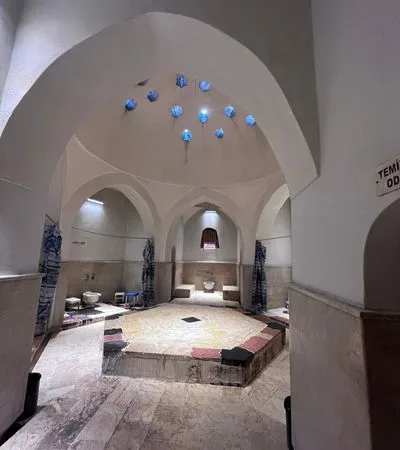
Inside, the three-stage layout of the classic Turkish bath reads clearly:
The cool room (soğukluk)
Square in plan and covered by a single dome, the cool room serves both as a changing space and as a place to rest after washing. The transition from the square walls to the round dome is achieved with Turkish triangles (and, in places, pendentives), a hallmark of Anatolian Turkish architecture that carries both the structural and the aesthetic unity of the bath.
The warm room (ılıklık)
The intermediate space between the cool and hot rooms, the warm room prepares the body for the heat and is usually covered with a vault. This is the threshold where the rhythm of the bath slows and conversation deepens.
The hot room (sıcaklık)
The heart of the building, the hot room is laid out symmetrically. At its very centre sits the octagonal heated stone (göbek taşı), where bathers stretch out to sweat. To the east and west are iwans (eyvan), and flanking these are small, enclosed private cells (halvet) for individual washing. Behind the hot room lies the furnace (külhan); through underground channels (the hypocaust), its heat spreads beneath the floor across the whole space.
The bath in the life of the city
In an Ottoman city the bath was never only a place to get clean; it was the neighbourhood's hub for meeting, resting and exchanging news. In Gaziantep, bath day was a ritual: for women it could mean hours-long gatherings with food and music, while ceremonies such as the bridal bath, the new-mother's bath and the soldier's send-off bath marked life's turning points in these rooms. Scrub-mitt, soap, steam and conversation washed away not only the day's fatigue but also refreshed the memory of the city itself.
The Naip Bath is one of the few buildings in which this bath culture has been lived without interruption in Gaziantep. Being among the city's least-altered baths makes it not just a historic monument but a living tradition that still breathes.
The bath today, and how to visit
The Naip Bath underwent a thorough restoration in the second half of the 2000s and was reopened with its original fabric preserved. In an age when many historic baths have become museums, the distinctive thing about the Naip Bath is that it still does its job: today it remains a working hammam, welcoming visitors with separate hours for women and men and offering the traditional washing, scrub and massage experience.
Sitting right at the foot of the castle, within walking distance of the historic bazaars and inns, the bath is a natural part of any city-centre walk. Visitors who want to understand Gaziantep's bath culture more closely can pair the bathing experience with a complementary stop: the Bath Museum, set inside another historic hammam, presents bath architecture and its everyday ritual in museum form. Because the Naip Bath was built as part of a külliye, it is also kin to the city's complex-building tradition; those curious about that context can look at the page on the Sheikh Fethullah Mosque and Complex. To extend your walk into the historic commercial fabric below the castle, the Coppersmiths' Bazaar and the Historic Buildings section make a good starting point.
Frequently Asked Questions
Where is the Naip Bath?
It is in the Şahinbey district of Gaziantep, around the Seferpaşa (Tabakhane) area on the southern slope below the castle, right in the city centre and within walking distance of the historic bazaars and inns.
When was the Naip Bath built?
The exact year is disputed. Foundation records point to the early 16th century, while some sources give 1640. As no dated inscription is documented, it is placed in the late-classical Ottoman period and it was certainly standing by the 17th century.
Is the Naip Bath still in operation?
Yes. After a thorough restoration that preserved its original fabric, it reopened and still operates as a working hammam today, offering the traditional bathing experience with separate hours for women and men.
Are the Naip Bath and the Bath Museum the same building?
No. The Naip Bath is a working hammam, while the Bath Museum is a separate historic bath (the Paşa Hamamı) that was restored and converted into a museum. They are different buildings, though both reflect Gaziantep's bath culture.
What makes the Naip Bath architecturally special?
Its most notable feature is that it is one of the city's least-altered Ottoman baths. With its rectangular plan sunk below street level, its domed cool room with Turkish-triangle transitions, and its hot room laid out symmetrically around an octagonal heated stone with iwans and private cells, it preserves the classic Turkish-bath scheme intact.
What else can I see while visiting the Naip Bath?
The bath is in the historic centre below the castle, with bazaars and inns within walking distance. To see bath culture in museum form visit the Bath Museum; for the complex-building tradition look at the Sheikh Fethullah Mosque and Complex; and for coppersmithing head to the Coppersmiths' Bazaar.