 Vegetarian
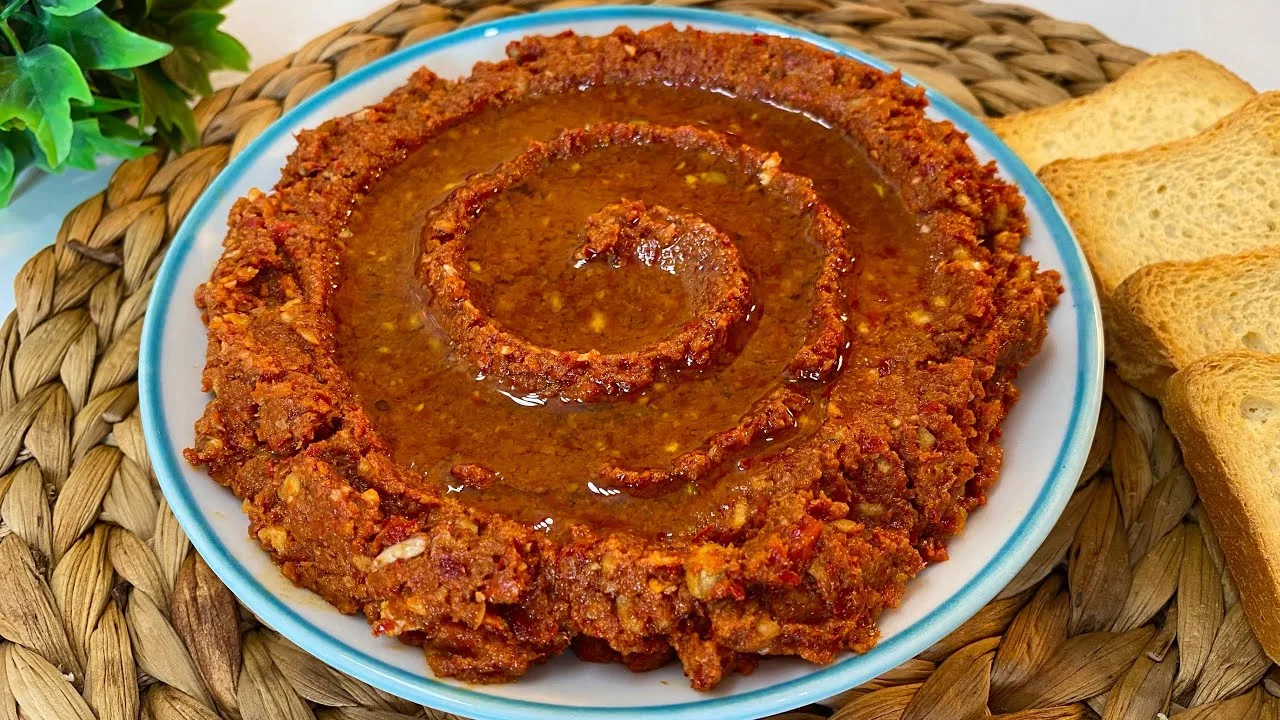
Muhammara is a cold, sweet-sour and mildly spicy Gaziantep meze in which red pepper, ground walnuts and pomegranate molasses come together. Its texture is soft and spreadable; its colour a deep red. Breadcrumbs or crushed rusk bind the paste, olive oil softens it, and spices such as garlic and cumin together with isot/pul biber (red pepper flakes) give it depth. It comes to the table both as a breakfast spread and as a cold meze; in Antep it carries a geographical indication under the name "Gaziantep Muhammarası."
On the Antep table, muhammara has a dual identity, moving between a spread for bread and a cold meze on the kebab table. In Gaziantep this meze has two local names: "cevizli biber" (walnut pepper), after its walnuts, and "acuka" (acıka), widely used in everyday speech. Whichever name it goes by, the balance of the walnut–pepper–pomegranate-molasses trio makes it recognisable; in this respect it is a deep-rooted part of Antep's cold-meze tradition, alongside Spicy Paste and Gavurdağı Salad.
What Is Muhammara and What Is in It?
Muhammara is a cold paste built on a red-pepper base, made rich with ground walnuts and carrying the sweet-sour note of pomegranate molasses. It is made meat-free, dairy-free and entirely plant-based; its character comes not from a single ingredient but from the balance between the sweetness of the red pepper, the oily fullness of the walnut, the tartness of the pomegranate molasses and the heat of the spices. Breadcrumbs or crushed rusk pull the mixture together and give it its characteristically full texture. A defining feature of Gaziantep's registered version is that the binder is breadcrumbs/rusk, not bulgur.
Core Components
- Red Pepper: The base and the colour of the meze; a sweet, full pepper foundation built from fresh red pepper, red pepper flakes and/or red pepper paste forms the body of muhammara.
- Walnuts: The signature of muhammara is ground walnuts; with their oily, faintly nutty fullness they give the paste its body. The local name "cevizli biber" (walnut pepper) comes directly from this.
- Breadcrumbs / Rusk: Crushed dry bread/rusk acts as the binder, pulling the paste together and giving it a spreadable texture. In the registered Gaziantep version this binder is used rather than bulgur.
- Pomegranate Molasses: Setting the sweet-sour balance, pomegranate molasses (nar ekşisi) offsets the richness of the walnut and pepper with a lively tartness.
- Olive Oil and Spices: Olive oil softens the texture and adds sheen; garlic, cumin and isot/pul biber lend the paste depth and a gentle heat.
Where the Name Comes From
"Muhammara" is a word of Arabic origin; it comes from the root ḥ-m-r, the same root as the Arabic aḥmar, "red." Accordingly, muhammara roughly means "reddened / made red," pointing to the deep red colour of the meze. In Gaziantep the same meze is known by two local names: "cevizli biber" (walnut pepper), after its walnuts, and "acuka" (acıka), common in everyday speech. These names highlight both the colour of the meze and its most distinctive ingredient, the walnut.
The History and Cultural Origins of Muhammara
Muhammara is a classic Levantine meze whose roots reach back to Aleppo (Halep), in Syria; it is part of a shared culinary heritage across the whole region. Muhammara is therefore not a Gaziantep invention but a flavour shared across the broad Aleppo–Levantine culinary zone. Throughout history, Gaziantep lay within the same culinary basin as Aleppo, and a deep exchange ran between the two cities; on this shared ground Antep, too, developed its own long-established version of muhammara.
The Aleppo–Antep Culinary Link
Gaziantep and Aleppo were, for centuries, bound by intense trade and culinary exchange, and ingredients such as pepper, walnuts and pomegranate molasses became a common language of this geography. Muhammara is one product of that shared cuisine: as in Aleppo, so in Antep it found a firm place within the tradition of the cold meze and the spread for bread. Antep has kept this shared meze alive in its own taste — with a breadcrumb/rusk binder and a local balance of pepper, walnut and pomegranate molasses — under the names "cevizli biber" and "acuka."
Muhammara is registered with TÜRKPATENT as a Geographical Indication (mark of source / Mahreç İşareti) under the name "Gaziantep Muhammarası." It is recorded under No 1073; the application was filed on 02.06.2021 and the registration was completed on 11.04.2022. The registrant is the Gaziantep Metropolitan Municipality. A defining feature of the registered Gaziantep version is that the binder is breadcrumbs/rusk rather than bulgur.
The Muhammara Tradition and Ritual in Gaziantep
In Gaziantep, muhammara has a dual role that stretches across both the morning and the evening table. On the one hand it is a breakfast spread put on bread; on the other it is a cold meze that comes alongside kebabs at lunch and dinner tables. It is always served cold; with its colour, full texture and sweet-sour-spicy balance, it makes itself known on the plate at once.
How It Is Eaten
Muhammara is most often eaten cold, with bread, lavaş or simit. At the breakfast table it is a paste spread on bread; on the meze plate it is a cold flavour set beside kebabs and grills. On Antep's meze table it sits side by side with cold flavours such as Spicy Paste and Gavurdağı Salad, offering a refreshing, sweet-sour balance to a meat-heavy spread. Spread thinly over a flatbread, it can also be eaten alongside fire-baked flavours such as Gaziantep Lahmacun.
Why You Should Try It
A spoonful of muhammara carries, in a single bite, the balance Antep cuisine builds around walnut, red pepper and pomegranate molasses: the sweetness of the pepper, the oily fullness of the walnut, the tartness of the pomegranate molasses and the gentle heat of the spices come together. Cold, spreadable and filling, it completes both a plain bread-and-cheese table and a rich kebab spread. The truest way to taste it is from a cold bowl drizzled with a little olive oil, alongside fresh bread or lavaş.
Frequently Asked Questions
What is muhammara and what is in it?
It is a cold, spreadable, sweet-sour-spicy Gaziantep meze in which red pepper, ground walnuts and pomegranate molasses come together, bound with breadcrumbs/rusk and made with olive oil and spices.
Where does muhammara originate?
Muhammara is a classic Levantine meze whose roots reach back to Aleppo (Halep), in Syria; it is not a Gaziantep invention. Gaziantep, in the same culinary basin, has its own long-established and registered version.
Does muhammara have a geographical indication?
Yes. It is registered as a TÜRKPATENT Geographical Indication under the name "Gaziantep Muhammarası," with No 1073; the registration was completed in 2022.
What are muhammara's local names and how is it eaten?
In Gaziantep it is known as "cevizli biber" (walnut pepper) and "acuka" (acıka). It is eaten cold, coming to the table both as a breakfast spread on bread and as a cold meze beside kebabs.