 Vegetarian
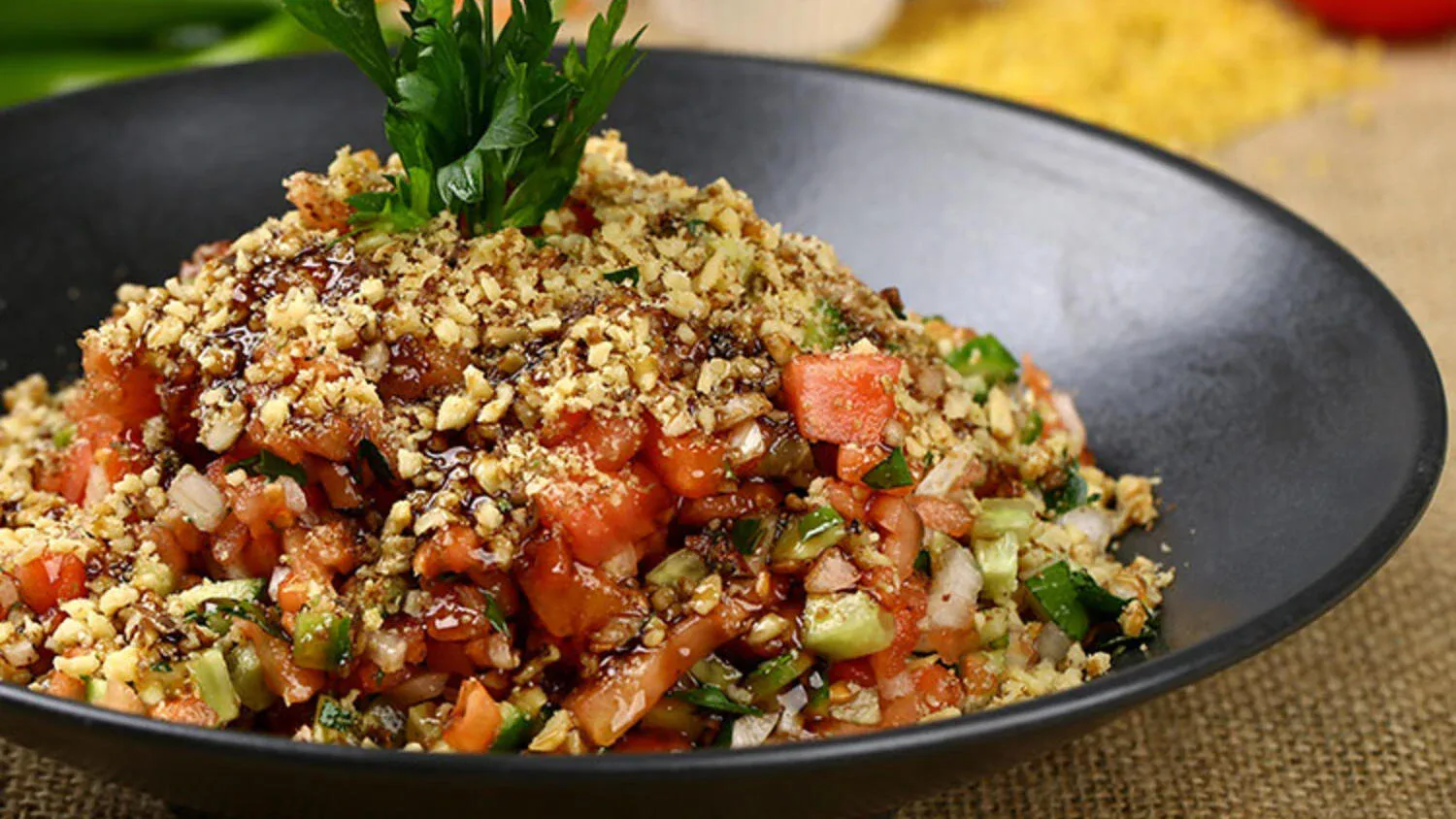
Gavurdağı salad is a walnut-and-tomato salad identified with Gaziantep, in which very finely and uniformly diced tomato is combined with onion, walnuts, parsley and green pepper and tossed with pomegranate molasses, sumac and olive oil. Three things set it apart from an ordinary tomato salad: the very fine, almost mince-like uniform dice of its ingredients, the walnuts it contains, and the pomegranate molasses (nar ekşisi) that gives it its tangy, fruity signature. Because it is diced so finely that it can be eaten easily with a spoon rather than a fork, in Antep it is also called "kaşık salatası" (spoon salad).
This salad most often takes its place beside kebab and grilled meats on the Gaziantep table. Its sour-fresh profile, drawn from pomegranate molasses and sumac, works as a fresh, acidic companion that balances the richness of fatty grilled meat. It takes its name not from a person or a single kitchen but from the Gâvur Dağları (the Amanos Mountains), the mountain range that gives the region its name.
What Is Gavurdağı Salad and What Is in It?
Gavurdağı salad is a cold salad whose base is very finely diced tomato, to which walnuts, onion and fresh herbs are added, and which is tossed with pomegranate molasses and olive oil. Its character comes less from any single ingredient than from a balance: the sweet, juicy body of the tomato, the oily crunch of the walnuts and the sharp sourness of the pomegranate molasses come together. It looks plain, but the fineness of its dice and the balance of pomegranate molasses make it distinctive.
Core Components
- Tomato: The base and the largest component is ripe tomato, diced very finely and uniformly. The fine dice lets the juicy body soak into the other ingredients.
- Walnuts: The signature ingredient of gavurdağı salad. Coarsely crumbled or chopped walnuts add an oily crunch and substance to the salad; they are one of the clearest things that set it apart from a shepherd's salad.
- Onion: Dry red onion or fresh (green) onion, finely diced, gives the salad sharpness and depth.
- Parsley and Green Pepper: Finely chopped parsley (often together with mint) and green pepper add freshness and a green aroma.
- Pomegranate Molasses (Nar Ekşisi): The tangy, fruity dressing that gives the salad its signature; it is the defining element of gavurdağı salad, the thing that separates it from plain salads.
- Sumac, Olive Oil, Salt and Pul Biber/İsot: Sumac deepens the sourness, olive oil binds the ingredients together, and pul biber or isot adds a gentle warmth.
- Cucumber (Commonly Included): Finely diced cucumber is most often part of the salad; some traditional versions omit it, so it is a commonly-included rather than a strictly defining component.
What Sets It Apart from Shepherd's Salad? ("Spoon Salad")
Three core features set gavurdağı salad apart from an ordinary shepherd-style salad: (a) the very fine, uniform, almost mince-like dice of its ingredients, (b) the walnuts it contains, and (c) the way it is tossed with pomegranate molasses. A coarsely cut mixture of tomato and cucumber, without walnuts and without pomegranate molasses, is a shepherd's salad; what makes gavurdağı salad different is exactly this trio of fine dice, walnuts and pomegranate molasses. The dice is so fine that the salad comes to the spoon rather than the fork; this is why, in Antep, it is also called "kaşık salatası" (spoon salad).
The History and Name of Gavurdağı Salad
Gavurdağı salad takes its name not from a person but from a mountain region: the Gâvur Dağları, that is, the Amanos Mountains (officially renamed Nur Dağları in the republican era). This range runs along the Kahramanmaraş–Gaziantep–Osmaniye–Hatay corner and forms a natural wall that separates the Çukurova and the Mediterranean lowlands from the Antep plain. The salad is a regional salad belonging to Southeastern Anatolia and the wider Gâvurdağı–Çukurova region that takes its name from this mountain region; it is most strongly identified with Gaziantep, though Osmaniye and Hatay also serve and claim it. In this respect, gavurdağı salad should be treated not as the invention of a single city but as "a regional salad most associated with Gaziantep."
Where the Name "Gavurdağı" Comes From
There are two competing explanations for the origin of the word "gâvur" that gives the salad its name, and neither is certain. The first is the folk reading: "gâvur dağı" ("infidel mountain"), tied to the range's historic frontier position and its non-Muslim associations (the word gâvur derives from the Persian gebr; after the 1856 Islahat Fermanı its use was officially discouraged and the range was renamed Nur Dağları). The second is a linguistic view: it proposes that the "gâvur" here derives from the Arabic gavr / al-gavr (low, sunken terrain between heights). Both explanations appear in the literature on the region's place names; this page conveys both, but asserts neither as definitively correct.
Gavurdağı salad does not carry a geographical indication under its own name; it is an unregistered salad. No invented registration is claimed for it on this page. Gavurdağı salad is treated as a regional salad most associated with Gaziantep, defined by walnuts and pomegranate molasses — an unregistered but deep-rooted part of the city's kebab and table culture.
The Gavurdağı Salad Tradition and Ritual in Gaziantep
In Gaziantep, gavurdağı salad is the classic salad that most often takes its place beside kebab and grilled meats. It comes to the table not as a main dish but as a fresh, sour companion that balances the meat. Its sour-fresh profile, drawn from pomegranate molasses and sumac, cuts the richness of fatty grilled meat; it provides an acidic counterbalance that refreshes the palate after each bite. In this respect the salad is an inseparable part of the Antep kebab table.
What It Is Served With
Gavurdağı salad is eaten above all beside kebab and grilled meat; it is served right next to grilled flavours such as liver kebab as a sour-fresh salad that balances the meat. On the same table it often appears alongside walnut-based appetizers such as muhammara; the shared presence of walnuts in both the salad and the appetizer reflects the Antep table's love of the walnut. With its brothy, ice-cold character, avrat salad is another contrasting accompaniment in the same meze group. A spoonful of gavurdağı salad beside the kebab adds both freshness and a sour balance.
Why You Should Try It
A spoonful of gavurdağı salad carries the meat-and-sour balance of the Gaziantep table straight to the palate: the juice of the finely diced tomato, the oily crunch of the walnuts and the sharp sourness of the pomegranate molasses and sumac come together. It is not a heavy or showy appetizer; what stands out is the balance that plain ingredients gain from the fine dice and the pomegranate molasses. The truest way to taste it is beside a hot kebab, cold and fresh, by the spoonful.
Frequently Asked Questions
What defines gavurdağı salad?
Three things: the very fine, uniform dice of its ingredients, the walnuts it contains, and the way it is tossed with pomegranate molasses. This trio sets it apart from a shepherd's salad, which has neither walnuts nor pomegranate molasses.
Where does the name "Gavurdağı" come from?
The salad takes its name from the Gâvur Dağları (the Amanos Mountains; officially Nur Dağları). For "gâvur" there are two explanations: a folk "infidel mountain" reading, and an Arabic gavr (low, sunken terrain) origin; neither is certain.
Does gavurdağı salad belong only to Gaziantep?
It is most strongly identified with Gaziantep, but it is a regional salad of the wider Gâvurdağı–Çukurova region; Osmaniye and Hatay also serve and claim it.
Does gavurdağı salad have a geographical indication?
No. Gavurdağı salad does not carry a geographical indication under its own name; it is an unregistered but strongly Gaziantep-associated regional salad.