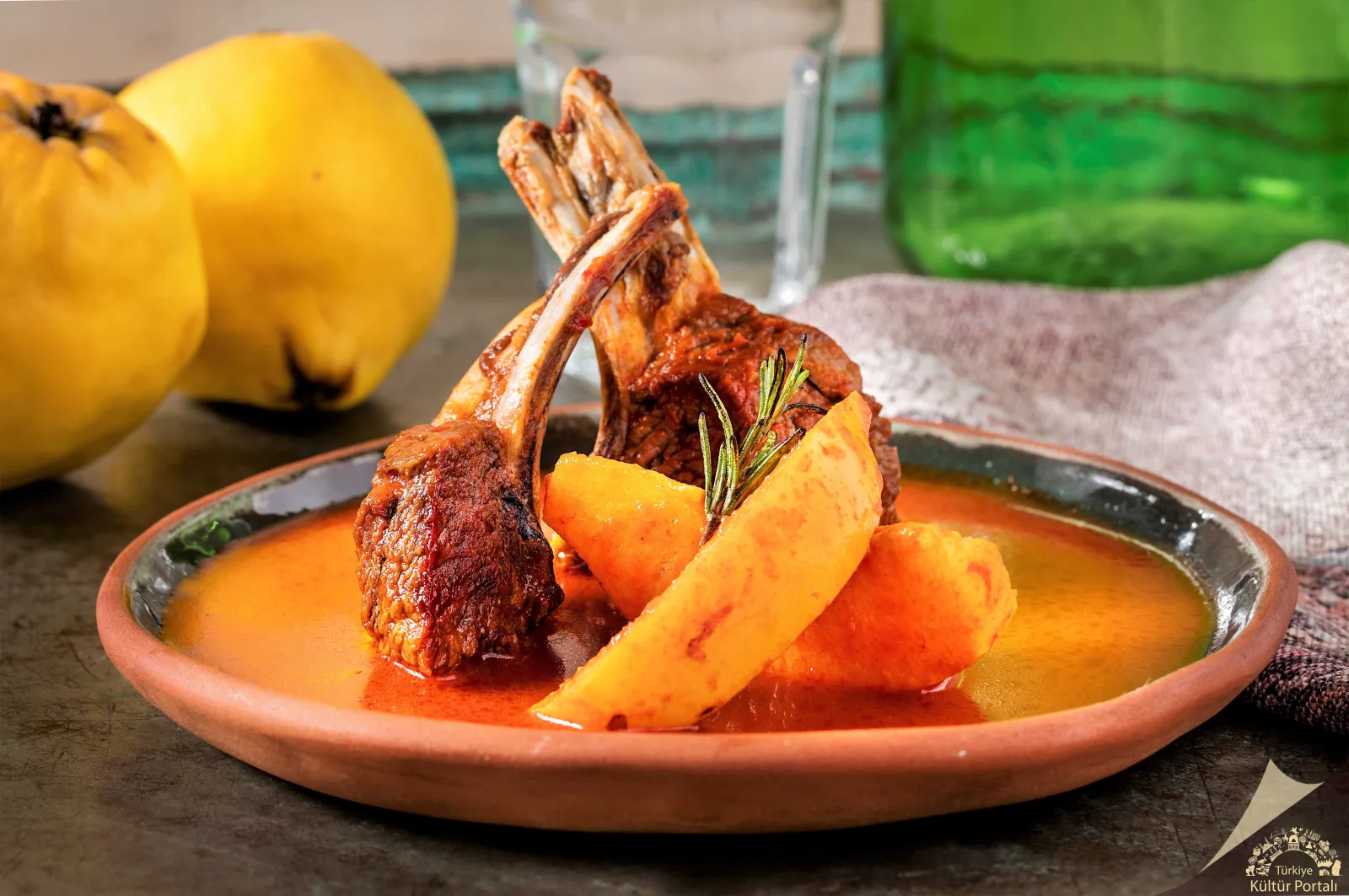
Quince Sour Ribs — known in Gaziantep as Ayvalı Ekşili Taraklık — is a winter dish built on a sweet-and-sour balance, in which the lamb rib-chop cut called taraklık is slow-braised together with sliced quince and pomegranate molasses. Unlike the summer logic of meat on the mangal skewer, here the meat is first seared, then softened at length in a pot; the resinous sweetness of quince and the sharpness of pomegranate molasses meet the fat of the meat to form a braise specific to the region's cold-weather table. The dish was placed under official protection in 2022 with TÜRKPATENT Geographical Indication status (No. 1084).
Its character arises from the harmony of three axes: the deep flavour of bone-in, fatty rib meat released by slow cooking, quince sliced with its skin on and added at the last moment, holding its shape and aroma, and the fat-cutting acidity given by pomegranate molasses (or lemon / verjuice). This article explores the ingredient world of the dish — beginning with the taraklık cut — its local origins documented by the registration record, and its place at Gaziantep's winter table.
What Is Quince Sour Ribs and What Is in It?
Quince Sour Ribs is a pot-braised sour meat dish that takes its name from its principal ingredient, the taraklık cut. In Gaziantep cuisine, the rib chop taken from the back of the sheep or lamb, adjacent to the ribs, is called "taraklık." The dish is not a classic shish or mince kebab; its first contact with fire happens only at the searing stage, while its true flavour comes from slow braising in the pot and from the quince-sour balance.
Core Components
The essential components of traditional Quince Sour Ribs are as follows:
- Taraklık (Rib Chop) Meat: The body of the dish is the rib chop cut, adjacent to the ribs, of sheep or lamb. Bone-in and naturally fatty, this cut softens without falling apart when cooked long over low heat, and its juices thicken with the gelatin from the bone. The registration record defines one portion as "2-3 chops."
- Quince: The signature of the dish is quince cut into large slices with the skin left on. It is generally added unpeeled and toward the end of cooking, in a stage of about five to seven minutes, so that it does not break down into a purée but keeps its slice texture and faintly resinous aroma. Its natural sweetness, balanced against the sharpness of pomegranate molasses, defines the dish's sweet-and-sour character.
- Souring Agent: The acidity that gives the dish its name is traditionally provided by pomegranate molasses, and in places by lemon juice or verjuice. The acid is usually added in the last three to five minutes of cooking; this preserves both the colour and the sharp aroma, and cuts the fat.
- Onion and Paste: Dried onion is sautéed in butter or clarified butter (sadeyağ); tomato and red pepper paste give the dish its colour and body. Pearl onions and garlic are added optionally.
The elements that complete the plate are butter or clarified butter, restrained salt and black pepper, and water or tomato juice as the braising liquid. The registered recipe calls for roughly 1–1.5 kg of taraklık meat and 2–3 quinces for a portion of four to five people.
The Geography of the Plate
On the plate, the bone-in chops, the quince slices and the thick braising liquid are served together; the registration record defines one portion as "2-3 chops, 4-6 quince slices and 3-5 spoonfuls of cooking liquid." Warm bread or pita sits beside the plate to wipe up the oily, sour sauce. In the autumn and winter months when quince is abundant, the dish stands out on Antep home tables and in tradesmen's restaurants.
The History and Cultural Origins of Quince Sour Ribs
Quince Sour Ribs is a member of Gaziantep cuisine's "sour braise" tradition. The idea of bringing meat and a seasonal fruit together in the same pot is a deeply rooted practice in and around Antep; alongside quince, the region also has meat dishes cooked with sour elements such as plum, sour cherry or verjuice. This dish is the version of that idea interpreted with quince and pomegranate molasses, built on the bone-in rib-chop cut.
The Origin of the Name "Taraklık"
The dish's identity comes directly from the name of the cut of meat. The reason the rib chop adjacent to the ribs is called "taraklık" in Gaziantep and surrounding regions is that the row of rib bones resembles a comb in appearance. The same cut is known as "Maraş taraklığı" in neighbouring Kahramanmaraş cuisine. In other words, "taraklık" describes not a cooking technique but a specific cut of meat; the prefix "ayvalı ekşili" (with quince, soured) describes how that cut is cooked.
A Trace of Seasonal Court Cuisine
The practice of cooking meat together with fruit — especially a sweet-and-sour fruit like quince — is one of the rooted techniques of Ottoman cuisine, and found a natural counterpart in an established city cuisine like Antep's. Because quince is limited to its harvest season, the dish has been seasonal from the outset, which sets it apart from the kebabs made year-round. Rather than a documented history, it is more accurate to say the dish lives on as a winter meal handed down from generation to generation in the regional kitchen.
Gaziantep/Antep Ayvalı Ekşili Taraklık was registered by TÜRKPATENT as a Geographical Indication (Mahreç İşareti) on 18.04.2022. The registration number is 1084, the applicant Gaziantep'i Geliştirme Vakfı (Gaziantep Development Foundation), with an application date of 10.02.2021 (file no. C2021/000065). The registration document defines the dish's main ingredients as the rib-chop meat called "taraklık," quince, onion, paste and spices, and notes that production concentrates especially in the quince season of September–February.
The Place of Quince in Antep Cuisine
Behind the dish lies the treatment of quince as a component entering meat dishes in Antep cuisine. Quince kebab, which interprets the same fruit through a different technique, is also known in the region; this shows that in Antep quince is seen not merely as an ingredient for desserts or compotes but as a direct companion to meat. Similar meat-and-plant combinations built with a vegetable or fruit also appear in regional examples such as Eggplant kebab.
The Tradition and Ritual of Quince Sour Ribs in Gaziantep
Quince Sour Ribs belongs to the slow-cooked, season-bound dishes of Antep home cooking. It is not a quick meal; it is a braise prepared with patience, requiring the meat to be seared, softened over low heat, and the quince added at the right moment.
The Seasonal Dish of the Winter Table
The dish's season is set directly by the quince harvest; as the registration record emphasises, production concentrates especially in the quince season stretching from September to February. In this respect the dish departs from the summer mangal culture, standing out in the cooling weather as a slow-cooked winter plate whose acidity whets the appetite.
The Sear-and-Slow-Braise Technique
Two approaches are known in traditional preparation: in one, the chops are first seared on both sides in a grill pan or hot dry pan to hold their juices, then braised over low heat with sautéed onion, paste and liquid; in the other, the meat is cooked slowly straight in the pot. In both, the meat is held over low heat for roughly thirty to sixty minutes until tender; the quince is added toward the end of cooking, and the souring agent last of all. This sequence keeps the quince from breaking down and the acidity sharp.
A Trace of Tinned Copper Vessels
The slow-cooked dishes of Antep home cooking were traditionally prepared in tinned copper pots and pans; the even, gentle heat distribution of copper was the reason it was preferred for long-cooked meat dishes. Quince Sour Ribs sits within this vessel culture. Although modern pots are now in common use, the regional preparation preserves unchanged the principle of low heat and long cooking.
Bread-Dipping and Table Etiquette
The sour, oily braising liquid left on the plate is wiped up with pieces of warm Antep pita or yufka bread. This table etiquette is part of the city's ethic of leaving nothing on the plate; the thick sauce is often a flavour sought after as much as the meat itself. Unlike Antep's lavish kebabs such as pistachio kebab, here it is the acidity that balances the plate on its own.
The Dish's Place in Antep Cuisine
In the regional order, Quince Sour Ribs is less an everyday meal than a home and tradesmen's-restaurant dish cooked with care when its season comes. Requiring particular knowledge from the cut of meat to the cooking technique, it is bound to the same craft tradition as the region's other "master-made" flavours, such as the zırh-prepared Gaziantep lahmacun. It is a dish offered to guests, whose recipe is asked for, whose season is awaited.
Why You Should Try It
A single bite of Quince Sour Ribs tells the Antep winter table in seconds: first comes the deep flavour of bone-in rib meat softened over low heat, then the faintly resinous sweetness of quince cooked with its skin on opens up, and finally the sharpness of pomegranate molasses cuts the fat and refreshes the palate. The balancing of this sour-sweet-fatty trio on a single plate leaves a palate memory unlike a classical kebab experience. For those who want to know Gaziantep not only through its summer kebabs but also through its seasonal winter cooking, a plate set before you in the quince months is one of the registration-documented examples of the region's meat-and-fruit tradition.
Frequently Asked Questions
What is Ayvalı Ekşili Taraklık (Quince Sour Ribs)?
It is a sweet-and-sour winter dish of Gaziantep in which the rib-chop cut of lamb or sheep called "taraklık," adjacent to the ribs, is slow-braised with sliced quince and pomegranate molasses.
What is in Quince Sour Ribs?
It uses taraklık (rib-chop) meat, quince sliced with its skin on, pomegranate molasses, onion and paste, and butter or clarified butter; the acidity is sometimes given by lemon juice or verjuice instead.
Does Quince Sour Ribs have a geographical indication?
Yes. Gaziantep/Antep Ayvalı Ekşili Taraklık was registered by TÜRKPATENT as a Geographical Indication (Mahreç İşareti) in 2022 (Registration No. 1084).
When and how is Quince Sour Ribs eaten?
It is eaten at the winter table during the September–February quince season. The bone-in chops, quince slices and thick braising liquid are served together, with warm bread or pita to wipe up the sauce.
How is Quince Sour Ribs cooked?
The meat is first seared, then softened over low heat with onion and paste for roughly thirty to sixty minutes; the quince is added toward the end of cooking and the pomegranate molasses last of all.