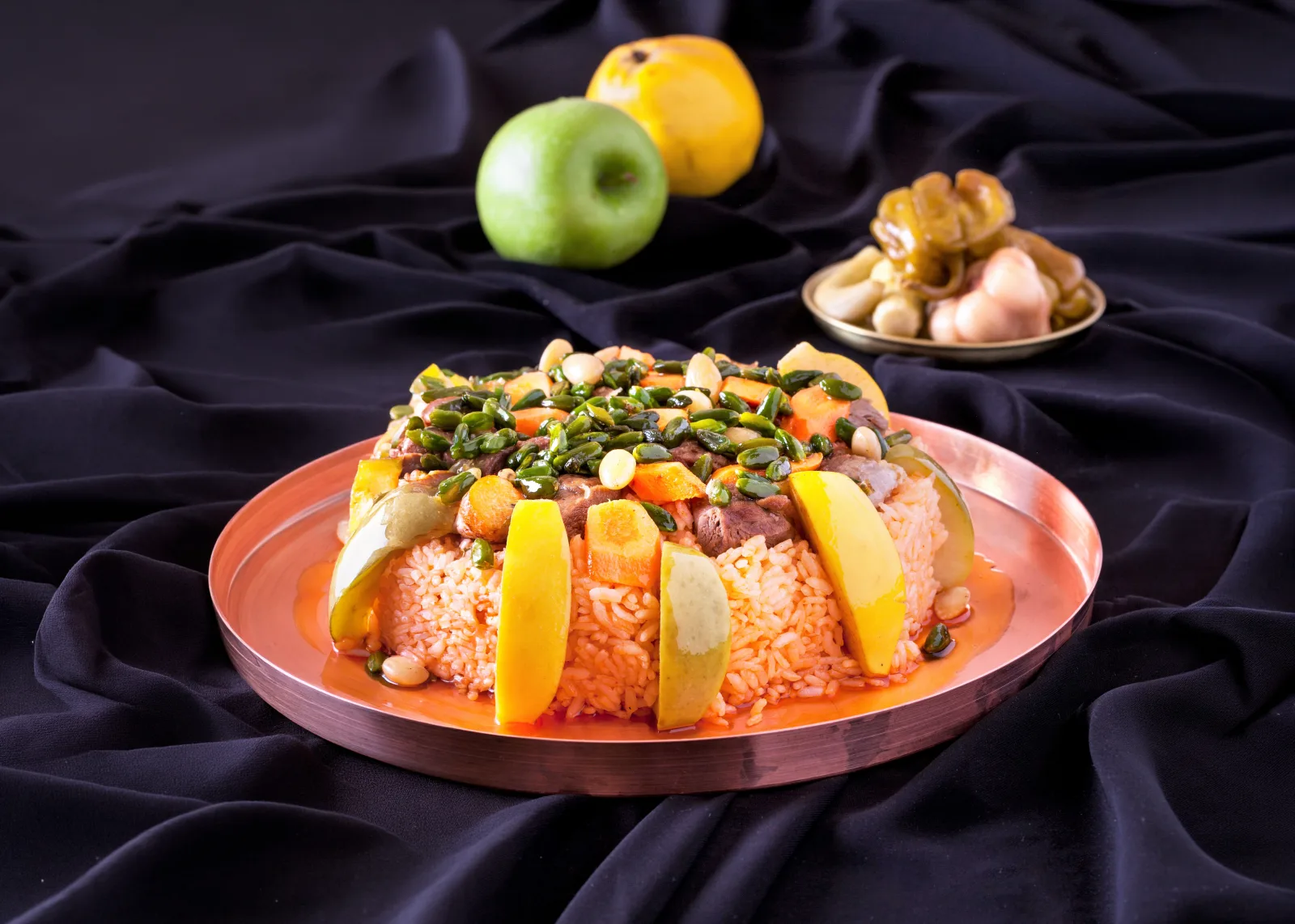
Buhara pilaf (Buhara Pilavı) is a registered Gaziantep pilaf in which rice is layered with meat, carrot, quince, sour apple, almonds and Antep pistachios, molded, and then turned out onto a platter as a dome. It is no ordinary pilaf; it is a festive dish set at the head of the table at weddings, on bayram (festival) tables and at gatherings for honoured guests — a complete meal in itself. With its glistening pieces of meat, sweet carrot and quince and toasted nuts, it appeals to the eye as much as to the palate.
Its name echoes the Central Asian city of Bukhara, and the dish is a deeply localized Gaziantep interpretation of a tradition of molded pilafs made with meat, carrot, fruit and nuts. Antep cuisine has reshaped it with its own ingredients — Antep pistachio, quince and sour apple — and, through a TÜRKPATENT geographical indication, made it an official part of the city's gastronomic heritage.
What Is Buhara Pilaf and What Is in It?
Buhara pilaf is a layered pilaf built on rice but holding far more than a single grain. The way the meat, the fruits and the nuts are each prepared separately, arranged in a set order, and then inverted from their mold to be served like a dome is what sets it apart from ordinary pilafs. Because the rice is cooked in the meat's cooking liquid (et suyu), it stays loose and separate yet rich in flavour; in this respect it is a meat dish.
Core Components
- Rice: Forms the body of the pilaf; cooked in the liquid the meat releases, it becomes separate-grained and aromatic.
- Lamb Shank (Meat): The main meat component is lamb shank (kuzu incik). It enters the pilaf both as pieces of meat and, through its cooking liquid, as flavour for the rice; this is why Buhara pilaf is a meat dish.
- Carrot: Sautéed in fat, it lends the pilaf both colour and a gentle sweetness; it is the constant vegetable of the molded-pilaf tradition.
- Quince and Sour Apple: The fruits give the dish a sweet-and-sour balance; meeting the fat of the meat, they bring the pilaf a characteristic, distinctly Antep flavour.
- Almonds and Antep Pistachios: Blanched almonds and Antep pistachios are each sautéed separately in fat and set into the layers; they are the signature nuts that bring crunch and richness to the pilaf.
- Butter or Olive Oil, Tomato Paste, Water, Salt and Black Pepper: The basic fats and seasonings used to sauté the components and cook the pilaf.
The registered original recipe contains no chickpeas or raisins; versions that include them are regional variations found in home kitchens. The official identity of Buhara pilaf rests on the balance of the components above and on the layered arrangement.
The Molded-Dome Presentation
What truly defines Buhara pilaf is the layered molded-pilaf technique. After the Antep pistachios, almonds, meat, quince, apple and carrot are each sautéed separately in fat, they are placed in a set order into a round-bottomed pot, with par-boiled rice spread over the top. Once the pilaf has cooked in this arrangement, it is inverted onto a platter; the pilaf then emerges like a ringed dome, with its meat, fruit and nuts visible on top. This striking presentation is Buhara pilaf's best-known feature and carries it to the centre of the table.
The History and Cultural Origins of Buhara Pilaf
The name "Buhara" points directly to Bukhara, the ancient city of Central Asia. The dish leans on Central Asia's broad plov / osh family — the tradition of molded rice made with meat, carrot, dried fruit and nuts. The Gaziantep interpretation of this family has been reshaped with local products such as Antep pistachio, quince and sour apple, and translated into the city's culinary language.
The Bukhara Name and the Question of Transmission
How the pilaf came to be tied to Bukhara is not clearly documented. Whether the name was carried by migration or simply given in homage to Bukhara is not known with certainty; it would be wrong to assert any firm date, person or migration story on this point. What is certain is this: the idea of a molded pilaf with meat, carrot, fruit and nuts is Central Asian in origin, and Gaziantep gave this idea its own distinctive form with its ingredients and palate. Today, although its name recalls a distant geography, Buhara pilaf is in its identity wholly an Antep dish.
Buhara pilaf is registered with a TÜRKPATENT geographical indication under the official name "Gaziantep Buhara Pilavı / Antep Buhara Pilavı," number No 1035. The application was filed on 27.08.2020 and registration was granted on 23.02.2022. The registrant is the Gaziantep Metropolitan Municipality. This registration officially safeguards the dish's geographical bond with Gaziantep and its traditional method of production.
The Buhara Pilaf Tradition and Ritual in Gaziantep
In Gaziantep, Buhara pilaf is not an everyday meal but the pilaf of special occasions. It appears at weddings, on bayram tables, at iftars, and at gatherings where honoured guests are received. The effort its preparation demands and its grand presentation make it a dish of celebration and hospitality; brought to the table, it carries the air of a feast all on its own. Its structure, full of meat, fruit and nuts, makes it not a light side but a filling and complete main course.
How It Is Served
The serving of Buhara pilaf is as traditional as the dish itself. The pilaf is inverted from the round-bottomed pot in which it cooked onto a platter and set out as a dome; on top appear the pieces of meat, the sautéed quince, carrot and the Antep pistachios and almonds. This dome is placed at the centre of the table and shared from there. Visually lavish, this presentation is a language of hospitality that speaks directly to the guest of the value of the invitation and the effort of the host.
Why You Should Try It
Buhara pilaf brings together the richness of Gaziantep cuisine on a single plate: the fullness of rice cooked in meat broth, the sweet-and-sour balance of carrot and fruit, the crunch of almond and Antep pistachio, and the splendour of the dome presentation. For anyone who wants to taste a registered festive pilaf of Antep, the truest way to experience it is to share it at a wedding or bayram table, just as it has been turned out onto the platter. Those who wish to explore Antep's other rice and stuffed dishes can begin with Firik Pilaf; Yuvalama, where meat meets yoghurt, and Antep's masterly İçli Köfte are neighbours at the same festive table.
Frequently Asked Questions
What is Buhara pilaf and what is in it?
It is a registered Gaziantep pilaf in which rice, lamb shank, carrot, quince, sour apple, almonds and Antep pistachios are layered and molded, then served as a dome; it is a meaty, filling main course.
Why is it called "Buhara"?
The name echoes the Central Asian city of Bukhara, and the dish belongs to Central Asia's family of molded meat-carrot-fruit pilafs (plov); however, how the name was given is not clearly documented. The pilaf has been localized in Gaziantep with Antep pistachio, quince and sour apple.
Does Buhara pilaf have a geographical indication?
Yes. It is registered with a TÜRKPATENT geographical indication under the name "Gaziantep/Antep Buhara Pilavı," number No 1035; registration was granted on 23.02.2022 in the name of the Gaziantep Metropolitan Municipality.
When is Buhara pilaf eaten?
It is not an everyday dish but the pilaf of special occasions; it is set at the head of the table as a festive dish at weddings, on bayram tables, at iftars and at gatherings for honoured guests.