In the very heart of Gaziantep's old bazaar quarter, where the scent of spices spills out into the street and Antep pistachios gleam on the counters, lies Almacı Market. Lively for roughly two and a half centuries, this bazaar is at once one of the city's oldest trading spots and an open-air showcase that gathers the region's natural flavours along a single street. Named after one of the city's oldest commodities, the apple, Almacı Market touches the daily life of Gaziantep locals just as surely as it fills the gift bag of every traveller who passes through.
Almacı Market sits in Gaziantep's historic bazaar quarter, within the fabric locals still call "old Antep." Today it falls administratively within the Şahinbey district, and although it may look like a single small street, it is one of the city's oldest commercial arteries and among the first addresses that come to mind when people speak of regional produce.
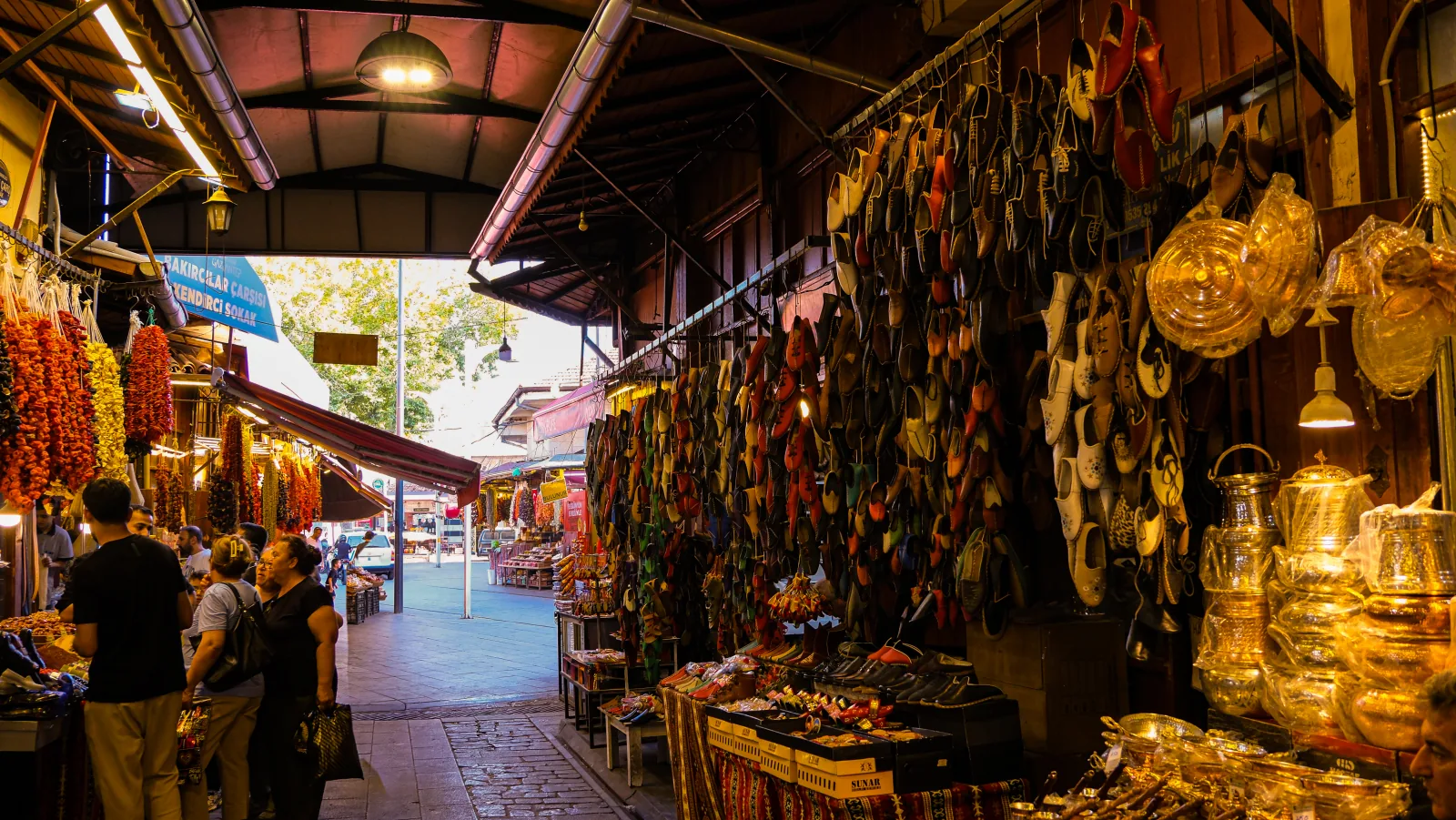
This is not a glossy, glass-fronted shopping centre. It is a living market where stalls spill into the street, sacks of spice stand open at the mouth, and the vendor presses a sample into your palm to taste. It is precisely this liveliness that turns Almacı Market from an ordinary bazaar into a genuine Gaziantep experience.
What is Almacı Market, and where is it?
Almacı Market lies right in the middle of Gaziantep's cluster of historic bazaars, immediately beside the Coppersmiths' Bazaar and Kürkçü Han (the Furriers' Inn). This old trading district in the heart of the city is a shopping network that has stood for centuries with its narrow lanes, inns and covered markets, and Almacı Market is one of its most fragrant and colourful links.
The bazaar is not confined to a single covered structure. Alongside the inner section that bears the market's name, the shops lined along the adjoining street carry on the same tradition. Visiting Almacı Market therefore really means wandering through the entire surrounding fabric of old bazaars at once.
Its history and the story behind the name
Almacı Market is said to have a history of roughly 250 years, approaching two and a half centuries. In that sense it is regarded as one of Gaziantep's oldest commercial spots. Because there is no dated inscription giving a precise founding year, its age is usually expressed in the rounded form of "about 250 years"; what matters is that this old street has hosted trade without interruption for centuries.
The origin of its name is the market's best-loved tale. In the past, the apple was not the everyday fruit it is today, found on every corner; it was rare and prized. For that reason apples were sold here one by one, and they were even taken as gifts when visiting the sick. Since apples are called "alma" in the local dialect, the market gradually settled into the name "Elmacı / Almacı Pazarı" (the Apple Market) and has kept it unchanged to this day. So this bazaar, whose name comes from a fruit, in fact carries a small record of the city's commercial memory.
"Almacı" derives from "alma," the local word for apple. In an era when apples were scarce and precious, the fact that they were sold here one by one gave the market its name.
What's on the counters? Flavours worth seeing
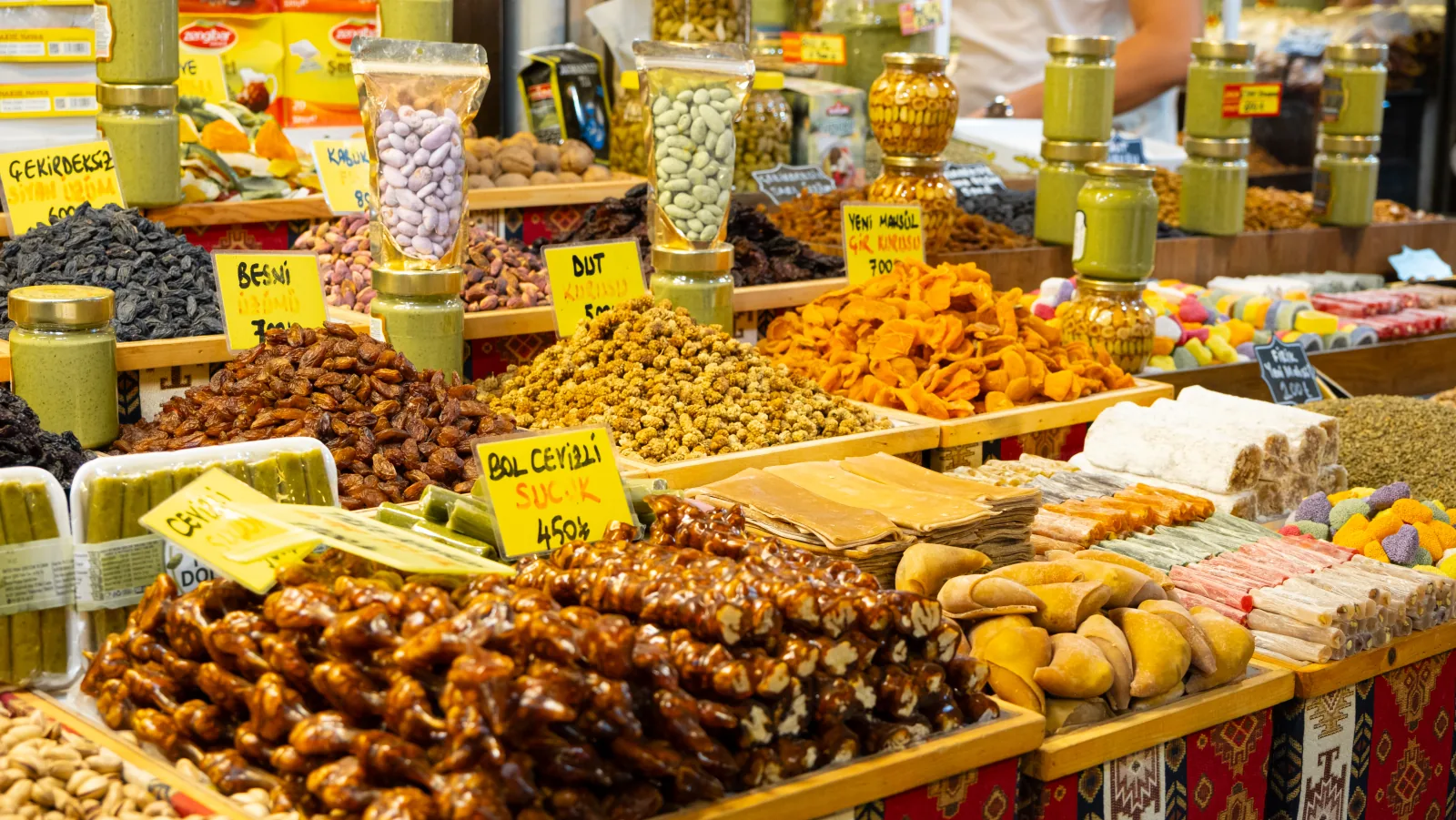
The true splendour of Almacı Market lies not in its architecture but on its counters. The bazaar is practically a catalogue of Gaziantep cuisine and regional produce. The star, of course, is the Antep pistachio: it greets you in every shop as roasted salted pistachios, in season as fresh "ben fıstık," and as under-tree and dry red varieties.
Alongside the pistachios, sacks of spices, red pepper flakes, mild and hot pepper and tomato pastes, and medicinal herbs form this market's signature. As the seasons turn, so does the face of the stalls: in summer, strings of dried eggplant, peppers, gherkins and squash hang for stuffing and drying; in winter, assorted nuts, grape-based pestil and sausage, pistachio-filled muska and dilme-style sweet dried treats take the lead. Add clarified butter, olive oil, bulgur and assorted grains, and the bazaar becomes a regional pantry all on its own.
Its place in city life and culture
For the people of Gaziantep, Almacı Market is not merely a place to shop but a habit and a meeting point. In this bazaar, the first that comes to mind for regional and natural products, the trade is usually handed down from one generation to the next; behind the counters stand third- and fourth-generation families. This continuity lends the market a built-in air of trust.
Shopping here unfolds with a courtesy that bears the traces of the ahi (guild) tradition: offering a taste, asking after the customer's well-being, recommending the right goods are all part of the job. That is why Almacı Market feels like an open-air museum where Gaziantep's old neighbourhood culture and trading etiquette are still alive. Nowhere can you breathe the city's spice-and-pistachio identity more intensely than here.
Today, and how to visit
As modern Gaziantep has grown and spread, Almacı Market has managed to stay put, in its old place and with its old spirit. Now a stop for both domestic and foreign travellers, it is the first port of call for anyone wishing to carry home a souvenir or a regional delicacy. Its greatest charm is how it interlocks with the other historic bazaars around it; you can buy spices on one street and step into a centuries-old covered market on the next.
When planning your visit, we suggest thinking of Almacı Market not on its own but as part of an old-bazaar tour. To catch the ring of copperwork, walk over to the Coppersmiths' Bazaar; to wander in the cool of a covered market, you can easily move on to the Zincirli Bedesten and the Kemikli Bedesten. The short walk between these markets is one of the finest routes for feeling Gaziantep's past and present at the same time.
Frequently Asked Questions
Where is Almacı Market?
Almacı Market lies in Gaziantep's historic bazaar quarter in the Şahinbey district, right beside the Coppersmiths' Bazaar and Kürkçü Han. It sits within the cluster of old markets in the city's historic centre.
How did Almacı Market get its name?
The name comes from "alma," the local word for apple. Because apples were once scarce and valuable, they were sold here one by one, and so the market came to be known as "Elmacı / Almacı Pazarı," the Apple Market.
How old is Almacı Market?
The market is said to be roughly 250 years old, approaching two and a half centuries. As there is no dated inscription giving an exact founding year, its age is usually given in rounded terms.
What is sold at Almacı Market?
Above all Antep pistachios, plus spices, pepper and tomato pastes, dried vegetables, nuts, pestil, pistachio-filled muska, clarified butter, bulgur and grains, and medicinal herbs. The stalls change with the season.
What else can I see near Almacı Market?
Because the market sits at the centre of Gaziantep's old trading fabric, you can also walk to historic bazaars such as the Coppersmiths' Bazaar, the Zincirli Bedesten and the Kemikli Bedesten. They can all be combined into a single old-bazaar tour.