 Vegetarian
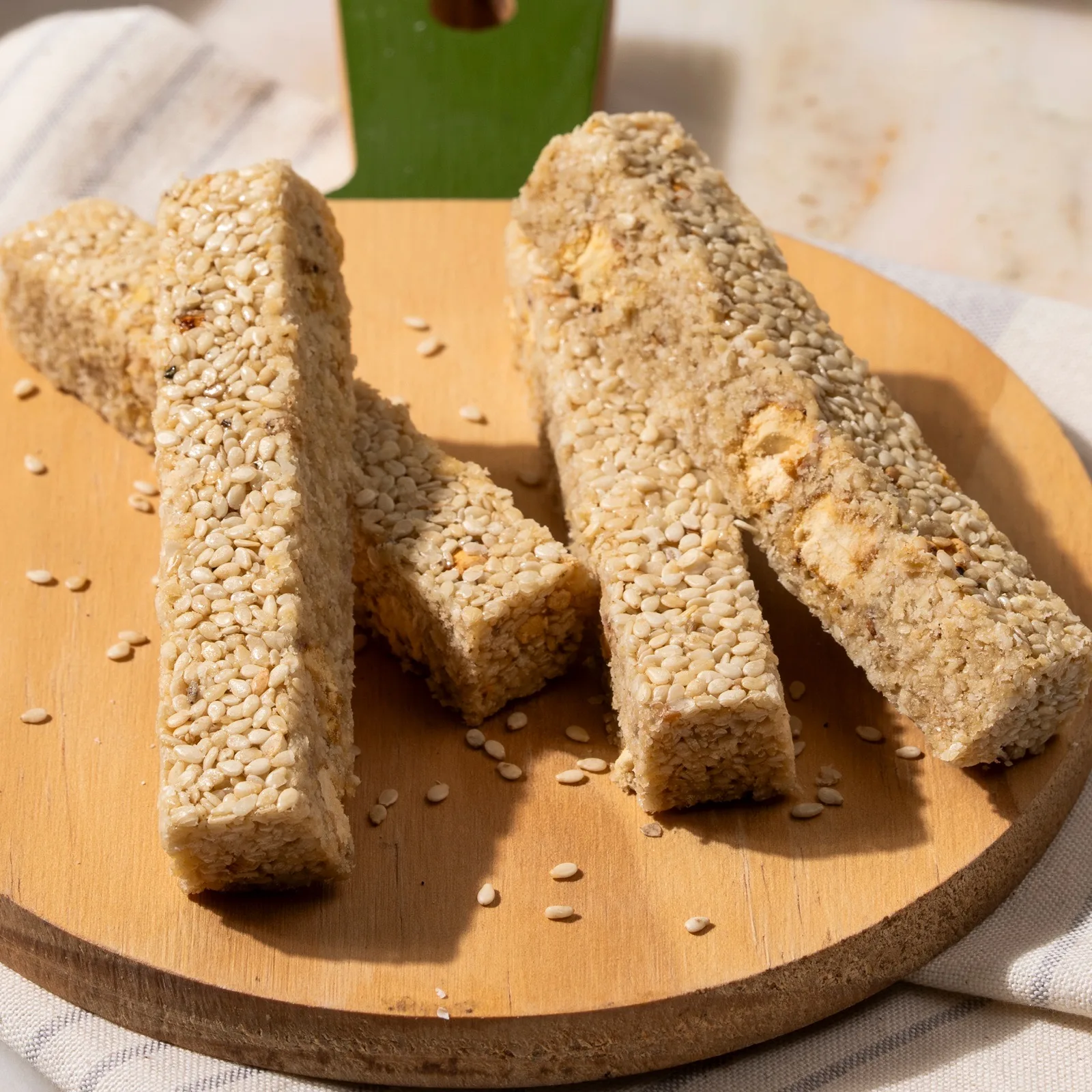
Gaziantep crunchy sesame halva (Susamlı Kıtır Helva) is a partly hard, brittle halva made by boiling sugar, water and saponaria (çöven) extract to around 120°C while stirring until it reaches a taffy-like consistency, then kneading it with plenty of roasted sesame and setting and cutting it. Whole and broken sesame seeds run through the white-cream mass; the texture crumbles crisply on the palate, carrying the faint nutty aroma of roasted sesame. Filed on 10 November 2023 through an application by the Gaziantep Metropolitan Municipality, Gaziantep crunchy sesame halva was registered as a geographical indication by TÜRKPATENT on 3 January 2025 (Geographical Indication / Mahreç İşareti, Reg. No: 1684).
The identity of the halva springs from the harmony of a few essentials: pulled, whitened sugar taffy; plenty of roasted sesame; and saponaria (soapwort) extract, which gives the taffy its porous, fibrous structure. Behind these lies not a process spread over days but a fast cycle that demands timing and arm strength — boiling the sugar to a precise temperature, pulling the taffy until it whitens, and folding in the sesame at just the right moment before it cools and is cut.
This article explores the world of ingredients that shapes Gaziantep crunchy sesame halva, its traditional boiling and pulling technique, its origins in Gaziantep cuisine, its geographical indication protection, and its place at the city's tea table.
What Is Crunchy Sesame Halva and What Is in It?
Gaziantep crunchy sesame halva is a brittle, crisp halva produced by boiling sugar and water together with saponaria extract until it reaches a taffy consistency, aerating and whitening that taffy, and then kneading it with plenty of roasted sesame before moulding it and cutting it while still warm. The word "kıtır" describes the product's crisp, crumbling texture; when the halva is broken, you can see the fibrous strands of pulled taffy and the scattered sesame seeds inside. What sets it apart from tahini halva or syrup-soaked sweets is that the sesame is not ground into a paste but added whole and roasted to the sugar taffy. Its sweetness comes not from syrup but from the sugar itself, which gains its body by being pulled.
Core Components
- Sesame: The soul of the halva is roasted sesame, and it makes up the largest share of the mixture; in the geographical indication recipe, about 75 kilograms of sesame are used for roughly 125 kilograms of finished product. Before it is added to the taffy, the sesame is roasted, both to intensify its aroma and to give the product the nutty, snack-like character behind its crunch.
- White Sugar: The sugar that builds the halva's backbone and sweetness is boiled with water and pulled into a taffy; the recipe specifies about 50 kilograms of white sugar for roughly 125 kilograms of finished product. Here the sugar works not as a syrup but as a taffy that hardens and turns brittle as it cools; the halva's crunchy texture is born of this setting sugar.
- Saponaria (Soapwort) Extract: The natural foaming agent that gives the taffy its porous, fibrous and pale structure is saponaria (çöven) extract; the recipe uses about 500 grams for roughly 125 kilograms of finished product. As the saponaria is added to the boiling sugar taffy and the taffy is pulled, air is trapped within it; this is how the halva gains a brittle, crumbling structure rather than a dense mass.
- Water: Water is needed so the sugar can dissolve and boil; the recipe uses about 8 litres of water for roughly 125 kilograms of finished product. During boiling, most of the water evaporates, leaving behind only the sugar taffy at the desired consistency.
- Lemon Salt (Citric Acid): Added as an acidity regulator, lemon salt helps the sugar reach a smooth, controlled consistency by preventing it from crystallising in an undesirable way as it boils; the recipe specifies about 100 grams for roughly 125 kilograms of finished product.
The Geography of Its Service
Crunchy sesame halva keeps its crunch best when eaten fresh, yet its shelf life is longer than that of fresh sweets such as baklava. For this reason it is both eaten on the spot in Gaziantep and carried away as a gift in a box or package. Its traditional presentation is plain and unshowy: the halva is sliced or broken onto a plate and usually offered alongside tea or coffee. Next to the hot drink the nutty aroma of the sesame stands out, and the halva's crunchy texture offers a different sensation to palates used to soft sweets. Alongside signature flavours such as Gaziantep baklava or pistachio paste, crunchy sesame halva is a plain but deep-rooted part of the confectionery and halva tradition at the Gaziantep table.
The History and Cultural Origins of Crunchy Sesame Halva
The origins of crunchy sesame halva rest both on Anatolia's deep-rooted confectionery and halva tradition and on Gaziantep's accumulated experience in working sesame. Although turning boiled, pulled sugar into halva with various additions is a widespread craft in Turkish cuisine, the crunchy halva associated today with Gaziantep gained its distinctive identity by meeting the city's sesame and its master-apprentice tradition.
A Deep-Rooted Sugar and Sesame Tradition
Turning boiled, pulled sugar taffy into halva with various seeds and grains is part of the centuries-old accumulation of Anatolian cuisine. The official registration document, too, describes Gaziantep crunchy sesame halva as a product "produced in Gaziantep for many years" that has "reached the present day through the cultural heritage of the province of Gaziantep." While this account shows the halva's deep place in the city, a precise starting date for the product is not documented; for this reason crunchy sesame halva is best regarded as part of the region's deep-rooted confectionery and halva heritage.
How It Became a Craft Halva of Gaziantep
What identifies crunchy sesame halva with Gaziantep is the city's accumulated experience in working sesame and a method of production that demands mastery at every stage. Boiling the sugar to the right temperature, pulling and whitening the taffy to just the right consistency, and folding in the sesame before it cools are skills learned over years of craft. The registration text, too, stresses that the product requires "craft skill at every stage of production"; the bond the halva builds with the city rests largely on this handwork. Another member of the same crunchy-halva family is crunchy roasted chickpea halva, which uses roasted chickpeas instead of sesame; the two products share a similar taffy technique but have different grains and textures. Softer and more elastic sakız halva is another registered member of Gaziantep's halva tradition.
Geographical Indication Registration
Crunchy sesame halva went through an official registration process to protect its region-specific ingredients and method of production. The process, begun through an application by the Gaziantep Metropolitan Municipality, was filed on 10 November 2023 and concluded with a geographical indication registration by TÜRKPATENT on 3 January 2025 (Geographical Indication / Mahreç İşareti, Reg. No: 1684). The registration guarantees that the name "Gaziantep Susamlı Kıtır Helva" may be used only for a product tied to the Gaziantep region and made with the defined ingredients and method.
Gaziantep crunchy sesame halva was entered into the TÜRKPATENT geographical indications register as a Geographical Indication (Mahreç İşareti, Reg. No: 1684) on 3 January 2025; the application was made on 10 November 2023 by the Gaziantep Metropolitan Municipality. Classified in the "Halva / Bakery and pastry products, doughs, desserts" group, the registration document defines the method of production, from the proportions of the ingredients to boiling the sugar at around 120°C, roasting and folding in the sesame, and cutting it.
The Crunchy Sesame Halva Tradition and Ritual in Gaziantep
In Gaziantep, crunchy sesame halva is not merely a sweet; it is a plain part of hosting guests, of offering hospitality and of special days. Beside heavy syrup-soaked sweets, it has earned a place of its own as the light, crisp option of the tea table.
An Offering at the Tea and Coffee Table
As the registration document notes, crunchy sesame halva is served "generally as a snack, especially when hosting guests, alongside offerings of tea and coffee." Offered in small pieces next to a hot drink, the halva is a lighter, drier option than syrup-soaked sweets such as baklava; for this reason it is eaten easily through the day, in the course of conversation. The halva's crunchy texture softens in the mouth with the warmth of the tea, bringing the aroma of the sesame to the fore.
The Craft of Pulling the Taffy
Crunchy sesame halva is defined as much by its technique of production as by its ingredients. According to the geographical indication recipe, sugar, water and saponaria extract are boiled together at around 120°C while being stirred continuously; at this stage, good stirring together with heat treatment is applied to achieve "a thick, taffy-like structure." After resting for one hour, the mixture is divided and kneaded for ten minutes, then roasted sesame is added and stirred for about twenty minutes more; finally the mass is moulded, cut to the desired sizes and rested for a short while. Pulling the taffy by hand to aerate and whiten it is the critical step that gives the halva its porous, brittle texture. The handing down through generations of such confectionery and halva crafts is also part of the diversity of crafts that was one reason for Gaziantep's admission to the UNESCO Creative Cities Network in the field of gastronomy in 2015.
Its Place as a Gift and a Seasonal Sweet
Thanks to its relatively long shelf life, crunchy sesame halva is also valued as a gift; it is offered in boxes or packages to guests who come to the city. The registration text notes that the halva is also eaten "on festivals, religious holidays and other special days"; especially in the winter months, crunchy halva eaten alongside hot tea is a plain sweet of the city's cold-season table.
Why You Should Try It
A single piece of crunchy sesame halva carries Gaziantep's confectionery craft and its bond with sesame to the palate in one bite: after the crisp, crumbling texture comes the nutty aroma of roasted sesame. Sweetened only by sugar that gains its body through pulling rather than drenched in syrup, the halva is a light, balanced sweet rather than a heavy one. For a palate sated with syrup-soaked sweets it offers a refreshing alternative, and the truest way to taste crunchy halva is to eat a fresh piece, alongside tea, in the city where it was born.
Frequently Asked Questions
What is crunchy sesame halva and where is it from?
It is a partly hard, brittle halva particular to Gaziantep, in which pulled sugar taffy is kneaded with plenty of roasted sesame and set firm.
What is in crunchy sesame halva?
It uses sesame, white sugar, water, saponaria (soapwort) extract and lemon salt as an acidity regulator. No syrup is used; its sweetness comes from the sugar pulled into a taffy.
Does crunchy sesame halva have a geographical indication?
Yes. Gaziantep crunchy sesame halva was registered as a geographical indication by TÜRKPATENT on 3 January 2025 (Mahreç İşareti, Reg. No: 1684).
How and when is crunchy sesame halva eaten?
It is generally offered as a snack alongside tea or coffee. It is given as a gift and eaten on festivals and other special days.
What is the difference between crunchy sesame halva and crunchy roasted chickpea halva?
Both are made with a similar sugar-taffy technique; crunchy sesame halva uses roasted sesame, while crunchy roasted chickpea halva uses roasted chickpeas.