 Vegetarian
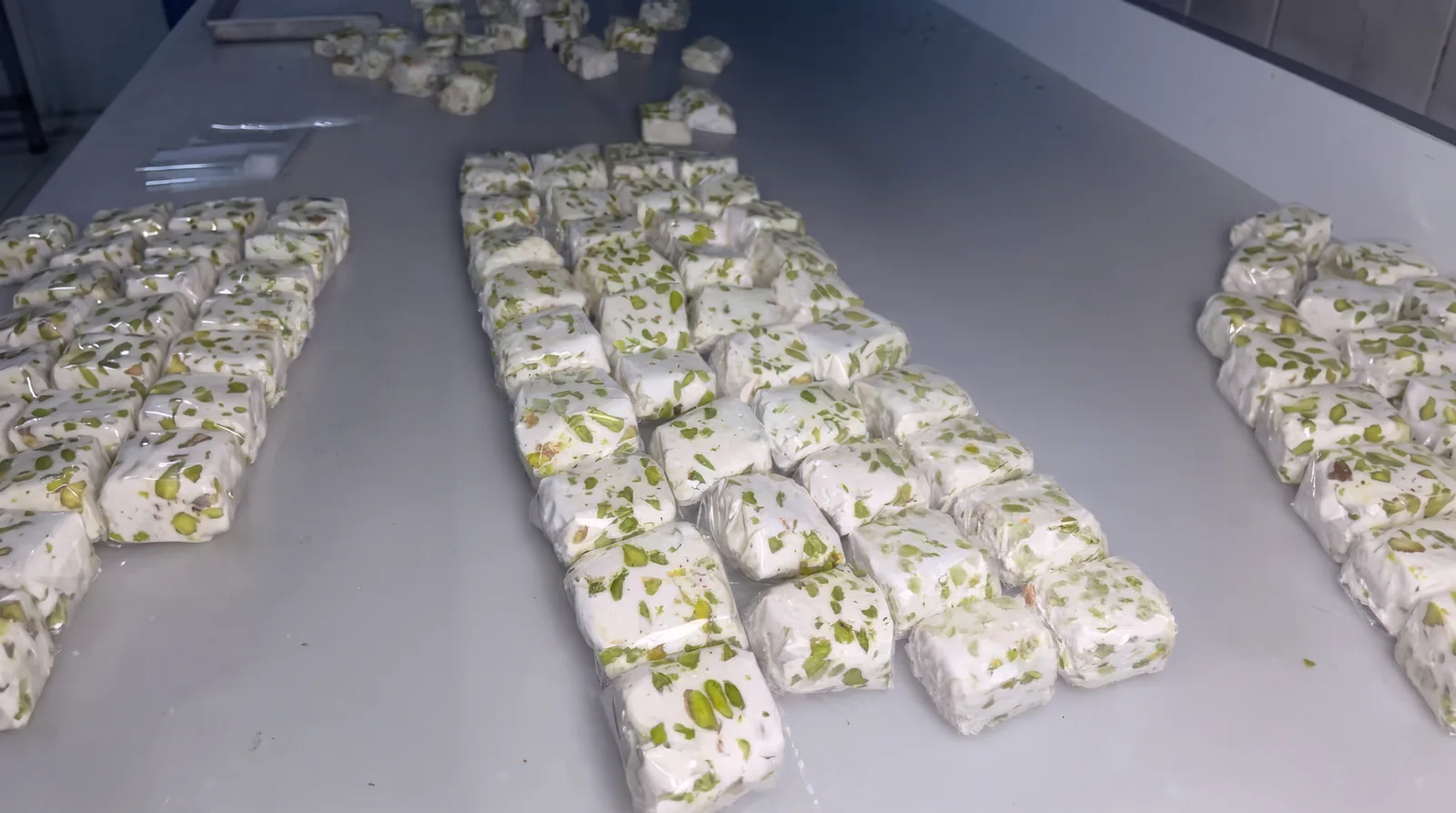
Sakız halva (sakız helva) is a soft, elastic Gaziantep halva made by whipping sugar syrup with soapwort (çöven) water until it turns white, then kneading the resulting mass by hand with Antep pistachios or walnuts. Pieces of pistachio or walnut are visible throughout; unlike Gaziantep's crunchy (kıtır) halvas, it does not snap but stretches like chewing gum (sakız). Following an application by the Gaziantep Metropolitan Municipality on 10 November 2023, Gaziantep Sakız Helva was registered as a geographical indication by TÜRKPATENT on 25 September 2026 (Geographical Indication / Mahreç İşareti, Reg. No: 1904).
The halva's identity rests on a handful of ingredients, each of them essential: boiled sugar; çöven, which gives it its whiteness and elasticity; the citric acid (limon tuzu) added to the syrup; and Antep pistachios or walnuts. What brings these simple ingredients together is the hand of the master halva maker, who judges the moment the syrup reaches the right consistency and patiently kneads the whitened mass on a marble counter.
What Is Sakız Halva and What Is in It?
Sakız halva is a sugar halva built on "ham helva" (raw halva). Water, sugar and citric acid are boiled into a syrup, çöven water is added, and the mixture is whipped until it turns white; this raw halva is then kneaded by hand with Antep pistachios or walnuts and set in moulds. The registration document describes it as soft, elastic and white in tone, and states that no food additives, colourings or sweeteners are used in making it. The crunchy sesame and roasted chickpea halvas, made from a similar çöven-and-sugar base, are hard and brittle; sakız halva, by contrast, is soft and elastic. This gives it a place of its own in the city's halva family. Because it contains no flour, fat, tahini or sesame, it also differs from relatives such as pişmaniye (floss halva) and tahini halva.
Core Components
- Sugar: Sugar, which makes up the bulk of the halva, is first boiled with water and citric acid into a syrup. No syrup is poured over sakız halva afterwards; its sweetness comes from this sugar mass itself, which takes on its texture as it is whipped.
- Soapwort (Çöven) Water: Çöven water is a foaming extract drawn from the root of the çöven (soapwort) plant, known colloquially as "helvacı kökü" (the halva maker's root). Added to the boiled syrup and whipped, it traps air in the mixture; this is what turns the sugar white and makes it elastic. Çöven is one of the long-established ingredients of Anatolian halva making.
- Antep Pistachio or Walnut: The pieces in the halva are Antep pistachios or walnut kernels; the pistachio version uses Antep pistachio registered with a geographical indication. Worked into the raw halva on the marble counter, the pieces spread through the mass and shape both the look of the halva and its texture in the mouth.
- Citric Acid (Limon Tuzu): Citric acid is boiled together with the sugar and water; in confectionery it is used to stop sugar from crystallising.
The Geography of Its Service
Sakız halva is not a sweet eaten with a spoon or sliced on a plate, but a halva picked up by hand in small pieces. After resting in the mould, the halva is cut into pieces and each piece is wrapped individually, which makes it easy to store and to hand round to guests. According to the registration document, care is taken over humidity and temperature during storage, and the halva is kept out of sunlight. It is eaten at room temperature or partly cooled, as preferred, and mostly as a snack.
The History and Cultural Origins of Sakız Halva
No written record has come to light of who first made sakız halva or when; the registration document likewise says only that it has been made in Gaziantep for many years and has come down to the present through the city's cultural heritage. On the other hand, the old records of Ayıntab, as the city was formerly known, and travellers' accounts show how deeply rooted halva making is in the city, while Ottoman culinary texts trace the history of the halva's name.
The Halva Makers of Ayıntab
Ayıntab's court records from the 16th and 17th centuries mention many kinds of halva sold in the city's halva shops, among them ak helva (white halva), ballı ak helva (white halva with honey), koz helvası (walnut halva), almond, pumpkin and raisin halvas, tahini halva, küncülü helva (sesame halva) and "cevizli ve leblebili ve tahinli helva" (halva with walnuts, roasted chickpeas and tahini). Records of the same period also mention the city's Helvacılar Pazarı (Halva Makers' Market) and the Helvacı Mescidi (literally "Halva Maker's Small Mosque") in the Şehreküstü neighbourhood; a 1689 endowment deed lists a halva shop among the shops in the area of today's Almacı Market. The traveller Evliya Çelebi, who passed through Ayıntab in 1671, writes that the city's many kinds of halva are found nowhere else, and that köfter (a grape-must sweet) "with almonds and Şam pistachios" was carried to the Arab lands, Persia and India. Şam fıstığı (literally "Damascus pistachio") is another name for the Antep pistachio. These sources do not mention the name "sakız helva" or say how the old halvas were made; even so, they make it clear that koz helvası (walnut halva) and the craft of halva making have been known in Ayıntab for centuries.
Halva in Poetry, Folk Song and Proverb
Halva's place in Ayıntab is also reflected in the city's poetry and folk songs. Aynî, an Ayıntab poet of the classical Ottoman (divan) tradition who lived in the late 18th and early 19th centuries, says in one couplet that he ordered sugared halva from the cook, but that it could not match the taste of the beloved's kiss. The folk song "Helvacı" (The Halva Seller), collected in Gaziantep, depicts a street halva seller praising his wares. And the widely known Turkish proverb "Ana ile kız, helva ile koz" ("mother and daughter, halva and walnut") holds that mother and daughter are as inseparable as halva and walnut in koz helvası.
Where Does the "Sakız" in Its Name Come From?
Although the word "sakız" in its name at first suggests mastic (damla sakızı), the registered recipe of Gaziantep Sakız Helva contains no mastic; the halva is made only with sugar, water, çöven water, citric acid and Antep pistachios or walnuts. No written record explaining the origin of the name has come to light. Even so, the Turkish expression "sakız gibi" (literally "like sakız") means "very clean, very white", and sakız in its natural form is a white resin that softens as it is chewed; both suggest that the halva was named for its likeness to sakız, in its colour and stretchy texture, rather than for anything in its recipe.
Sakız Helvası in Ottoman Cuisine
The name "sakız helvası", as it appears in Ottoman sources, has been known in Ottoman halva making since at least the 18th century. In records of Istanbul's halva makers' guild from the second half of that century, sakız helvası is listed among the varieties the halva makers produced and sold; these records, however, do not say how it was made. More revealing is the recipe for "Mülûkî Sakız Helvası" (sakız helvası "fit for sovereigns") in a cookery compilation (mecmua) written in Istanbul between 1825 and 1835. In this recipe, sugar is boiled with çöven water, here called helvacı çöveni (halva makers' çöven), pulled on marble or a tray and mixed with skinned pistachios; the recipe also uses flour and clarified butter but contains no mastic. This royal halva is not made exactly as sakız halva is in Gaziantep today; still, it shows that even then the name was used for a çöven-based sugar halva without mastic. Çöven, marble and pistachios are common to both.
Geographical Indication Registration
The name "Gaziantep Sakız Helva" has been protected by official registration, together with its defined ingredients and method of production. The process, which began with the application made by the Gaziantep Metropolitan Municipality on 10 November 2023, concluded on 25 September 2026 with registration by TÜRKPATENT (Geographical Indication / Mahreç İşareti, Reg. No: 1904). The registration guarantees that the name may be used only for halva produced within the provincial borders of Gaziantep using the defined ingredients and method.
Gaziantep Sakız Helva was entered into the TÜRKPATENT geographical indications register as a Geographical Indication (Mahreç İşareti, Reg. No: 1904) on 25 September 2026; the application was made on 10 November 2023 by the Gaziantep Metropolitan Municipality. Classified in the "Halva / Bakery and pastry products, doughs, desserts" group, the product must go through every stage of production within the provincial borders of Gaziantep; production is inspected by a three-member committee formed under the coordination of the Gaziantep Metropolitan Municipality.
The Sakız Halva Tradition and Ritual in Gaziantep
In Gaziantep, sakız halva is not so much a centrepiece dessert as a small treat for the cooler months, for guests and for special days. Seasonal, kneaded by hand and wrapped piece by piece, it remains a living part of the city's halva culture.
The Halva of Autumn and Winter
Sakız halva is generally made and eaten in the autumn and winter months. This fits the way Gaziantep sees halva in general, as a cold-weather sweet; in winter especially, halvas often appear on the city's breakfast tables.
On the Guest Tray and on Special Days
Sakız halva's place in Gaziantep culture shows most clearly in the tradition of hosting guests. Usually eaten as a snack, it is offered especially to guests visiting the house, and it is also served on special days such as religious holidays (bayram) and festivals. Wrapped one by one, the small pieces are easy to share from a crowded tray of treats.
The Craft of the Marble Counter
Gaziantep's halvas fall into two broad groups: those made at home with flour or semolina, and those made mostly by master halva makers. Made from raw halva whipped with çöven, sakız halva stands close to the second group, the craft halvas. The stages that demand the most skill are whipping the syrup white with çöven water and kneading the resulting raw halva by hand with pistachios or walnuts on a marble counter. Getting the consistency right and spreading the pieces evenly through the mass is a master's work; the registration document likewise states that every stage of production requires mastery.
Why You Should Try It
A single piece of sakız halva carries Gaziantep's halva-making tradition, and the skill with which simple ingredients are shaped, to the palate in one bite: within the soft, gently stretching texture of the çöven-whitened sugar, pieces of pistachio or walnut meet the teeth. With no syrup poured over it and no additives, colourings or sweeteners, it is a sweet made from a handful of plain ingredients. The truest way to taste it is to unwrap a fresh piece on a cool autumn or winter day in the city where it was born.
Frequently Asked Questions
What is sakız halva?
Sakız halva (registered as Gaziantep Sakız Helva) is a soft, elastic, white Gaziantep halva: sugar whipped white with çöven water and kneaded by hand with Antep pistachios or walnuts.
Does sakız halva contain mastic?
Despite its name, the registered recipe contains no mastic: Gaziantep Sakız Helva is made only with sugar, water, çöven water, citric acid and Antep pistachios or walnuts.
Why is it called "sakız"?
No written record explaining the name has come to light; it may refer to the halva's likeness to sakız (gum), in its white colour and its soft, stretchy texture, rather than to an ingredient.
Does sakız halva have a geographical indication?
Yes. Following an application by the Gaziantep Metropolitan Municipality, Gaziantep Sakız Helva was registered as a geographical indication by TÜRKPATENT on 25 September 2026 (Mahreç İşareti, Reg. No: 1904).
When and how is sakız halva eaten?
It is generally eaten as a snack in the autumn and winter months; it is offered in small wrapped pieces when hosting guests and on special days such as religious holidays and festivals.
What is the difference between sakız halva and the crunchy halvas?
Sakız halva and Gaziantep's crunchy sesame and roasted chickpea halvas are all made from a sugar base whipped with çöven. The crunchy halvas, however, are hard and brittle, while sakız halva, kneaded with Antep pistachios or walnuts, is soft and elastic.