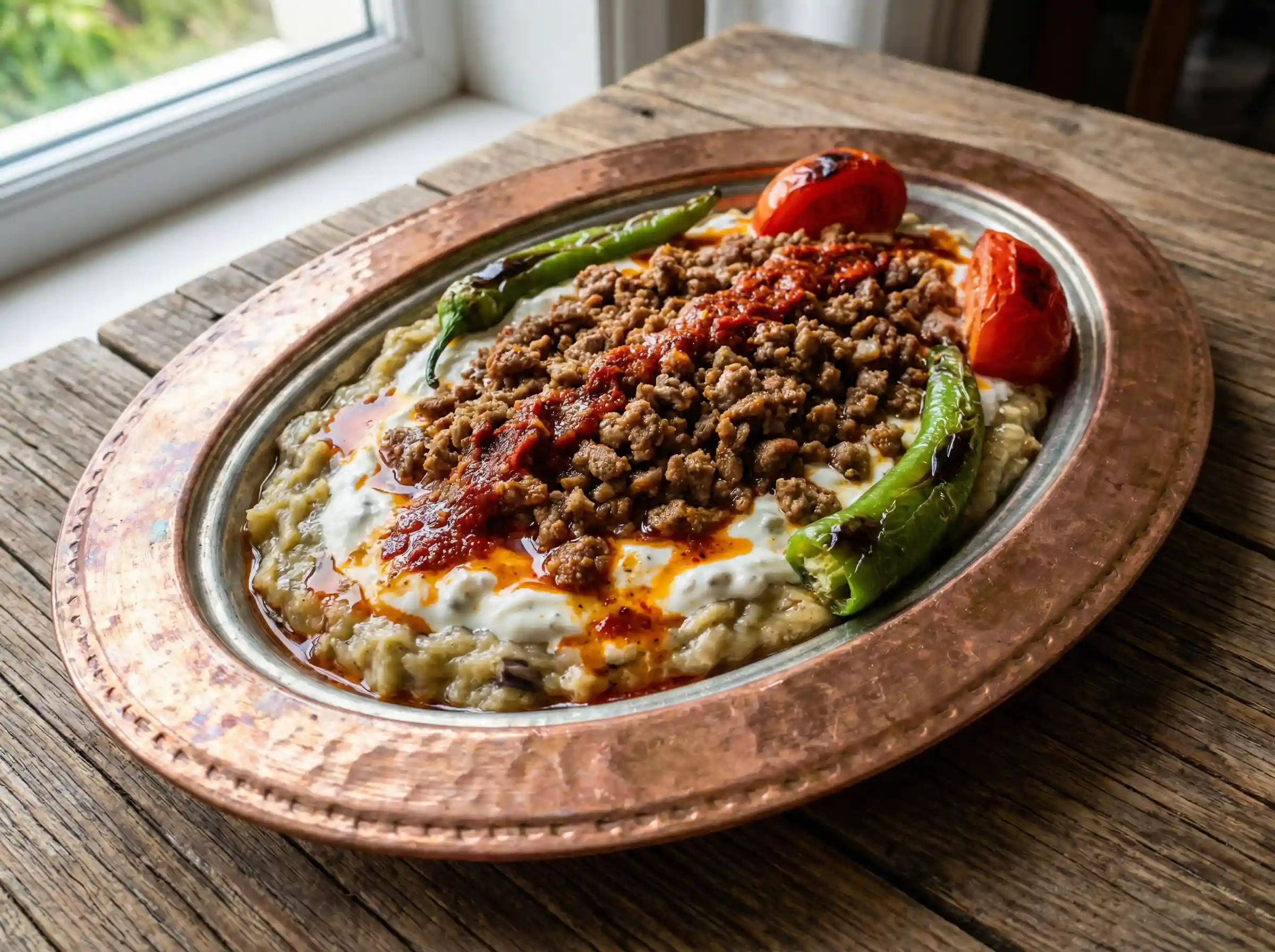
Ali Nazik Kebab — known locally in Gaziantep as Alenazığı — is one of Antep cuisine's most refined signatures: a bed of smoked eggplant purée folded into garlicky yogurt, crowned with hand-chopped grilled lamb mince and finished with a glaze of melted butter. According to oral tradition, the dish takes its name from Sultan Selim I's exclamation upon tasting it on his return from the Egyptian campaign in 1517: "What a gentle hand" — ali nazik. In 2021 it was granted TÜRKPATENT Geographical Indication status (No. 748), placing it under official protection.
The secret of the dish lies not in the simplicity of its parts, but in three textures meeting on the palate at the same instant: the soft, smoke-scented eggplant purée, the garlicky strained yogurt, gently warmed so the meat and butter will not congeal, and the hot fat of just-poured butter over freshly grilled meat. A single bite delivers warm, hot, smoky and garlicky notes all at once.
This article explores the ingredients that define Ali Nazik kebab, the legends behind its name, its place in Gaziantep cuisine, and the rituals of how it is served today.
What Is Ali Nazik Kebab and What Is in It?
Ali Nazik is one of the rare members of the kebab family that is not built around the skewer. Only one element actually meets the fire — the meat, whether cubed lamb or zırh-chopped mince. The body of the dish comes from the yogurt-eggplant bed beneath. In that sense, it does not belong to the classic shish kebab tradition; it belongs to Gaziantep's "meet the warm with the hot, the ember with the milk" philosophy of the table.
Core Components
Traditional Ali Nazik has three essential layers:
- Smoked Eggplant: Long, slender local eggplants are charred directly over open flame — traditionally on the coals — until the skins are blackened and the flesh collapses into softness. The skin is peeled off and the flesh is mashed in a mortar or chopped fine. The signature of the dish is the smoke-perfumed aroma of the eggplant; oven-roasted eggplant cannot reproduce this flavour.
- Garlicky Yogurt: Strained yogurt is combined with crushed garlic and a pinch of salt. Traditional kitchens prefer Araban garlic, which lends the yogurt a sharp, slightly bitter and richly layered pungency. Antep masters gently warm the eggplant-yogurt bed in a copper pan over the stove; otherwise the hot butter and meat fat poured on top would congeal within seconds.
- Grilled Lamb: Alenazığı is traditionally made with cubed lamb or zırh-chopped mince. The zırh mince is prepared with the same curved rocker blade used in making Gaziantep lahmacun, giving a coarse, full body that machine-ground meat cannot replicate. Whether cubed or minced, the meat is threaded onto skewers, grilled over charcoal, and pulled straight onto the eggplant bed before it loses its heat.
Two final touches complete the plate: a glaze of melted butter (traditionally clarified butter known as sadeyağ) and a light dusting of the region's heritage roasted red pepper flakes.
The Geography of the Plate
The three layers are stacked one over another on the plate: yogurt-folded eggplant purée on the bottom, grilled meat in the middle, golden rivers of butter on top. Pita or yufka bread is served alongside, because the diner is expected to sop up the buttery sauce by the end.
The History and Cultural Origins of Ali Nazik Kebab
The dish's history must be read through the shadow of the double identity in its name. What is known across Türkiye today as "Ali Nazik" is referred to in Gaziantep's everyday speech as Alenazığı. The official TÜRKPATENT registration preserves the local form: "Gaziantep Alenaziği / Antep Alenaziği."
The Legend Behind the Name
The most widely told story in Antep's oral culture goes like this: in 1517, returning from his Egyptian campaign, Sultan Selim I (Yavuz Sultan Selim) passes through Antep and is hosted in a mansion where this dish is served. The Sultan, struck by the refinement of the dish and the skill of its cook, asks: "Ali nazik?" — "Whose hand is this gentle?" From that day forward, the dish is said to bear that question as its name — ali nazik, meaning "noble gentleness."
This account lives in oral tradition rather than in any documented source; it is one of the legends Antep's culinary memory carries down through generations. Even if its historical accuracy cannot be confirmed, Sultan Selim I's 1517 route from Egypt is in fact recorded as passing through Antep.
"Alenazığı": A Trace of Local Phonetics
The reason the dish is called Alenazığı in Antep lies in the sound features of the local dialect. In Gaziantep's spoken culture, for ease of pronunciation and vowel harmony, "Ali" softened into "Ale" and "Nazik" evolved into "Nazığı / Naziği." In other words, Alenazığı is simply the local phonetic counterpart of the name "Ali Nazik"; both names point to the same dish and live side by side in today's Antep kitchen.
Antep Alenaziği was registered by TÜRKPATENT as a Geographical Indication in 2021. Registration number is 748, the applicant Gaziantep Metropolitan Municipality. The official registration reads "Gaziantep Alenaziği / Antep Alenaziği"; the widely used commercial name "Ali Nazik Kebab" is its everyday Turkish counterpart.
The Place of Eggplant in Antep Cuisine
Behind Ali Nazik lies Antep's special relationship with the eggplant. The Nizip eggplant — grown in the Nizip district of Gaziantep — is registered by TÜRKPATENT as a Protected Designation of Origin, and in Antep homes, eggplant is almost never absent from a summer meal. The region's repertoire also includes other eggplant-and-meat combinations, such as Eggplant kebab; Ali Nazik is this tradition reinterpreted through fire-charred eggplant and yogurt.
The traveller Evliya Çelebi stopped in Ayntab in 1671 on his way to the pilgrimage; in Book 9 of his Seyahatname he called the city "Şehr-i Ayıntab-ı Cihan" and praised its vineyards, fruits and yogurt — a sign that the garlicky yogurt beneath ali nazik rests on a deep-rooted local tradition. The name's origin is uncertain: a popular legend says Sultan Selim I, on tasting the dish, exclaimed "How delicate the hand (eli ne nazik) that made this"; another folk account traces it to "âlâ nazik" ("âlâ" meaning fine or excellent). These stories have no documented historical basis and are passed down as legend.
The Tradition and Ritual of Ali Nazik Kebab in Gaziantep
Ali Nazik belongs to the "served-when-the-guest-comes" category of Antep home cooking. It is not a quick meal or a street food; it is a patient dish, demanding time for the eggplant to char, the flesh to be puréed, and the yogurt to be strained.
The Special Guest of the Family Table
In Gaziantep, Ali Nazik appears as the "softening" element of a classical kebab table. Alongside rich, oily kebabs — such as Antep's signature pistachio kebab — the warm yogurt layer of Ali Nazik refreshes the palate. In Antep's restaurant and banquet culture, it is served as the centerpiece main course after the meze plates.
Summer and the Ember Season
Traditionally, Ali Nazik is cooked at the end of summer and the start of autumn — the season when eggplant is most abundant and most fragrant. In the courtyards of old Antep houses, eggplants charred over open flame or mangal coals define the dish's entire character. Even in modern kitchens that use stove-top embers, traditional masters insist that the smoke of an open fire is the dish's irreplaceable foundation.
The Bread-Dipping Tradition
On an Antep table, the final phase of Ali Nazik is the "bread-dipping" moment. The butter, yogurt and eggplant mixture left in the dish is wiped up with pieces of warm Antep pita. This act of finishing the plate embodies the city's wider table ethic: nothing on the plate should be left behind.
The Dish's Place in Daily Cuisine
In Antep's daily rhythm, Ali Nazik is an evening dish — answering the morning's beyran at the other end of the day. It is the dish offered to guests, the one whose recipe is asked for, the one talked about. It does not belong to the everyday routine; it belongs to special moments.
Why You Should Try It
A single spoonful of Ali Nazik tells the Antep table in seconds: the softness of the warm yogurt comes first, then the smoky aroma of charred eggplant opens, and finally the deep warmth of the lamb in melted butter arrives. The way these three layers meet in a single bite leaves a palate memory entirely unlike a classical kebab experience. If you are setting aside an evening to know Antep, when Ali Nazik kebab arrives in front of you — know that you are facing a dish as gentle as the hand of the cook who, five hundred years ago, is said to have made a sultan pause.
Frequently Asked Questions
What is Ali Nazik kebab?
It is a Gaziantep dish, known locally as Alenazığı, in which grilled lamb and melted butter are spread over a bed of smoked eggplant folded into garlicky yogurt.
What is in Ali Nazik kebab?
It is made with smoked eggplant, garlicky strained yogurt, cubed or zırh-chopped lamb, melted butter and roasted red pepper flakes.
Does Ali Nazik kebab have a geographical indication?
Yes. Antep Alenaziği was registered by TÜRKPATENT as a Geographical Indication in 2021 (Registration No. 748).
Where does the name Ali Nazik come from?
According to legend, Sultan Selim I tasted the dish in Antep on his return from the 1517 Egyptian campaign and asked "What a gentle hand?"; the name comes from this.
How and when is Ali Nazik kebab eaten?
It is served as a main course in the evening, after the meze; the buttery yogurt left on the plate is sopped up with warm Antep pita.