Zeugma Ancient City is a Hellenistic–Roman city on the banks of the Euphrates, in the village of Belkıs in the Nizip district of present-day Gaziantep province. It grew out of a twin settlement founded around 300 BCE by Seleucus I Nicator on both banks of the river, and in the Roman era it flourished as a frontier and garrison city guarding the principal crossing of the Euphrates. Taking its name from the boat bridge that spanned the river, the city is recognised today both as an open-air archaeological site and as a heritage place on Türkiye's UNESCO World Heritage Tentative List.
The city's magnificent floor mosaics and bronze works, however, are preserved and displayed not on site but at the Zeugma Mosaic Museum in central Gaziantep. This page deals with the city itself — its founding, its history, its destruction and its rediscovery; for the movable finds, the museum page is a complementary stop.
Founding and Origins
The origins of Zeugma reach back to Seleucus I Nicator (reigned 312/305–281 BCE), one of the successors (Diadochi) of Alexander the Great and the founder of the Seleucid Empire. Around 300 BCE, Seleucus founded a twin city on both banks of the Euphrates. To the settlement on the western (right) bank he gave the name Seleucia, derived from his own name; in scholarly literature, to distinguish it from the other Seleucias, this city is referred to as "Seleucia on the Euphrates" or "Seleucia at Zeugma."
On the opposite shore, on the eastern (left) bank, Apamea was founded; the two cities were linked across the river. Apamea takes its name from Apama, Seleucus's Iranian/Sogdian wife. Over time the name "Zeugma" came to denote the combined twin-city area (Seleucia and Apamea) and largely replaced the original name "Seleucia"; today "Zeugma" is most often used to describe the Seleucia settlement on the western bank. The city lies in the ancient region of Commagene, within the borders of present-day Gaziantep province.
The Meaning of Its Name and the Euphrates Crossing
The name "Zeugma" comes from the Greek word ζεῦγμα, meaning "bridge," "crossing" or "boat bridge." The name derives from the pontoon boat bridge that Seleucus had built across the Euphrates. This crossing was no ordinary bridge: for hundreds of kilometres it was one of the river's few — at times the only — permanent crossing points, and the city drew all of its strategic importance from this location.
The word's roots run deeper still. ζεῦγμα literally means "a yoking together," "a joining" or "a bond"; it comes from the verb ζεύγνυμι ("to join, to yoke") and the root ζεῦγος ("yoke"), and ultimately rests on the Proto-Indo-European root *yeug- ("to join"). The sense of "boat bridge" is a secondary usage that arose from this idea of joining. In other words, the city's name directly reflects its function of binding together both the two banks and the trade routes of two continents.
The Roman Golden Age: Legio IV Scythica and the Silk Road
The region entered Rome's sphere of influence in 64 BCE: Pompey the Great conquered the area during the collapse of the Seleucid Empire and his campaign against Mithridates VI, King of Pontus. Zeugma, however, was not directly incorporated into the province of Syria at this date; according to Strabo, Pompey gave the city to Rome's ally, the Kingdom of Commagene (King Antiochus I Theos). The year 64 BCE marks the beginning of Roman dominion; direct provincial administration would come later.
The city's permanent annexation to the province of Syria took place in 72 CE, under Emperor Vespasian: Lucius Caesennius Paetus, the governor of Syria, had accused Antiochus IV, King of Commagene, of collaborating with the Parthians. (Commagene had once before been briefly annexed, in 17 CE under Tiberius, and afterwards restored as a kingdom.)
Guardian of the Frontier: Legio IV Scythica
The element that defined Zeugma's identity in the Roman period was the legion stationed in the city. The Legio IV Scythica (Fourth Scythian Legion) had been raised around 42 BCE by the triumvir Mark Antony for a Parthian campaign. Around 66 CE the legion became Zeugma's principal and permanent garrison and remained there until the 3rd century. Because it was positioned on the frontier between the Roman and Parthian empires, it took part in nearly every war between the two states: foremost among them were Trajan's campaign (114–117 CE) and the campaign of Lucius Verus (161–166 CE), which ended with the sacking of the Parthian capital Ctesiphon.
The city's strategic value can be summed up in a single sentence: Zeugma guarded the principal ancient crossing of the Euphrates and the only permanent bridge over the river for hundreds of kilometres. This position made the city both the eastern frontier link between the Roman and Parthian empires and an important junction on the trade route running from Antioch eastward to Iran — a route widely regarded as part of the Silk Road. According to Oxford Archaeology, the twin cities formed a vital trade link between the Roman and Parthian empires for around 200 years.
The Sasanian Destruction and Decline
Zeugma's splendid age came to an abrupt end in the middle of the 3rd century. The city was sacked and burned by the Sasanian ruler Shapur I. The context of the event was this: Shapur had annihilated a Roman army of 60,000 at the Battle of Barbalissos on the bank of the Euphrates. After this victory he divided his forces, neutralised the legionary bases of Raphaneae and Zeugma, and then took Antioch. The campaign and devastation are documented above all in Shapur's own inscription at Naqsh-e Rostam (the Res Gestae Divi Saporis), which records the plundering of the province of Syria and the conquered cities — the inscription lists, as the accounts of two separate campaigns, 37 cities (Zeugma among them) and 36 cities. The exact year of the sack is debated among sources; the most likely range, based on archaeological evidence, is 252/253 CE. This dating rests on the fact that the latest coins sealed within the destruction layer are silver tetradrachms of Trebonianus Gallus dated to 252–253 CE; these coins provide a date limit for the destruction layer. (Later coins are also found across the site as a whole; these belong to the resettlement that followed the destruction.)
One of the most striking aspects of the site is the evidence showing that the population was warned before the sack and that the city was largely evacuated. There is no trace of street fighting; rather, the inhabitants left without being able to recover the belongings they had hidden away for safekeeping. A hoard of bronze coins concealed beneath a floor and a life-size bronze statue of Mars set aside are the most tangible examples of this. Because the burned and abandoned houses were preserved as they were, archaeologists compare Zeugma to Pompeii, in that it freezes a snapshot of everyday life in the middle of the 3rd century.
The city never recovered its former prosperity after this destruction. Although it was partly resettled and repaired (there are traces of late Roman and early Byzantine settlement), its decline from the 3rd century onward deepened with shifting trade routes, dwindling Roman frontier investment and small-scale raids. That said, the swift recovery of other Syrian cities after Shapur's campaign has led some researchers to suggest that the literary sources may have exaggerated the scale of the devastation; whether the collapse was a sudden destruction or a gradual decline therefore remains a matter of debate.
Rediscovery: The Birecik Dam and the Rescue Excavations
Zeugma's story at the end of the 20th century turned into a race to rescue. The Turkish government announced the Birecik Dam, to be built on the Euphrates, in 1980. The dam's waters would submerge a significant part of the city. The flooding of the site took place in 2000; the water rose in two stages: the lower terrace, Area A, was scheduled to be submerged around June–July 2000, and Area B in October 2000. For six months the waters rose by an average of roughly 10 centimetres a day. Multiple independent sources agree that, in the end, about one-third (roughly 30 percent) of the ancient city was submerged — that is, roughly two-thirds remained above water; the eastern bank, where the twin city of Apamea stood, was entirely submerged.
Scholarly work had in fact begun earlier, in 1992, under the direction of the Gaziantep Museum Directorate; a French team also took part in the excavations from 1995/1996 until 1999. The truly dramatic phase, however, was the emergency rescue excavation between June and October 2000.
The American philanthropist David W. Packard and the Packard Humanities Institute donated about 5 million US dollars after reading about the threatened site in The New York Times. The fieldwork was carried out by the British firm Oxford Archaeology (Oxford Archaeological Unit); Robert Earley served as field director, and within a few weeks 100 archaeologists were on site. The operation was coordinated by the Turkish Ministry of Culture together with the Gaziantep Museum Directorate; multinational teams of Turkish, French, American, Australian, Austrian and British experts worked there. The conservation of the mosaics was undertaken by the Italian Centro di Conservazione Archeologica (CCA).
Beyond the rescue excavations, systematic excavations in the sections that were not submerged have continued since 2005 under the direction of Prof. Dr. Kutalmış Görkay (Ankara University, Classical Archaeology). In this process the masterpieces lifted from their settings and rescued — including floor mosaics and the bronze Mars statue — were moved to the museum in Gaziantep.
The movable finds recovered from the site were first stored and displayed at the Gaziantep Archaeology Museum, and then transferred to the purpose-built Zeugma Mosaic Museum. For the pre-Roman periods and the wider regional history, the Gaziantep Archaeology Museum is a complementary stop.
The Ancient City Today and the UNESCO Tentative List
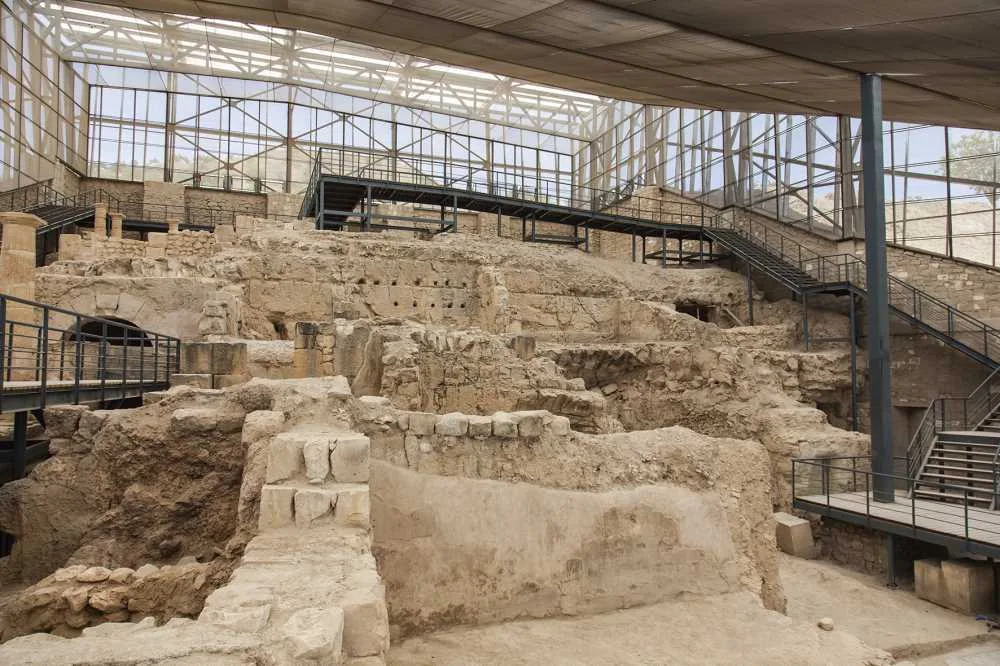
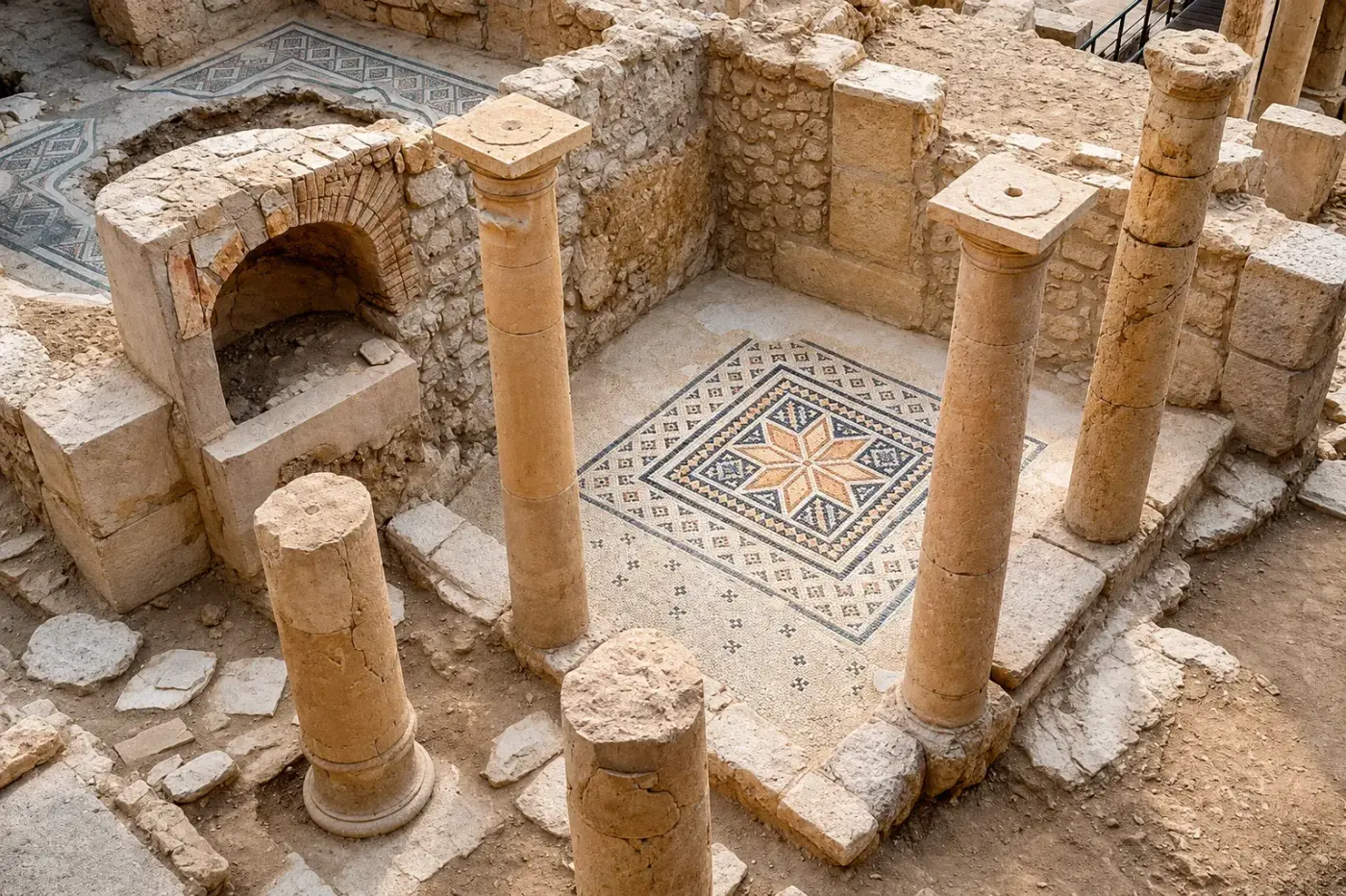
Foremost among what can still be seen on the site today is the acropolis hill, which continues to rise above the dam's waters; scattered stones and a few columns can be made out on the summit. The Roman villas preserved on the slope — such as the Houses of Dionysus and Danaë — can be visited along a covered metal walkway; in some rooms, frescoes and mosaic fragments preserved in situ can be seen.
Among the known and protected elements listed in the UNESCO Tentative List documents are the Hellenistic Agora, the Roman Agora, two sanctuaries, the stadium, the theatre, two baths, the Roman legionary base and administrative buildings, residential quarters, the Hellenistic and Roman city walls, and the Eastern, Southern and Western necropolises. It must be emphasised, however, that most of the city's magnificent mosaics are not on site but at the Zeugma Mosaic Museum in central Gaziantep (the site is about an hour from the city). The open-air area, largely submerged, is the find-spot; the movable mosaics and frescoes are preserved and displayed at the museum in the city.
The "Zeugma Archaeological Site" was submitted by Türkiye in 2012 and added to the UNESCO World Heritage Tentative List; its UNESCO reference number is 5726. The site's inclusion on this list does not mean it holds permanent/inscribed World Heritage status; the Tentative List is a preliminary inventory of sites put forward for future formal nomination. The application was made through Türkiye's Permanent Delegation, with the location given as Belkıs village, Nizip district, Gaziantep province.
To follow, in a broader frame, the place of the Hellenistic and Roman age that Zeugma belongs to within the city's history, see the History of Gaziantep page; for the region's other ancient settlements, you can look at the Carchemish and Duluk Ancient City pages.
Frequently Asked Questions
Where is Zeugma Ancient City and who founded it?
Zeugma lies in the village of Belkıs in the Nizip district of Gaziantep province, on the banks of the Euphrates. It was founded around 300 BCE by Seleucus I Nicator, the founder of the Seleucid Empire, on both banks of the river; the city on the western bank was named Seleucia and the one on the eastern bank Apamea.
What does the name "Zeugma" mean?
Its name comes from the Greek word ζεῦγμα, meaning "bridge," "crossing" or "boat bridge." It refers to the pontoon boat bridge that Seleucus had built across the Euphrates; this crossing was one of the river's few permanent crossing points for hundreds of kilometres.
Why was Zeugma strategically important?
The city guarded the principal ancient crossing of the Euphrates and the only permanent bridge over the river. Because it lay on the eastern frontier link between the Roman and Parthian empires and on the trade route running from Antioch to Iran, in the Roman era it became a garrison city that served as the base of the Legio IV Scythica.
Who destroyed Zeugma?
The city was sacked and burned in the middle of the 3rd century by the Sasanian ruler Shapur I (the most likely date being 252/253 CE). After his victory at the Battle of Barbalissos, Shapur neutralised the legionary base of Zeugma. Archaeological evidence shows that the population had largely evacuated the city before the sack; for this reason the site is often compared to Pompeii.
Why was Zeugma submerged?
The waters of the Birecik Dam, announced on the Euphrates in 1980, rose in 2000 and submerged a significant part of the city. According to multiple sources, about one-third (roughly 30 percent) of the ancient city was submerged — that is, roughly two-thirds remained above water — while the twin city of Apamea on the eastern bank was entirely submerged.
Where can I see Zeugma's mosaics?
The city's famous floor mosaics and the bronze Mars statue are displayed not on site but at the Zeugma Mosaic Museum in central Gaziantep. The open-air archaeological area is the find-spot; the movable works were lifted during the rescue excavations and moved to the museum.