Tilmen Mound is a Middle Bronze Age city that rises on the bank of the Karasu River, on the plain at the foot of the Amanos Mountains, in the İslahiye district of Gaziantep. With its monumental architecture built of basalt blocks, its walled lower town and its fortified acropolis, it was one of the most magnificent settlements in the region at the beginning of the 2nd millennium BCE. Belonging to the Old Syrian cultural world, this city is identified by most researchers with ancient Zalwar and held an important place within the orbit of the Aleppo-centred Yamhad kingdoms.
The mound was established at a strategic point on the İslahiye plain, on a natural passage linking Mesopotamia with Anatolia. The site, on which an archaeopark has now been laid out, is both an excavation area and an open-air archaeological site where you can read the region's Bronze Age past in tangible form. Together with Gaziantep's other ancient settlements, this page deals with the strata, architecture and discovery of Tilmen Mound.
Location and General Appearance
Tilmen Mound lies within the boundaries of the İslahiye district of Gaziantep province, on the İslahiye (Sakçagözü–İslahiye) plain, on the bank of the Karasu River. The mound forms a hill roughly 225 metres in diameter and about 21 metres high above the surrounding plain; the settlement area is roughly 4.5 hectares in size. This scale makes it a relatively compact but intensely fortified city.
The city's geographical position largely explains its importance in history. The İslahiye plain lies on the natural routes linking the Mediterranean coast with Inner Anatolia and, to the south, with Northern Syria. Situated on the eastern foot of the Amanos range, in a well-watered plain, Tilmen Mound commanded both an agricultural hinterland and the line of trade and communication between Mesopotamia and Anatolia. This location was one of the fundamental factors that turned the city into a regional centre of power in the Middle Bronze Age.
Location: Gaziantep, İslahiye plain, bank of the Karasu · Size: roughly 225 m in diameter, ~21 m high, ~4.5 hectares · Floruit: Middle Bronze Age II (roughly the 18th–17th centuries BCE) · Culture: Old Syrian · Probable ancient name: Zalwar (Zalbar) · First excavation: Bahadır Alkım, 1959 · Current excavation: University of Bologna – Nicolò Marchetti, after 2003.
Strata and Periods
Excavations have revealed that Tilmen Mound has a long and intermittent sequence of settlement. Traces of occupation on the mound extend from the Late Chalcolithic Age to Late Bronze Age I; in addition, remains belonging to the Roman and early medieval (early Byzantine) periods have also been identified at the site. The mound is, in other words, a settlement hill inhabited intermittently by people over several thousand years.
The city's truly magnificent age, however, is the Middle Bronze Age II (roughly the 18th–17th centuries BCE). In this period Tilmen Mound, with its monumental palace and temple structures, its powerful walls and its basalt architecture, became one of the region's leading cities. The roots of many monumental structures, the palace included, go back, according to the excavation publications, as far as the 19th century BCE; the city's fortified urban fabric therefore matured as it developed throughout the Middle Bronze Age.
This brilliant age in the Middle Bronze Age makes the city a part of the Old Syrian cultural world of Northern Syria. In the same period the Yamhad (Aleppo)-centred political order in the region consisted of a series of local kingdoms; Tilmen Mound too is accepted as having had its place within this network of kingdoms.
The Ancient Name: Zalwar and the World of Yamhad
Although the ancient name of Tilmen Mound is not known for certain, most researchers identify the mound with the ancient city of Zalwar (Zalbar). Zalwar was one of the cities of the Old Syrian political geography of Northern Syria at the beginning of the 2nd millennium BCE. This identification is a proposal based on the city's location, scale and finds; as with many Bronze Age settlements in the region, its exact identity has not yet been fully confirmed by a direct cuneiform record.
The world in which the city stood was the sphere of influence of the Kingdom of Yamhad, whose capital was Aleppo. In the Middle Bronze Age, Yamhad was one of the most powerful political structures of Northern Syria, and around it lay a series of local kingdoms subject to it. Tilmen Mound too is accepted as being counted among these kingdoms. Written and seal finds from the site show that the city was also in contact with the Old Babylonian world: an inscribed bulla (seal impression) recovered at the mound has been associated with the reign of the Babylonian king Sumu-la-el and has been counted among the evidence pointing to the existence of an Old Babylonian trading post in the city.
These findings suggest that Tilmen Mound was not merely a local centre but also a node in the trade and diplomatic networks extending from Mesopotamia to Anatolia and the Mediterranean. For the wider historical framework of the region you can look at the History of Gaziantep page.
Basalt Architecture: Palace, Temple and Towered Walls
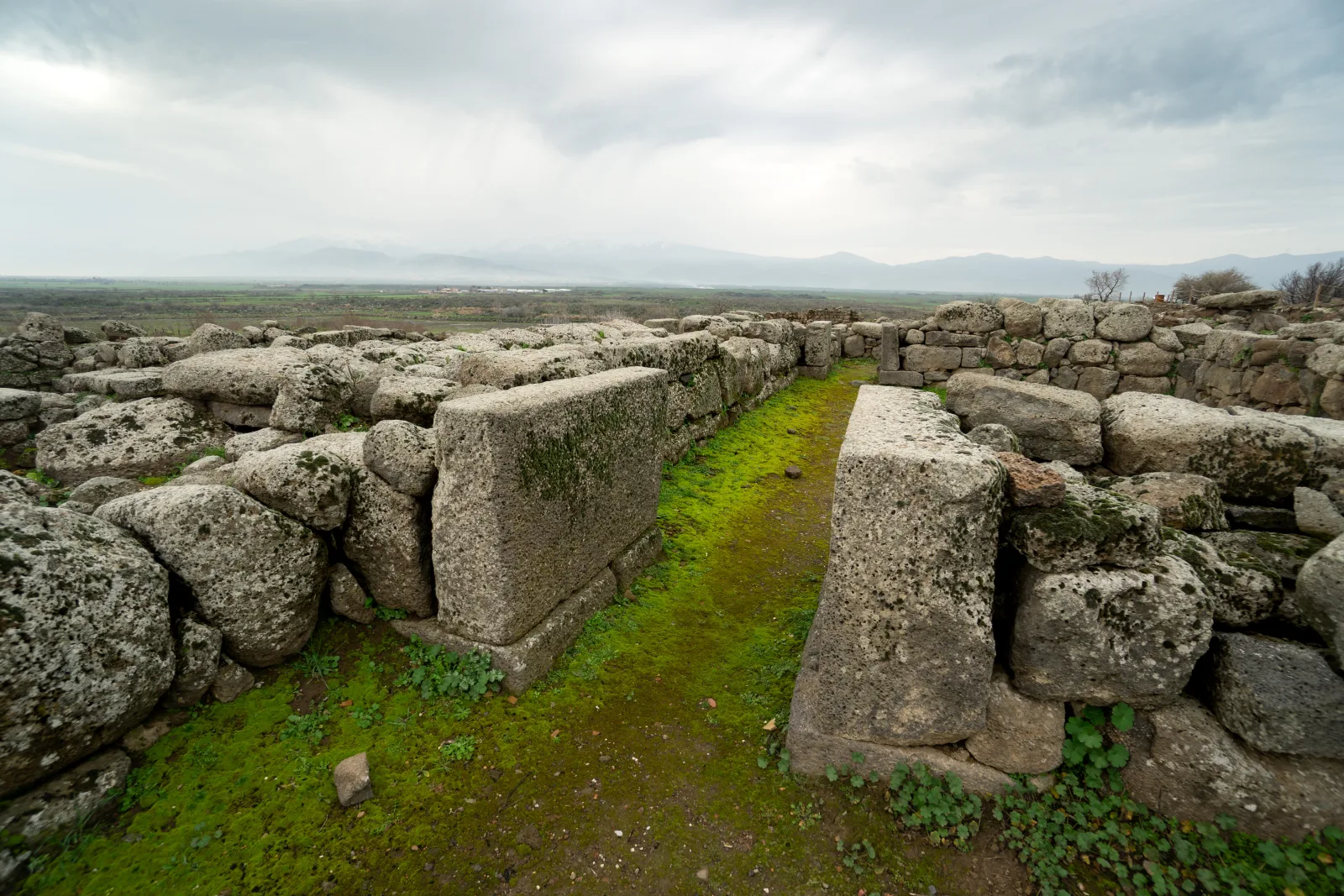
The most striking feature that sets Tilmen Mound apart from other settlements of the period is its architecture. The city's structures and walls were built largely of basalt blocks; this technique, using large, roughly worked stones, is described by researchers as "Cyclopean architecture." Along the inner walls of many structures, rectangular basalt blocks were set as orthostats (upright stone slabs). This magnificent stonework makes the city one of the most monumental settlements of the period in the region.
The city consists of two basic sections: a lower town powerfully enclosed by walls, and the fortified acropolis that crowns it. On the acropolis stood the monumental royal palace belonging to the city's rulers (called Building A / Bina A in the excavation literature), a temple (Building E) and a fortress structure (Building H / Fortress H). This magnificent palace, dated to the 19th century BCE, is one of the city's most important discoveries.
Walls, Gates and Towers
The defensive system surrounding the lower town is one of the most impressive aspects of Tilmen Mound. The walls were strengthened with casemate walls with chambers set inside them and with tower-fortresses placed at intervals; in the excavation records these towers and fortification structures are referred to by names such as P, P2, K-1 and K-6. At a point near the middle of the eastern face of the walls, a monumental entrance belonging to Middle Bronze Age II had been opened; this entrance consisted of a projecting body (K-6) joined by walls to the main gate (K-1). Along the line of the walls there were also smaller back gates (posterns) (K-2, K-3).
This arrangement of towered, gated and casemated walls makes Tilmen Mound one of the most developed examples in the region of Middle Bronze Age Northern Syrian defensive architecture. The scale of the walls and gates was designed to reflect both the city's military power and the prestige of its rulers.
Notable Finds
The Tilmen Mound excavations brought to light remarkable works that shed light on the city's art and writing culture. Foremost among them are the seal and bulla finds in the Old Syrian style. An inscribed bulla (seal impression) in the classic Old Syrian style, found in the palace area during the 1962 excavation season, is important evidence documenting the city's administrative and commercial relations.
Another striking find is a basalt stele uncovered in one of the city's monumental temples (the towered temple in Area M). Carved in the late Old Syrian style, this stele depicts a high-ranking official making a gesture of prayer before the Storm God. Such religious scenes vividly reveal the city's world of belief and Old Syrian iconography.
Among the finds belonging to earlier periods are flat female figurines (types called "idols") dating to the Early Bronze Age. The principal institution where the portable works recovered from the region's excavations are preserved and displayed is the Gaziantep Archaeology Museum; for those who wish to see Gaziantep's rich archaeological heritage in full, the Zeugma Mosaic Museum is also a complementary stop.
Excavations, Discovery and the Archaeopark
Scientific excavations at Tilmen Mound began in 1959 under the direction of Dr. Bahadır Alkım. Carried out with the support of Istanbul University, the Turkish Historical Society and the Ministry of Culture of the time, this work continued until 1972 and brought to light a significant part of the city's monumental palace and wall system.
After a long interval, the work on the mound was taken up again by Prof. Dr. Refik Duru. Then, in 2003, a joint Turkish–Italian team under the direction of Prof. Dr. Nicolò Marchetti of the University of Bologna began a new period of excavation in collaboration with Refik Duru of Istanbul University. These excavations, carried out between 2003 and 2008, documented in detail the city's topography, stratigraphy, architecture, pottery and finds.
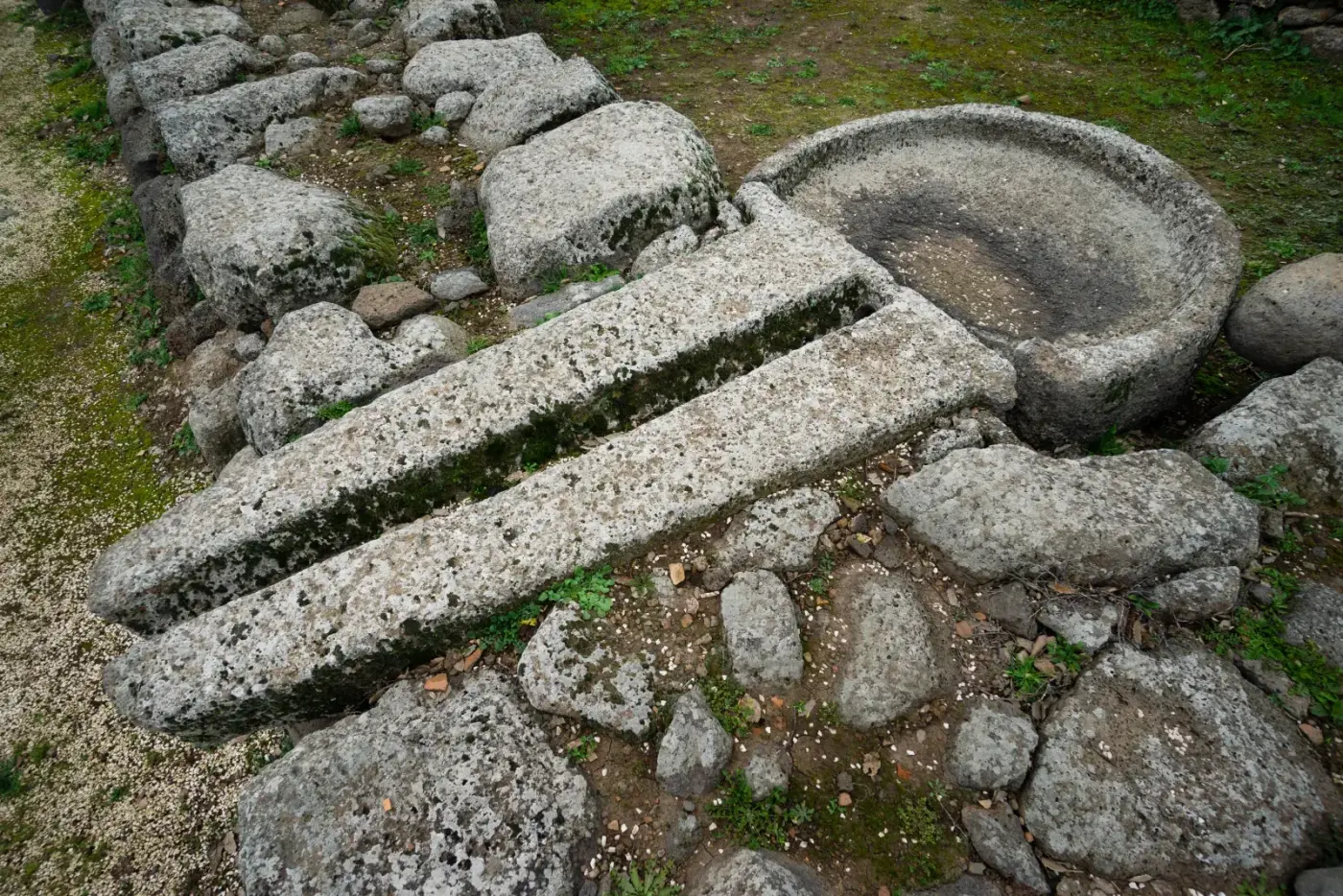
An important dimension of the current excavation period was also the conservation and presentation work. An archaeopark that visitors can tour was laid out over the site; with orthophoto and visitor arrangements, the mound was turned into an open-air museum open both to academic research and to visits. Tilmen Mound thus became one of the rare points where you can see Gaziantep's Bronze Age past on the spot.
First period (1959–1972): Dr. Bahadır Alkım — with the support of Istanbul University, the Turkish Historical Society and the Ministry of Culture. Renewed undertaking: Prof. Dr. Refik Duru (Istanbul University). Current period (after 2003): Prof. Dr. Nicolò Marchetti — University of Bologna, joint Turkish–Italian team. An archaeopark has been laid out at the site.
For those who wish to set Tilmen Mound in its context, the region's other ancient centres are also of interest: foremost among them are the Yesemek Open-Air Museum (a sculpture workshop) and Sakçagözü in the same İslahiye area, Carchemish and Zeugma on the bank of the Euphrates, and, to the north, Duluk (Doliche). For a list of all the settlements you can take a look at the Ancient Cities page.
Frequently Asked Questions
Where is Tilmen Mound located?
Tilmen Mound is a mound settlement located in the İslahiye district of Gaziantep, on the İslahiye plain at the foot of the Amanos Mountains, on the bank of the Karasu River. It was established at a strategic location on the natural passage between Mesopotamia and Anatolia.
To which period does Tilmen Mound belong?
Traces of settlement on the mound extend from the Late Chalcolithic Age to Late Bronze Age I; there are also remains from the Roman and early medieval periods at the site. The city's truly magnificent age, however, is the Middle Bronze Age II (roughly the 18th–17th centuries BCE); the roots of many structures, the monumental palace included, go down to the 19th century BCE.
What is the ancient name of Tilmen Mound?
Although the city's ancient name is not known for certain, most researchers identify the mound with the ancient city of Zalwar (Zalbar). The city lay within a network of local kingdoms in the sphere of influence of the Kingdom of Yamhad, whose capital was Aleppo, and belonged to the Old Syrian cultural world.
Why is Tilmen Mound important?
With its "Cyclopean" architecture built of basalt blocks, its walled lower town, its fortified acropolis and its monumental palace, Tilmen Mound was one of the most magnificent cities in the region in the Middle Bronze Age. Its towered, gated and casemated wall system is among the leading examples of the period's Northern Syrian defensive architecture.
What kinds of finds were recovered at Tilmen Mound?
Among the notable finds are an inscribed bulla in the Old Syrian style found in the palace area in 1962, a basalt stele in the late Old Syrian style uncovered in a towered temple and depicting an official praying before the Storm God, and flat female figurines from the Early Bronze Age. An inscribed bulla has been associated with the reign of the Babylonian king Sumu-la-el.
Who excavated Tilmen Mound?
The first excavations began in 1959 under the direction of Dr. Bahadır Alkım and continued until 1972. The work was later taken up again by Prof. Dr. Refik Duru; from 2003 onward a Turkish–Italian team under Prof. Dr. Nicolò Marchetti of the University of Bologna continued the excavations. An archaeopark open to visitors has been laid out at the site.