Sakçagözü is an archaeological mound located in the Nurdağı area of Gaziantep province, in the stretch of the İslahiye plain that extends northward. Also known by its true archaeological name, Coba Höyük, the settlement is famous for its superimposed strata reaching from the Neolithic Age to the Late Hittite (Neo-Hittite) period, and above all for the Sakçagözü reliefs that adorned a palace gateway. These orthostats, depicting lion-hunt scenes, gate lions, sphinxes and winged creatures, are counted among the most striking examples of the palace art of the Late Hittite principalities of south-eastern Anatolia.
This page deals with the mound itself — its location, its deep stratification, the Late Hittite palace, the famous reliefs, the history of the excavations and the museums in which the finds are kept today. For the other settlements that together made up the Late Hittite world of the region, Carchemish and the open-air quarry-workshop Yesemek are complementary stops.
Where Is It? A Mound to the North of the İslahiye Plain
The Sakçagözü mound rises in the Nurdağı area of Gaziantep province, about three kilometres north-west of the village of Sakçagözü that bears the same name. Geographically, it lies on the plain that continues northward from the İslahiye plain to the south; this position places the mound on the natural transit line between the Amanos (Nur) Mountains and the interior regions.
The settlement is known in the scholarly literature by more than one name. Foremost among these is the mound's own name, Coba Höyük; in older publications the place is also recorded with different transliterations such as Sakje Geuzi. The settlement that gives the mound its name is also referred to in the sources as Keferdiz. This location makes the mound a natural part of Gaziantep's Late Hittite-era settlement network; Tilmen Mound, lying at the southern end of the same plain, is likewise one of the ancient settlements of this region.
From the Neolithic to the Late Hittite: Superimposed Millennia
To see Sakçagözü merely as a Late Hittite settlement would be incomplete; the mound is built upon a far deeper past. Excavations have revealed that the settlement saw an intermittent occupation extending from the second half of the 7th millennium BCE down to the 1st millennium BCE. This long span can be read in the form of a series of cultural strata piled one upon another in the mound.
The lowest strata belong to the Late Chalcolithic and the prehistoric cultures that followed it; in these phases the mound bears the traces of the early farming societies of the Near East. Within the stratification, prehistoric cultural layers of Mesopotamian origin such as the Halaf culture, known for its painted pottery, and the Ubaid period have also been documented. These early phases make the mound an important reference point for the prehistory of the region as well.
The last known great peak of occupation is the phase to which the mound owes its fame: the Late Hittite (Syro-Hittite) period. In the upper strata of the mound, fortification walls of this period, a palace structure and the stone reliefs that adorned it have been brought to light. After the Late Hittite phase, the mound continued to be occupied on a limited scale and in later periods as well.
The Late Hittite Palace and "Bit Hilani" Architecture
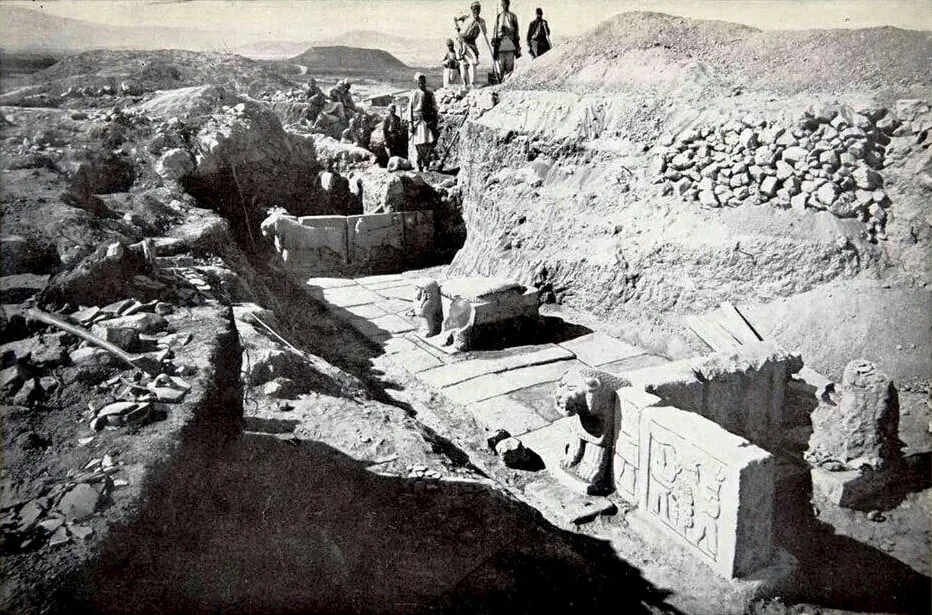
The most magnificent structure uncovered in the upper strata of the mound is a palace complex set within an area enclosed by fortification walls. This palace was built in the bit hilani type characteristic of Late Hittite and North Syrian architecture. The bit hilani is a monumental palace-residence plan recognised by a columned entrance portico opening onto the façade; one ascends into the entrance by a stairway, and behind the portico lies a broad reception hall.
The truly distinctive feature of the Sakçagözü palace is that this entrance was adorned with sculptures and reliefs. The gateway was guarded by monumental stone lions placed to either side like sentinels; the bases of the building's walls, meanwhile, were ringed by rows of orthostats — that is, stone slabs carved in relief and set upright. In this way a visitor approaching the palace, advancing step by step, was met by a sequence of images worked into stone.
The date of the palace and the reliefs that adorn it is placed by researchers at around 730–700 BCE, that is, the final phase of the Late Hittite principalities. This is an age when the region was gradually entering the political sphere of influence of the Neo-Assyrian Empire; Sakçagözü palace art, too, is a product of this period in which the Late Hittite tradition and Assyrian influences were intertwined.
The Sakçagözü Reliefs: Lion Hunt and Winged Creatures
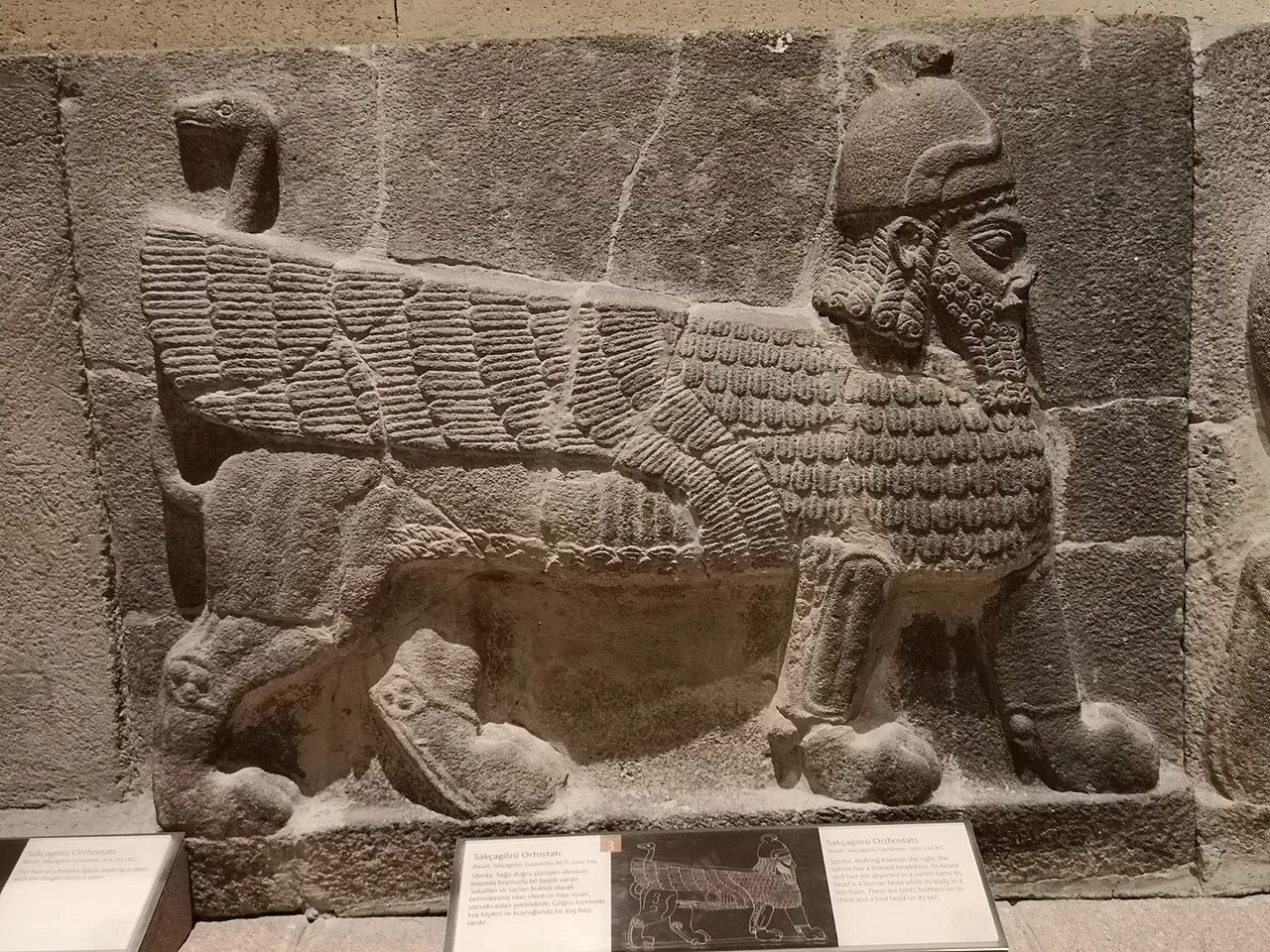
The true element that carried the mound into world archaeological literature is the series of stone reliefs that adorned the palace gateway. Carved on basalt, a hard stone, these orthostats were arranged around the gateway so as to form a composition, recalling a ceremonial procession or a narrative scene.
The best-known subject of the reliefs is a lion-hunt scene. Alongside this, the series includes lion figures holding the two sides of the gateway, the sphinx — a hybrid/mixed creature — and mythologically charged winged creatures (winged protective genii / composite creatures). This repertoire — protective animal-human hybrids and the royal hunt — belongs to the shared visual language of Late Hittite and contemporary Assyrian palace art; it both weaves a protective belt around the palace and symbolises the power of the ruler and the established order.
The Sakçagözü reliefs are, for this reason, not merely a local find but one of the fundamental examples consulted in understanding the palace iconography of the Late Hittite principalities. To see the "production" side of a similar tradition of stonework, the open-air sculpture workshop of the region, the Yesemek Open-Air Museum, offers a context that complements these reliefs.
Discovery and Excavations: Garstang and Those Who Came After
The Sakçagözü reliefs came to the attention of the scholarly world before the systematic excavations. The orthostats on the mound were noticed in the 19th century; one of the lion-hunt reliefs was taken during the visit of Carl Humann and Felix von Luschan to the mound in 1883 and carried off to Berlin. These reliefs explain why a portion of the Sakçagözü finds is today located in Berlin.
The first systematic excavations on the mound were carried out by the British archaeologist John Garstang. Garstang worked at the site in 1908 and 1911; it was through these excavations that he introduced to the scholarly world the columned entrance of the bit hilani palace and the series of sculptures and reliefs that adorned it. Garstang's work of this period holds an important place in the early discovery of the Hittite and Late Hittite world, which was only just beginning to be understood.
Other work was carried out on the mound after Garstang as well. In 1939, as the Second World War broke out, the sculpted portico of the palace façade was removed from its place by the Turkish authorities; in 1949, a new excavation campaign was conducted on the mound under the auspices of the British Institute of Archaeology at Ankara, which Garstang had founded in 1947, directed by John d'Arcy Waechter. With this later generation of excavation, the deep prehistoric strata of the mound (including phases such as Halaf and Ubaid) were documented in greater detail.
Location: Gaziantep, Nurdağı area; to the north of the İslahiye plain, about 3 km north-west of the village of Sakçagözü. Other names: Coba Höyük, Sakje Geuzi. Occupation: from the second half of the 7th millennium BCE to the 1st millennium BCE (from the Late Chalcolithic / Halaf / Ubaid to the Late Hittite). Notable find: a bit hilani type Late Hittite palace and orthostats with lion-hunt, sphinx, lion and winged-creature reliefs (around 730–700 BCE). First systematic excavation: John Garstang (1908 and 1911).
Where Are the Finds Today?
The finds uncovered at Sakçagözü are scattered across more than one museum, because the excavations were carried out in different periods and by different teams. In Türkiye, the greater part of the mound's Late Hittite finds — including those moved to Ankara in 1939 — is held at the Museum of Anatolian Civilizations in the capital, Ankara; this museum holds one of the country's principal collections of Hittite and Late Hittite-era stone works of Anatolia. The Museum of the Ancient Orient in Istanbul also contains finds originating from Sakçagözü.
Abroad, a group of works — among them the lion-hunt relief carried off by Humann and von Luschan in 1883 — is in the collection of the Vorderasiatisches Museum (Museum of the Ancient Near East) in Berlin. Thus the mound's famous series of reliefs is today not in a single place; it is spread across the halls of different museums such as those in Ankara, Istanbul and Berlin.
To follow Gaziantep's own archaeological heritage and the Late Hittite age of the region within a broader frame, the Gaziantep Archaeology Museum and the Zeugma Mosaic Museum, which displays the city's ancient-era finds, are the principal stops.
Placing Sakçagözü on the Ancient Map of the Region
Sakçagözü is not a find-spot standing on its own; it is a link in the ancient settlement network that fills Gaziantep and its surroundings from one end to the other. In the Late Hittite age this region was a world of principalities distinguished by their own palaces, fortifications and stone art; the Sakçagözü palace, too, is a powerful example of this world.
To explore the other centres that share the same age and geography — the great capital on the bank of the Euphrates, Carchemish; Yesemek, where the stone sculptures were carved; the ancient cult and settlement centre of Duluk (Doliche) Ancient City; and the Hellenistic–Roman city of Zeugma — are the principal stops. For an overview of all the ancient settlements of the region, you can look at the Ancient Cities category page, and for the city's long historical line, the History of Gaziantep page.
Frequently Asked Questions
Where is Sakçagözü (Coba Höyük) located?
The Sakçagözü mound lies in the Nurdağı area of Gaziantep province, in the stretch of the İslahiye plain that extends northward. It rises about three kilometres north-west of the village of Sakçagözü, which bears the same name, and is also known in the archaeological literature as Coba Höyük.
What do the Sakçagözü reliefs depict?
The basalt orthostats that adorned the gateway of the Late Hittite palace on the mound depict, above all, a lion-hunt scene, along with the lions holding the two sides of the gateway, a sphinx and mythological winged creatures. These scenes belong to the typical visual repertoire of Late Hittite palace art, symbolising the power of the ruler and the protective order of the palace.
Who excavated Sakçagözü and when?
The first systematic excavations on the mound were carried out by the British archaeologist John Garstang in 1908 and 1911, and it was he who introduced the bit hilani type palace to the scholarly world. Earlier, Carl Humann and Felix von Luschan had taken a lion-hunt relief and carried it off to Berlin in 1883; in 1949 the mound was excavated again with the support of the British Institute of Archaeology at Ankara, and the deep prehistoric strata were documented in greater detail.
What periods does the mound span?
Sakçagözü saw an intermittent occupation extending from the second half of the 7th millennium BCE down to the 1st millennium BCE. The lowest strata belong to prehistoric cultures such as the Late Chalcolithic and Halaf and Ubaid; the best-known upper strata, with the palace and its reliefs, belong to the Late Hittite (Syro-Hittite) period.
What does "bit hilani" mean?
The bit hilani is a monumental palace-residence plan characteristic of Late Hittite and North Syrian architecture, recognised by a columned entrance portico opening onto the façade. The Sakçagözü palace was built in this type; its entrance was adorned with monumental lions and orthostats carved in relief.
Where can I see the Sakçagözü finds today?
The finds are scattered across more than one museum. In Türkiye, finds originating from Sakçagözü are held at the Museum of Anatolian Civilizations in Ankara and the Museum of the Ancient Orient in Istanbul. The lion-hunt relief carried off by Humann and von Luschan in 1883 is in the collection of the Vorderasiatisches Museum (Museum of the Ancient Near East) in Berlin.