You step into a dim room. On the wall hangs a woman's face, built from thousands of tiny colored stones. You shift a few steps to the right; the gaze comes with you. You cross to the left; it is still upon you. Laid nearly two thousand years ago into the floor of a Roman villa's dining room, that gaze is today the emblem of an entire city: the Gypsy Girl. This article sets off in pursuit of it, telling the story of the city that created her, of her rescue before the waters closed over her, and of the museum that holds her today.
To understand the Gypsy Girl properly, you need to hold two places in mind at once: the ancient city of Zeugma, where the mosaic was found, and the Zeugma Mosaic Museum, which protects it today. One is the find-site on the banks of the Euphrates; the other, the exhibition hall in the city center. Between them lies a rescue effort waged against the clock at the close of the 20th century.
The Gypsy Girl: The Gaze That Watches You From Everywhere
Let's begin with the name, because the name is a little misleading. There is no solid evidence that this face, popularly known as the "Gypsy Girl," actually depicts a wandering woman. The most widely accepted scholarly reading is that the figure is one of the female followers who joined the cultic processions of Dionysos, the god of wine — in other words, a Maenad. The mosaic is only a single fragment of a vast composition, stretching for meters, that once covered the floor of a villa's dining room (triclinium) in Zeugma; this surviving face is one piece broken away from the whole.
What makes the work "the Mona Lisa of mosaics" is that hard-to-describe gaze. Whichever corner of the room you move to, you cannot shake the impression that the eyes are following you. This is no trick but the fruit of sheer craftsmanship: the mosaic masters of Zeugma worked the eyes and the contours of the face with extremely small colored stone cubes — the pieces known as tesserae — in such soft gradations that the gaze comes alive as light and angle shift. That part of the face is damaged does not soften the effect; strangely, it deepens it, the missing portion making the remaining expression all the more intense.
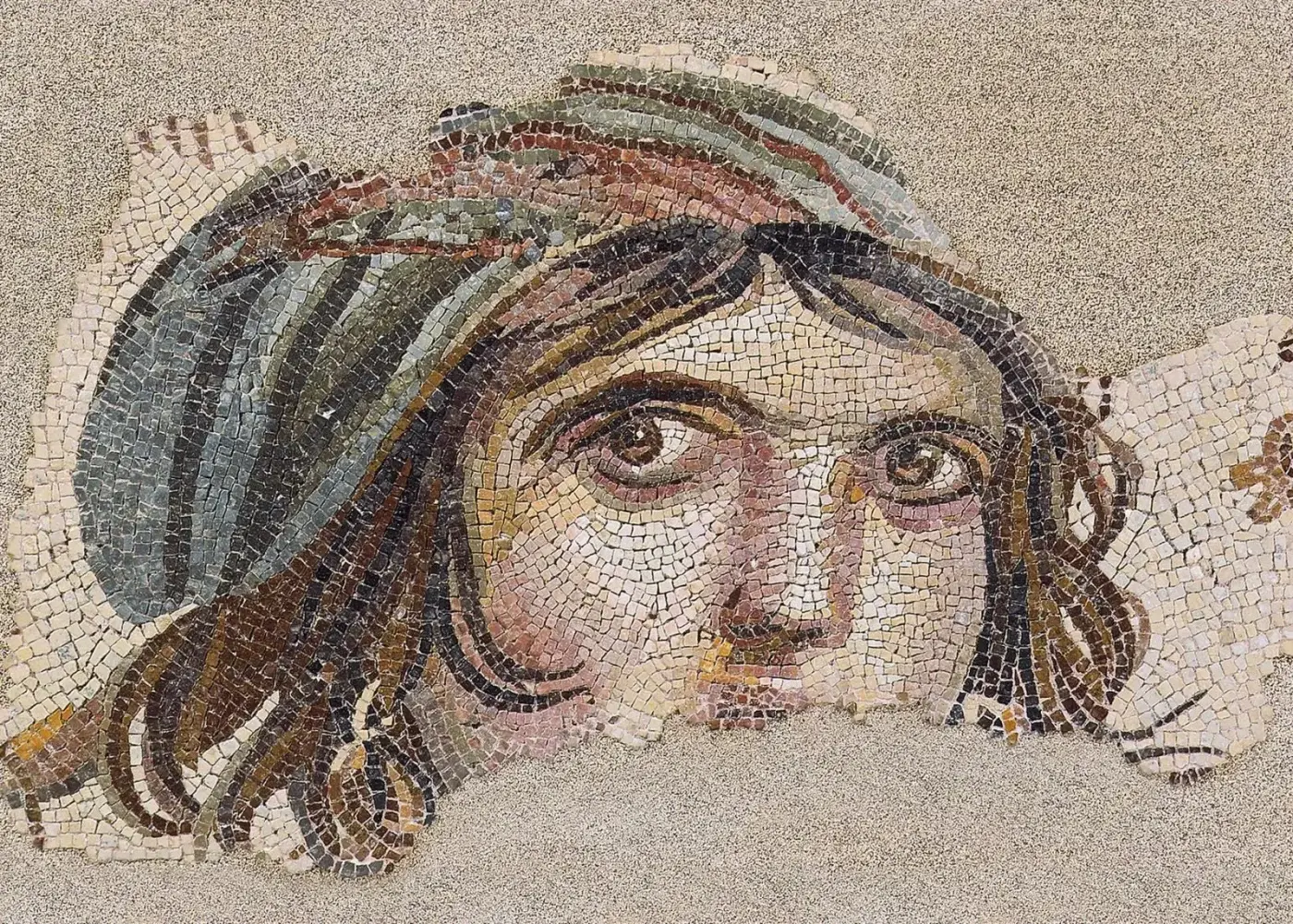
The most dramatic part of the mosaic, though, is the story of its frame. Twelve pieces, once smuggled abroad and held for many years at Bowling Green State University in the United States, were brought back to Gaziantep in December 2018 through sustained scholarly and diplomatic efforts, and carefully set back into the empty spots around the main panel in the dim exhibition room. In the years since, still more fragments of the composition have continued to be returned to the country. In other words, the wholeness you see today in the Gypsy Girl's room is the work not only of an ancient master, but of a repatriation struggle waged decades later. If you'd like to visit the Gypsy Girl together with Gaziantep's other museums in a single day, our Gaziantep museum route guide proposes an itinerary that includes this stop.
Where Did This Face Come From? A Short History of Zeugma
The city that gave rise to the Gypsy Girl is Zeugma, on the banks of the Euphrates. The city's origins reach back to Seleucus I Nicator, one of the successors of Alexander the Great and the founder of the Seleucid Empire. Around 300 BCE, Seleucus founded a twin settlement on both banks of the Euphrates: the city on the west bank was named Seleucia after himself, and the one on the east bank Apamea, after his Persian wife Apama. In time, the name "Zeugma" came to denote this combined twin city — and, most often, Seleucia on the west bank.
The name itself sums up the city's fate. "Zeugma" means "bridge," "crossing," or "bridge of boats" in Greek, and derives from the pontoon bridge that Seleucus had built across the Euphrates. This was no ordinary bridge: for hundreds of kilometers, it was one of the river's few — at times its only — permanent crossing points. The city's entire strategic importance flowed from this crossing. In the Roman period, Zeugma rose to prominence as a frontier and garrison city guarding this vital passage over the Euphrates; here the Legio IV Scythica (the Fourth Scythian Legion) was stationed, and the city became one of the key points along the eastern border between the Roman and Parthian empires. It also lay on the trade route running east from Antioch, widely regarded as part of the Silk Road.
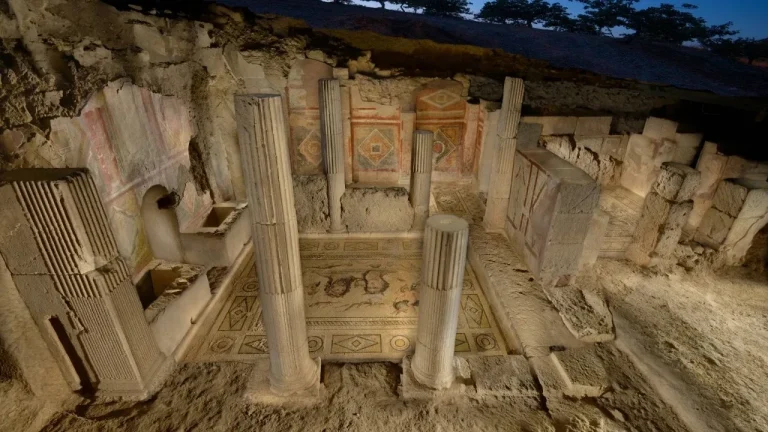
The city's splendid age came to an abrupt end in the mid-3rd century: Zeugma was sacked and burned by the Sasanian ruler Shapur I (the most likely date, based on archaeological evidence, being 252/253 CE). What is striking is that the population appears to have been warned before the sack and to have largely evacuated the city. There is no trace of street fighting; instead, the residents left without being able to recover the belongings they had hidden away for safekeeping. The homes, burned and abandoned just as they were, effectively froze everyday life in the middle of the 3rd century — which is why archaeologists often compare Zeugma to Pompeii. It is precisely this "frozen moment" that explains why mosaics like the Gypsy Girl have survived so remarkably well.
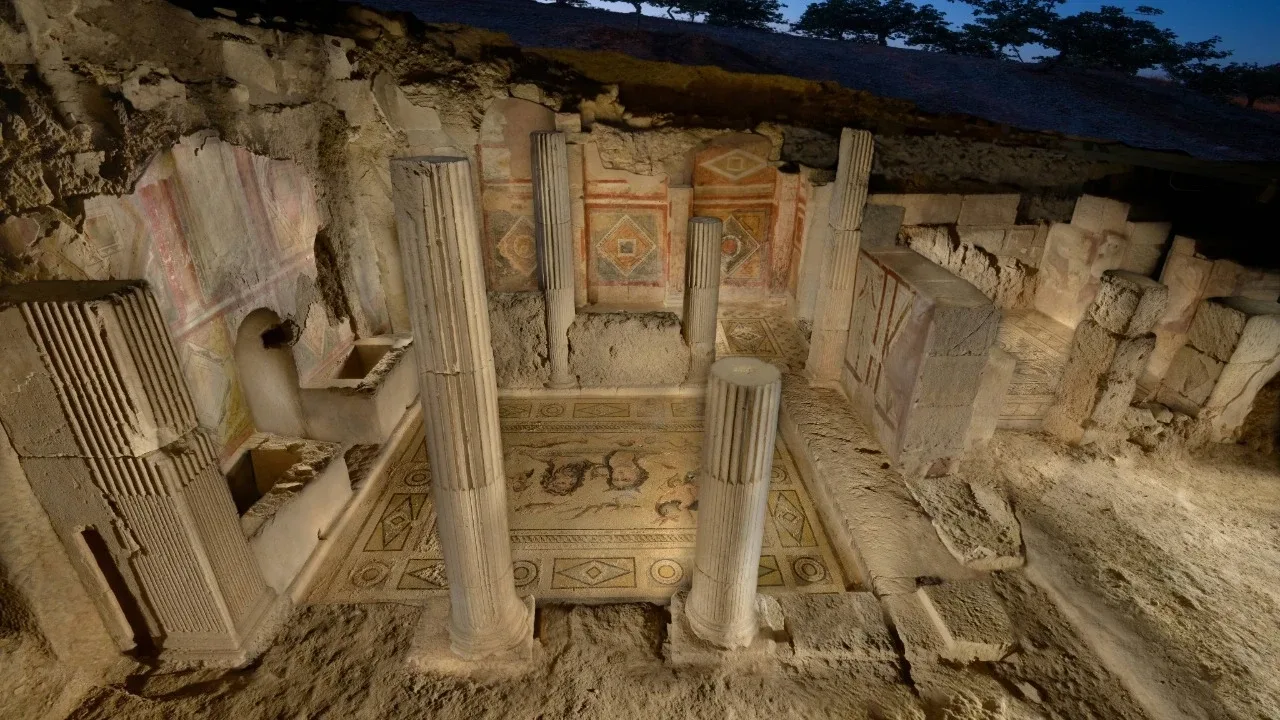
For those who want to trace the city's history, its destruction, and its rediscovery in more detail, our ancient city of Zeugma page is a comprehensive resource.
A Race Against the Water: How Were the Mosaics Rescued?
Zeugma's story at the end of the 20th century turned into a rescue race. The rising waters of the Birecik Dam, built on the Euphrates, were set to submerge a significant portion of the city. The flooding of the site took place in 2000; the waters rose slowly over months, and in the end roughly a third of the ancient city — all of Apamea, the twin city on the east bank — went under. It was at precisely this critical moment that many mosaics, the Gypsy Girl among them, were lifted from their places with great care and rescued.
This was no quiet, unnoticed excavation. Once the threatened site reached the international press, nearly a hundred archaeologists soon arrived on site; teams of Turkish, French, American, and other experts drew the works out from ahead of the advancing waves, as the water level rose by centimeters a day. The operation was coordinated by the Ministry of Culture of the Republic of Türkiye together with the Gaziantep Museum Directorate. The lifted mosaics were first stored at the Gaziantep Archaeology Museum, and later moved to the purpose-built Zeugma Mosaic Museum.
The waters of the Birecik Dam reached the lower parts of the ancient city in 2000; this was the most critical period of the emergency rescue excavations. The large composition containing the Gypsy Girl had been uncovered during the 1998 rescue work, and was lifted and secured before the waters rose. In other words, the work you see in the museum today is, quite literally, a heritage rescued from the water.
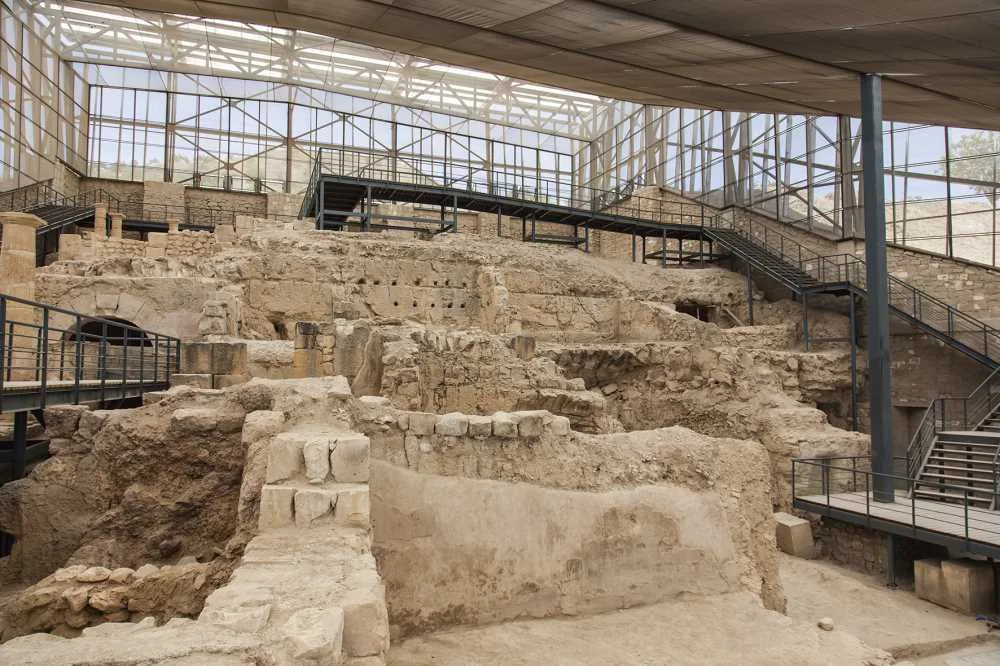
Systematic excavations in the parts that were not flooded continue to this day; the site is an open archaeological area that can be toured along covered metal walkways. If you'd like to see Zeugma as part of a wider tour together with the region's other ancient settlements, our ancient cities tour guide covering Zeugma, Dülük, and Yesemek offers a comprehensive route.
The Museum: Rebuilding a City
For the rescued mosaics, a purpose-built museum was constructed in the center of Gaziantep, on the grounds of a former tobacco factory. The Zeugma Mosaic Museum opened to visitors on September 9, 2011, and at the time was hailed as the largest mosaic museum in the world; even today it displays one of the world's most extensive collections of Roman mosaics.
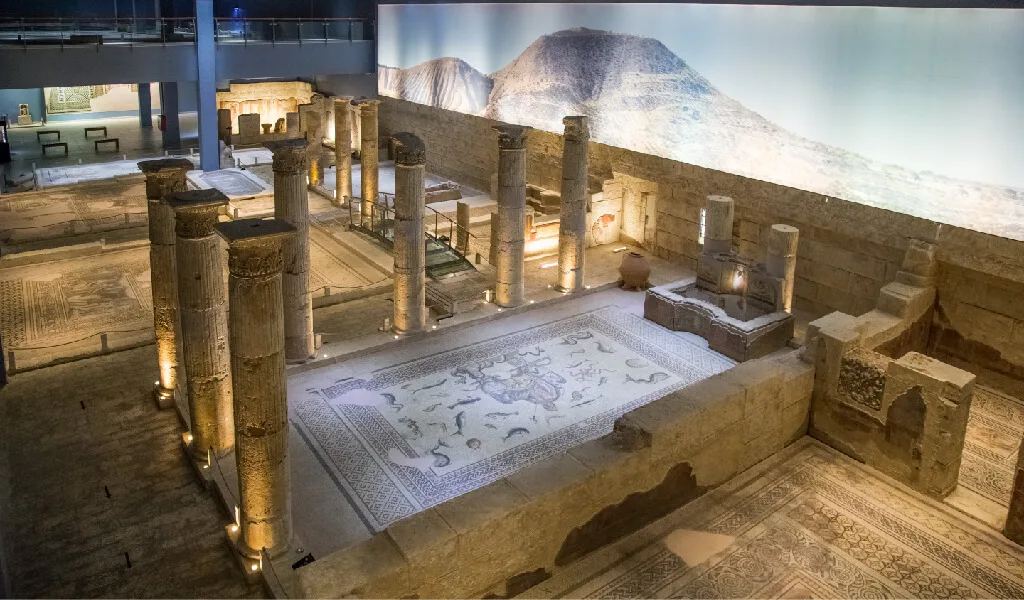
The museum's real subtlety is that, rather than arranging the mosaics at random, it displays them by reconstructing the actual topography of the ancient city. Zeugma was a terraced city that began at the banks of the Euphrates and climbed up the slopes; the museum carries this stepping of levels into the building itself. Mosaics from homes near the river level are displayed at the lower levels, while works rescued from the elite residences on the upper slopes are shown higher up. In this way the visitor doesn't merely tour a museum; they make a virtual climb from Zeugma's riverside neighborhoods up to the homes on the hilltops. The panorama of the Euphrates on the hall's back wall completes this context. To read in more detail about the museum's architecture, the craft of restoration, and tips for your visit, take a look at our Zeugma Mosaic Museum page.
The Works You Must See at the Museum
Most visitors head straight for the Gypsy Girl and leave a few minutes later. Yet the museum holds several more masterpieces every bit as striking. Here are the works you should be sure to stop at before you change rooms.
The Bronze Statue of Mars (Ares)
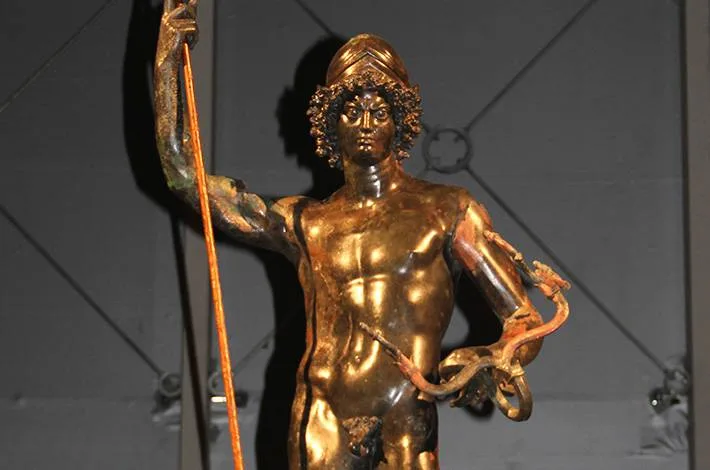
The most important work in the collection apart from the mosaics is the bronze statue of Mars, the god of war. The reason it has come down to us almost intact is a poignant one: before a Sasanian raid it was carefully hidden among the storage jars in the villa's cellar, and its owners never came back to retrieve it. That the god of war should be so prominent in a legionary city is, of course, no coincidence. Life-sized, the statue holds a spear in one hand and unites destruction and abundance in a single figure — the other hand offering fertility. Its most distinctive feature is the gold and silver inlay in the pupils of the eyes; this refinement makes the statue one of the most magnificent examples of bronze casting in the world.
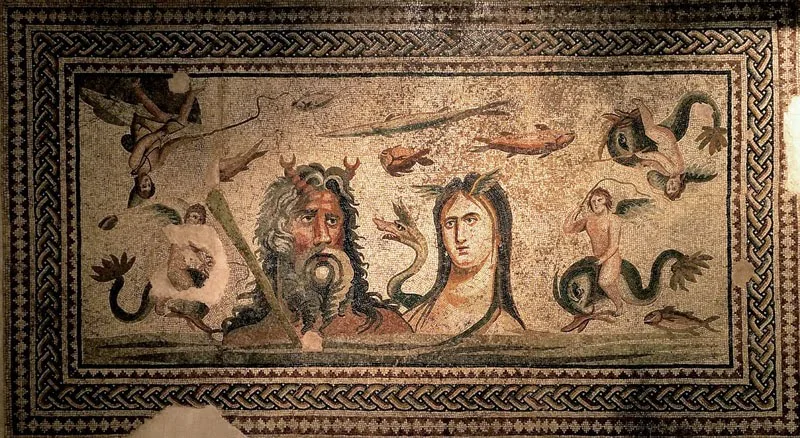
The Okeanos and Tethys Mosaic
Depicting Okeanos and Tethys, the divine couple of the sea and fresh waters, this mosaic once adorned the center of a villa floor. The fish and sea-creature figures surrounding the couple show how Zeugma's masters built up gradations of color and a sense of movement upon stone. The water theme is a direct geographical reference for a city on the banks of the Euphrates: the city's life, like its name, is woven from water and from the crossing.
Villa Mosaics With Mythological Scenes
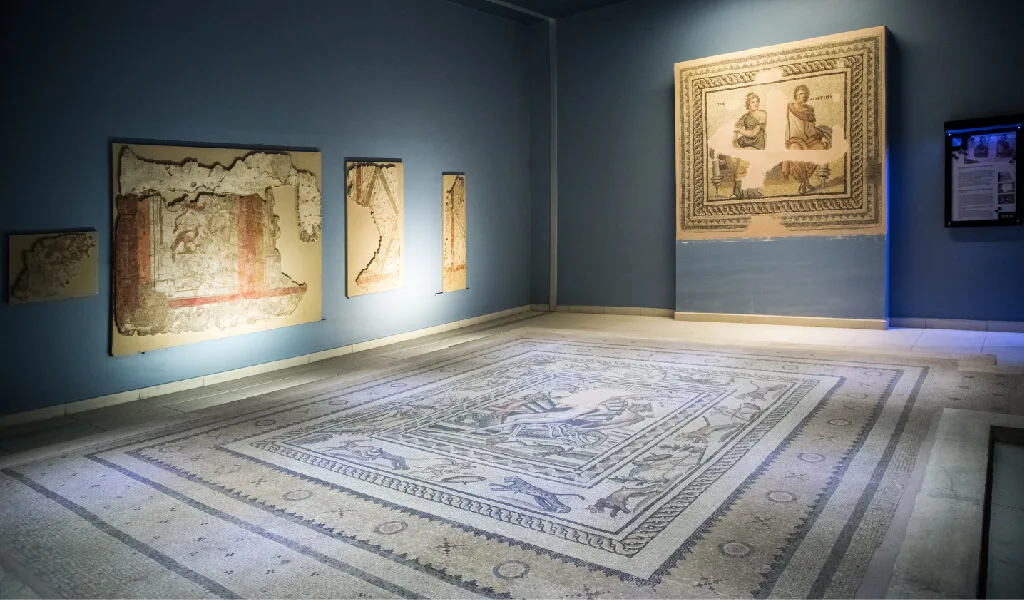
The museum brings together a large number of floor mosaics from Zeugma's wealthy homes, each depicting a scene from mythology. The mosaics of the houses named after figures such as the story of Achilles, the abduction of Europa, Dionysos, and Danae show how the elite families of the age turned their homes into galleries of myth. These scenes were not merely decorative; they were statements displaying the host's cultural sophistication and social standing. In some rooms the mosaic is shown together with wall frescoes, preserving its original spatial unity.
Before the Gypsy Girl: Practical Tips
A few small suggestions for experiencing the work as it deserves:
- Walk around inside the room: The Gypsy Girl is displayed in a separate, dim room with controlled lighting. Rather than standing still and looking, take a few steps from left to right; you'll only notice the gaze "following" you by moving.
- Get close to the detail: Notice just how small the stone cubes are that make up the eyes and the face; the softness of the expression arises from the density of these tiny tesserae.
- Don't settle for the emblem alone: Most people see the Gypsy Girl and leave. Don't depart the museum without also seeing the statue of Mars, the Okeanos and Tethys, and the villa mosaics.
- Follow the topography: If you tour the mosaics from the lower level up to the upper floor, you will have reconstructed Zeugma's actual fabric, rising from the riverbank to the hilltops.
To tour all of Gaziantep's museums efficiently in a single day, see our museum route guide, and for those who want to discover the city in just two days, our Gaziantep in 48 hours plan. For a broader cultural map, the Culture Atlas, for all the museums the museums page, and for the region's other ancient settlements the ancient cities page can all be your starting point.
Frequently Asked Questions
What is the Gypsy Girl mosaic, and whom does it depict?
It is a fragment of a large composition that covered the dining-room floor of a Roman villa in Zeugma. The most widely accepted interpretation is that the figure is a female follower (a Maenad) who took part in the cultic processions of Dionysos, the god of wine. The name "Gypsy Girl" is a popular one that has stuck; because the gaze appears to follow the viewer, the work is often called "the Mona Lisa of mosaics."
Where can I see the Gypsy Girl?
The work is displayed at the Zeugma Mosaic Museum in the center of Gaziantep, in a separate, dim room with controlled lighting. The ancient city of Zeugma itself is at the Belkıs locality in the district of Nizip, and is where the mosaic actually came from; its famous floor mosaics are not on site but in the museum in the city.
Where did the Gypsy Girl's missing pieces come from?
Twelve pieces of the mosaic that had been smuggled abroad and held at Bowling Green State University in the United States were brought back to Gaziantep in December 2018 and set back into their places around the main panel. In the years since, still more fragments of the composition have continued to be returned to the country.
What does the name Zeugma mean, and when was the city founded?
Zeugma means "bridge," "crossing," or "bridge of boats" in Greek, and derives from the pontoon bridge across the Euphrates. The city was founded around 300 BCE on both banks of the river by Seleucus I Nicator, founder of the Seleucid Empire; the settlement on the west bank was called Seleucia, and the one on the east bank Apamea.
How and when did the mosaics come to the museum?
When the waters of the Birecik Dam on the Euphrates rose in 2000 and threatened a significant part of the city, the mosaics were lifted from their places and rescued through emergency salvage excavations. First stored at the Gaziantep Archaeology Museum, the works were then moved to the Zeugma Mosaic Museum, which opened on September 9, 2011.
What is there to see at the museum besides the Gypsy Girl?
The bronze statue of Mars found in the Villa of Poseidon (famous for the gold-and-silver inlay in its eyes), the Okeanos and Tethys mosaic, and a great many villa floor mosaics depicting mythological scenes such as Dionysos, Danae, and Achilles are among the museum's standout works.